
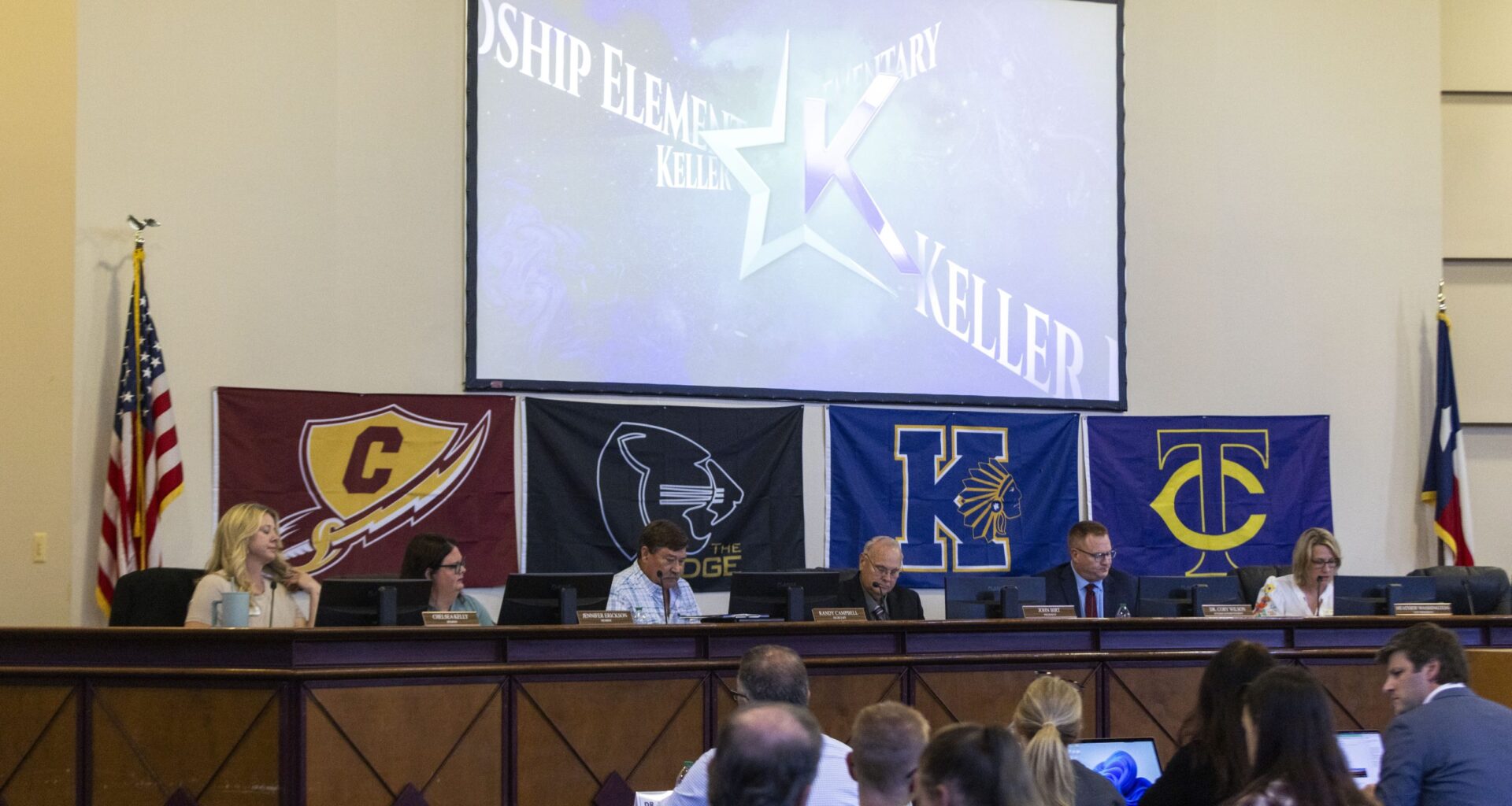
Keller ISD will reveal options for closing schools on Thursday as the district grapples with rising utility costs, enrollment uncertainty and an aging infrastructure in need of investment.
The meeting is at 6 p.m. April 2 at the Keller ISD Education Center, 350 Keller Parkway. Superintendent Cory Wilson said he expects the response from families, staff and the community to be challenging after closure options are announced.
“Once you’re talking about closing campuses, you’re talking about where kids are going to go to school,” Wilson said.
The push to consolidate campuses reflects a four-year enrollment slide. The district has seen a roughly 13% decrease in students since the 2021-22 school year. The 2021-22 school year was the last time the district saw enrollment grow, and projections expect the decline to continue.
Since January, close to 100 Keller ISD community members have gathered to examine enrollment data, facility conditions and district finances as part of a committee process designed to produce a recommendation to the board. Wilson said the board will consider voting on a formal consolidation proposal later this month.
“I’d rather make sure our details are correct and we get input from our community before we go with that,” he said.
A budget under pressure
Closures are unfolding amid financial uncertainty.
Keller ISD splits its electricity across two providers: Oncor, with which the district has negotiated a fixed rate, and Tri-County Electric Cooperative, where rates can fluctuate.
Deputy Superintendent John Allison told trustees that Tri-County has signaled it may raise its rate — currently 12 cents per kilowatt hour to somewhere between 13 and 17 cents.
Because Tri-County operates as a cooperative, Allison said the district has no ability to negotiate rates.
Aging HVAC systems add to the strain. Allison said rentals of portable air conditioning units when heating and cooling systems fail nearly doubled budgeted amounts.
“If they’re not replaced, we could not have held school,” Allison said.
Debating bond alternatives
Trustee Chris Coker asked whether the district has explored alternatives to a bond election for financing HVAC repairs.
Allison acknowledged the district has talked with outside capital investment firms, but those arrangements carry interest charges and require districts to surrender a percentage of any savings achieved.
Wilson added that a previous energy management contract left a negative impression, saying outside firms often take operational control in ways that create classroom problems. As an example of the dynamic, he described a situation where a teacher reported a classroom temperature of 99 degrees — but the contracted firm’s data shows 54, leaving the district with little recourse.
“It’s all about what control we want to give up as a school district to somebody else,” Wilson said.
Every financing option needs to be on the table and weighted against its cost to taxpayers because voters are unlikely to approve a bond, Coker said.
“To pretend like I’m not having conversations about a lot of resistance on it would just be a lie,” Coker said.
Board President John Birt suggested administrators reach out to other districts that use energy management companies to evaluate whether this approach could work at Keller’s scale.
Another unknown for the budget? Texas’ new education savings account program that allows families to use public funds for private school tuition.
Allison said the district has already projected a decline of roughly 1,000 students for the coming school year based on demographic trends, but has no way to know yet how many current Keller ISD students applied for an ESA.
“That could have a profound effect on our budget,” he said.
Because state funding is tied to attendance, each student who leaves the district represents a loss of state funding.
Staffing adjustments will largely come through attrition rather than direct cuts, with staff shifted between campuses as needed, Allison added.
Nicole Williams Quezada is a reporting fellow for the Fort Worth Report. Contact her at nicole.williams@fortworthreport.org
At the Fort Worth Report, news decisions are made independently of our board members and financial supporters. Read more about our editorial independence policy here.
This <a target=”_blank” href=”https://fortworthreport.org/2026/03/31/which-keller-isd-schools-will-close-north-fort-worth-district-to-reveal-options/”>article</a> first appeared on <a target=”_blank” href=”https://fortworthreport.org”>Fort Worth Report</a> and is republished here under a <a target=”_blank” href=”https://creativecommons.org/licenses/by-nd/4.0/”>Creative Commons Attribution-NoDerivatives 4.0 International License</a>.<img src=”https://i0.wp.com/fortworthreport.org/wp-content/uploads/2021/04/cropped-favicon.png?resize=150%2C150&quality=80&ssl=1″ style=”width:1em;height:1em;margin-left:10px;”>
<img id=”republication-tracker-tool-source” src=”https://fortworthreport.org/?republication-pixel=true&post=468759&ga4=2820184429″ style=”width:1px;height:1px;”><script> PARSELY = { autotrack: false, onload: function() { PARSELY.beacon.trackPageView({ url: “https://fortworthreport.org/2026/03/31/which-keller-isd-schools-will-close-north-fort-worth-district-to-reveal-options/”, urlref: window.location.href }); } } </script> <script id=”parsely-cfg” src=”//cdn.parsely.com/keys/fortworthreport.org/p.js”></script>