
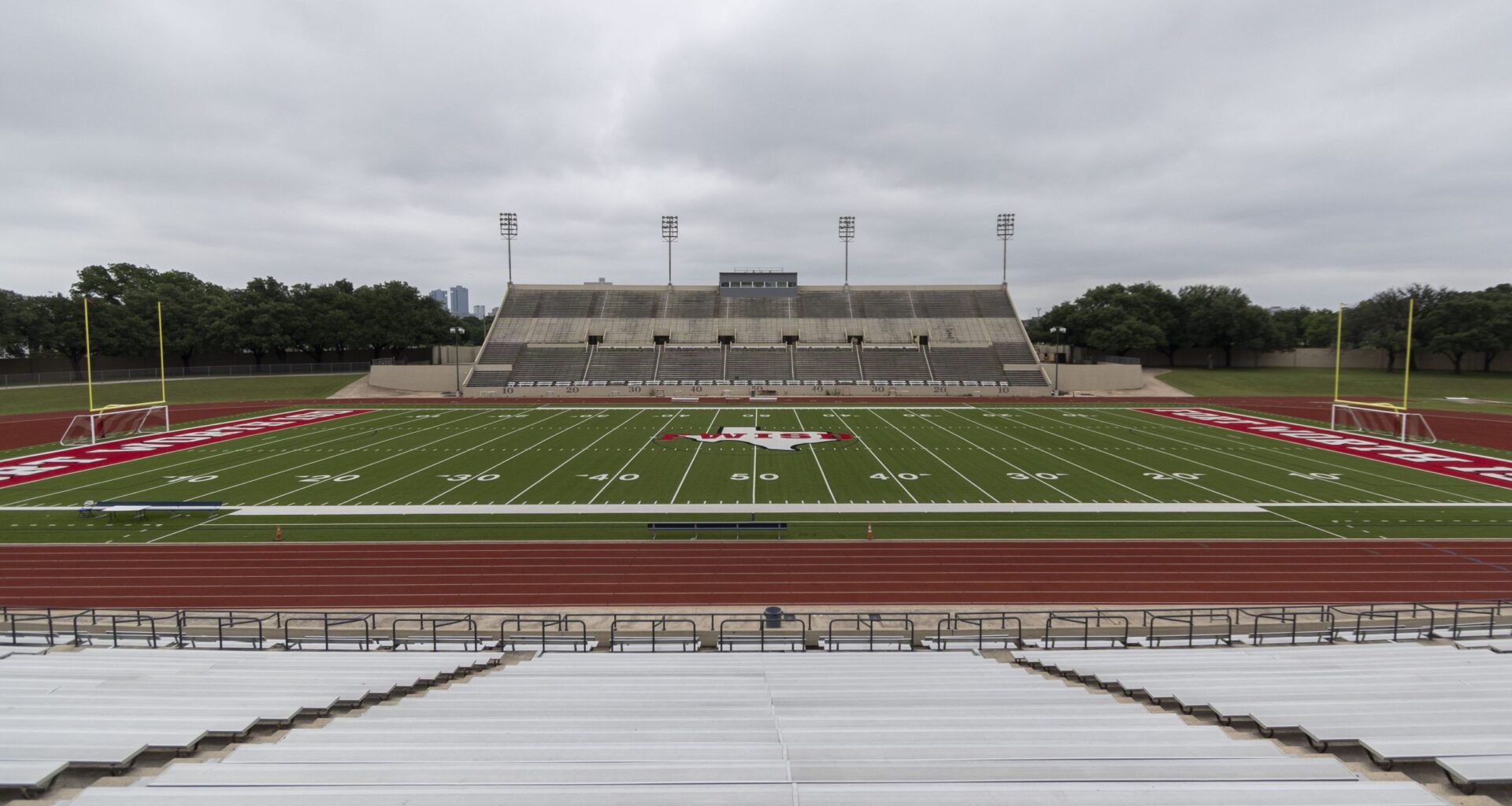
Fort Worth ISD trustees were lining up to stop a major redevelopment of Farrington Field.
But the state stepped in before the elected school officials could make a play to rescind a proposal tied to the historic stadium.
Three days before that scheduled vote, Texas finalized its takeover of FWISD — stripping elected trustees of authority and handing control to a state-appointed board of managers and superintendent.
Now, the future of one of the district’s most visible — and valuable — properties will be decided by new leadership.
Trustees planned a March 27 special meeting to consider rescinding a request for proposals seeking private development around Farrington Field, according to district records.
Trustee Tobi Jackson said she requested the meeting to ensure full transparency around the possible sale of land around the stadium and ensure elected representatives, not state appointees, had the final say on any development project.
“As the elected board of trustees, we owed a fiduciary responsibility to safeguard the interests of taxpayers who own this valuable property,” Jackson said. “Taking that responsibility seriously was the purpose of the previously scheduled meeting.”
Farrington Field, which opened in 1939, has long been a symbol of Fort Worth ISD athletics. But the stadium now faces tens of millions of dollars in needed upgrades, and its location near the city’s Cultural District has made it one of the district’s most valuable redevelopment opportunities.
FWISD’s solicitation for proposals — issued in January — aims to attract at least $250 million in mixed-use development while preserving the stadium.
But because the redevelopment concept shifted from what trustees were initially shown, some trustees have grown uneasy about the ask, elected trustee Michael Ryan said.
About two years ago, the board was approached with a proposal to bring a professional soccer team to Farrington Field, paired with a phased redevelopment of the stadium and surrounding land, he said.
That vision evolved — including delays and changes to how the property would be divided into multiple parcels — raising concerns about how the land would ultimately be used, Ryan said.
“This was about making sure we’re doing it right,” he said.
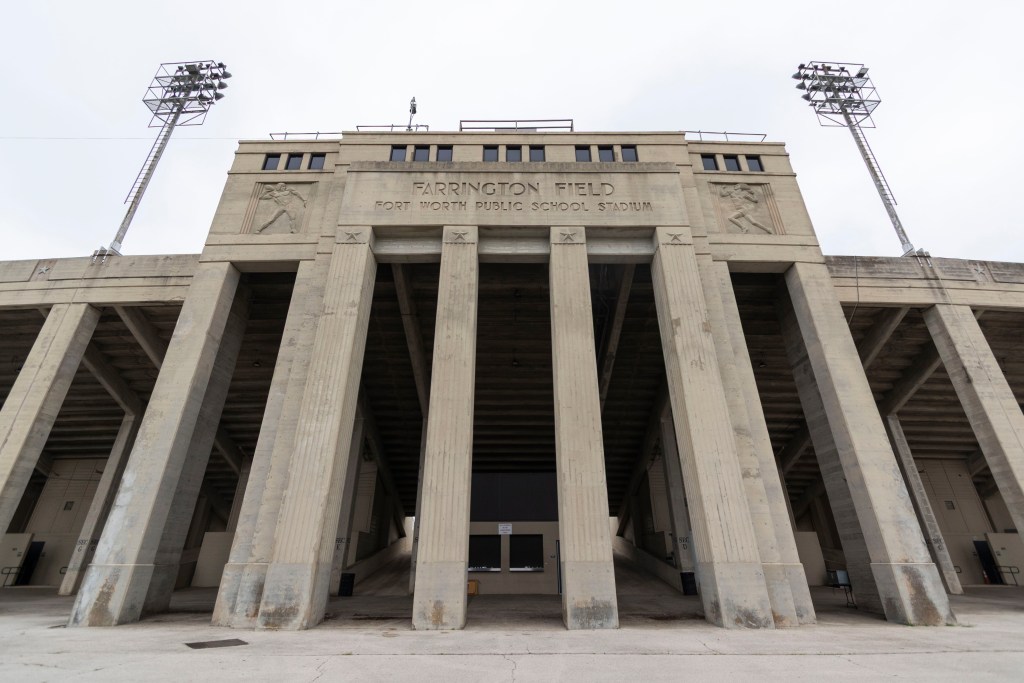 Farrington Field stands tall on June 4, 2025. (Mary Abby Goss | Fort Worth Report)
The trustees had previously signaled support for exploring redevelopment. In June, they authorized former Superintendent Karen Molinar to negotiate with the city of Fort Worth and potential developers on infrastructure, safety and redevelopment terms related to the Farrington Field site.
Those discussions were tied to a city-backed tax increment financing district, approved in June, designed to capture future property tax growth in the area and fund infrastructure improvements — including a potential $55 million renovation of Farrington Field.
The stadium requires significant upgrades, including Americans with Disabilities Act compliance, elevator access, locker room renovations and other safety improvements — costs the district has struggled to fund without tapping classroom dollars.
That plan envisioned hundreds of millions of dollars in adjacent private development to support the project, according to city officials.
FWISD issued a redevelopment solicitation roughly seven months later, seeking at least $250 million in private investment around Farrington Field while retaining ownership of the stadium itself.
But as details of the proposal evolved, some trustees said their support shifted — particularly around whether the district should sell land tied to the project.
“We only want to accept RFPs that go with a lease, not a sale,” Ryan said. “Farrington Field should not be sold.”
Then on March 24 — three days before trustees were to vote — Texas Education Commissioner Mike Morath installed Fort Worth ISD’s new leader. The managers he appointed now hold the authority once exercised by locally elected trustees.
“The timing of the takeover, however, ensures the elected board will not necessarily have the final say on the future of Farrington Field,” Jackson said. “It was our hope to resolve outstanding matters so that the board of managers can focus on student achievement, as they have stated it as their primary objective.”
FWISD officials said the move to rescind the solicitation was a board-driven effort and confirmed that next steps will be determined under the new governance structure, including newly appointed Superintendent Peter Licata.
Licata told the Report the district must consider multiple strategies for its properties, including selling land, partnering with developers and repurposing sites.
“We have to strike a nice blend,” Licata said. “We can’t afford to sit on our hands.”
Elected trustees, meanwhile, said they would prefer leasing district land — particularly at Farrington Field — to preserve long-term control.
Long-term lease agreements, rather than outright sales, are a way to generate revenue while preserving ownership of district land, Ryan said.
“If we lease it, we still own it,” he said. “If we sell it, it’s gone.”
FWISD has experienced the loss Ryan described when district leaders sold the administration building and surrounding properties at 100 N. University Drive for $5 million in 2020. For three years, the district spent around $600,000 annually renting that building while waiting for renovations at the District Service Center at 7060 Camp Bowie Blvd.
Fort Worth ISD’s former headquarters are now being transformed into a nearly $2 billion development that includes housing, offices and stores.
Ryan raised concerns about the timing of the takeover and whether it was accelerated in a way that limited the board’s ability to act, as well as the potential influence of outside stakeholders such as City Hall.
City officials reject that suggestion.
“I have not personally, nor has my office, had any communication with TEA regarding Farrington Field,” Mayor Mattie Parker said in a statement.
Parker described the stadium as a notable historic asset with significant maintenance needs and said she supports preserving it while exploring redevelopment opportunities.
“With the current transition at Fort Worth ISD, I fully respect the decision to pause any discussions around partnership opportunities,” she said. “I also believe there is a way to preserve Farrington Field as a historic asset while providing an opportunity to explore what a public-private partnership could create.”
 The historic Farrington Field features a football player carved into the stone facade, as photographed on June 4, 2025. (Mary Abby Goss | Fort Worth Report)
District leaders have spent years exploring ways to fund long-needed upgrades without pulling from classroom budgets, including partnerships tied to surrounding development.
For Ryan, the question is not whether Farrington Field should evolve — but how.
Decisions made now will shape FWISD’s future for decades, he added.
“Like everything else with public schools, there are people that are looking at how they can make money off our kids,” he said.
The future of Farrington Field now rests with a board led by Pete Geren — whose grandfather, Preston Geren, designed the stadium in the 1930s.
Geren, the board president, said managers and the superintendent are concentrated on a singular goal.
“Our focus is 100% going to be on student outcomes and making decisions that improve student outcomes,” he said.
Disclosure: The Sid W. Richardson Foundation, which is led by FWISD manager Pete Geren, is a financial supporter of the Fort Worth Report. FWISD manager Laurie George is a member of the Report’s reader advisory council. FWISD manager Courtney Lewis is a member of the Report’s business advisory council. At the Fort Worth Report, news decisions are made independently of our board members and financial supporters. Read more about our editorial independence policy here.
Editor’s note: This story was updated March 31, 2026, to reflect that FWISD board President Pete Geren’s grandfather designed Farrington Field.
Matthew Sgroi is an education reporter for the Fort Worth Report. Contact him at matthew.sgroi@fortworthreport.org or @matthewsgroi1.
Jacob Sanchez is education editor for the Fort Worth Report. Contact him at jacob.sanchez@fortworthreport.orgor @_jacob_sanchez.
At the Fort Worth Report, news decisions are made independently of our board members and financial supporters. Read more about our editorial independence policy here.
This <a target=”_blank” href=”https://fortworthreport.org/2026/03/30/farrington-field-proposals-questioned-by-fwisd-trustees-then-the-state-took-over/”>article</a> first appeared on <a target=”_blank” href=”https://fortworthreport.org”>Fort Worth Report</a> and is republished here under a <a target=”_blank” href=”https://creativecommons.org/licenses/by-nd/4.0/”>Creative Commons Attribution-NoDerivatives 4.0 International License</a>.<img src=”https://i0.wp.com/fortworthreport.org/wp-content/uploads/2021/04/cropped-favicon.png?resize=150%2C150&quality=80&ssl=1″ style=”width:1em;height:1em;margin-left:10px;”>
<img id=”republication-tracker-tool-source” src=”https://fortworthreport.org/?republication-pixel=true&post=467561&ga4=2820184429″ style=”width:1px;height:1px;”><script> PARSELY = { autotrack: false, onload: function() { PARSELY.beacon.trackPageView({ url: “https://fortworthreport.org/2026/03/30/farrington-field-proposals-questioned-by-fwisd-trustees-then-the-state-took-over/”, urlref: window.location.href }); } } </script> <script id=”parsely-cfg” src=”//cdn.parsely.com/keys/fortworthreport.org/p.js”></script>