
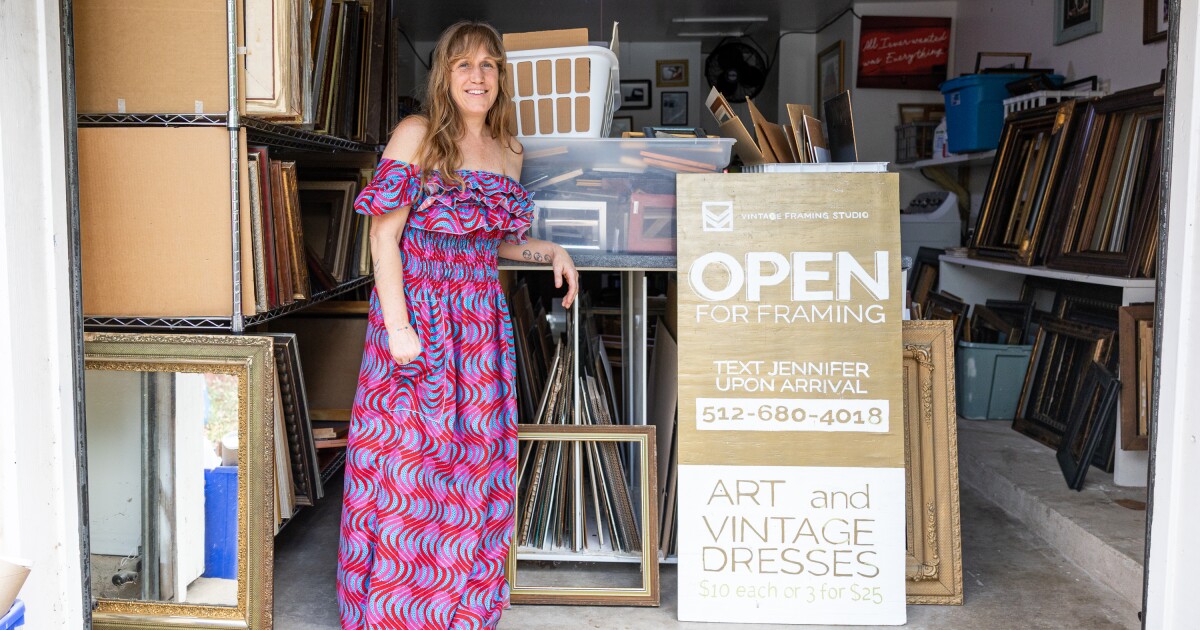
Jennifer Worth frames art, posters and photos out of her East Austin home through Vintage Framing Studio, the business she started in 2010.
She reuses and recycles frames she finds at thrift stores and works with each customer to find the right frame for their art piece. It’s an extension of the work she and her partner used to do at South Austin Gallery before closing the brick and mortar in 2016.
In February 2024, Worth put up a small sign with the studio name on her front fence. That July she added a banner with her 2024 Best of Austin award. But last March, she was forced to remove them both.
“There is a greenbelt across the street and there is constantly people waking, and I would get a lot of people because they saw my signs,” Worth said. “One day the city knocked on my door and said I had to take [my sign] down.”
She said the man told her that someone in her neighborhood had complained.
But soon Worth will be able to put her signs back up, and people will be able to find her framing studio and her vintage clothing business.
The reversal comes after the Austin City Council adopted its “Strong Local Commerce Initiative” last week. The initiative will allow home-based businesses like Worth’s to advertise and sell their products in their front yards.
It’s part of a recent effort to create more ways for micro businesses to operate and thrive in Austin, officials said.
Last year, the city began offering on-site inspections for food trucks. In 2023, the city expanded where child care centers could operate. The city is also exploring how to make it easier to open neighborhood coffee shops and cafes.
Thriving small businesses
Council Member Natasha Harper-Madison led the “Strong Local Commerce Initiative” with the goal of allowing small businesses owners to operate from their homes without hiding.
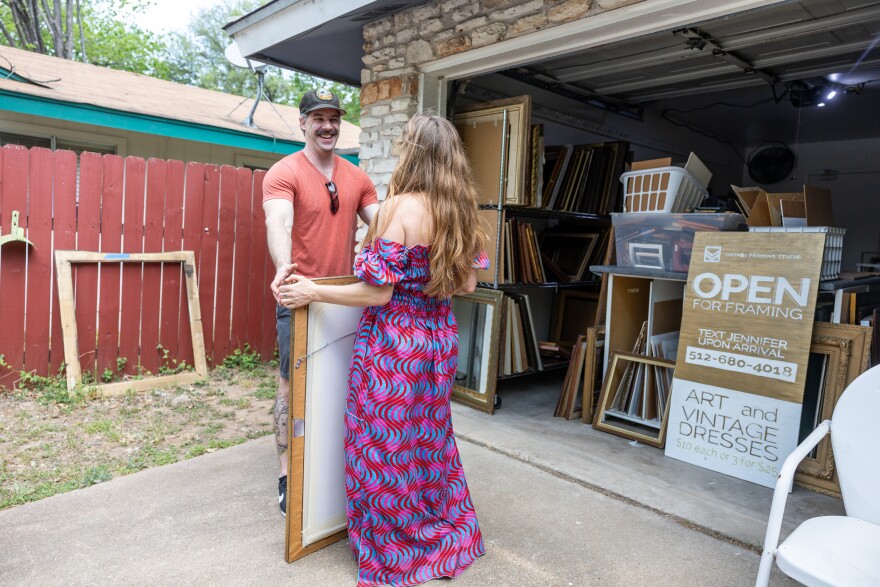
Geoff Walker picks up his framed artwork from Worth’s home studio.
Sharon Mays, Harper-Madison’s chief of staff, said this isn’t a new concept.
“Austin has had home occupation rules on the books for a really long time and that lets residents run a limited number of businesses inside their home,” Mays said.
But until now, these businesses usually did not have customers come to their homes.
In the last legislative session, lawmakers made it easier for Texans to start a home business and expanded rules for cottage food businesses. Mays said that gave the city more to build upon.
“Our Strong Local Commerce Initiative is really trying to empower those entrepreneurs and those home-based businesses by saying there is an option to also bring that business outside of the house,” she said.
This includes allowing entrepreneurs to advertise their businesses with a small sign in the yard, or sell goods from their front porch.
Kelley Masters, president and founder of nonprofit Homemade Texas, said this is the kind of flexibility she and her team have been fighting for in the cottage food industry.
As a stay-at-home mom in 2005, Masters was looking for a way to earn a little extra money by making and selling cakes. But at the time cottage food businesses were illegal. That roadblock led her to lobby lawmakers.
In 2011, the state legalized cottage food businesses, but some limitations remained, including what kinds of homemade goods could be sold and where they could be sold. The law has been updated several times since, to expand the kinds of home-baked goods permitted to be sold and allowing sales to take place at homes, fairs, farm stands and events.
But many cities still have rules in place that prohibit home-based businesses from being visible, Masters said, making it difficult to sell those products from a residence.
“You can make the best product in your kitchen, but it’s hard to find a place to sell it,” Masters said. “And so for a lot of these bakers and makers the most natural place to sell and the easiest place to sell is right at your own home.”
Neighborhood sentiment
Several residents spoke in support of the measure and cited potential for entrepreneurs to test their ideas, enhance neighborhood connection and provide more walkability for people looking for baked goods or artisan crafts.
Other residents expressed concerns about increased traffic to neighborhoods, parking impacts, and unwanted eyesores, noise and odors.
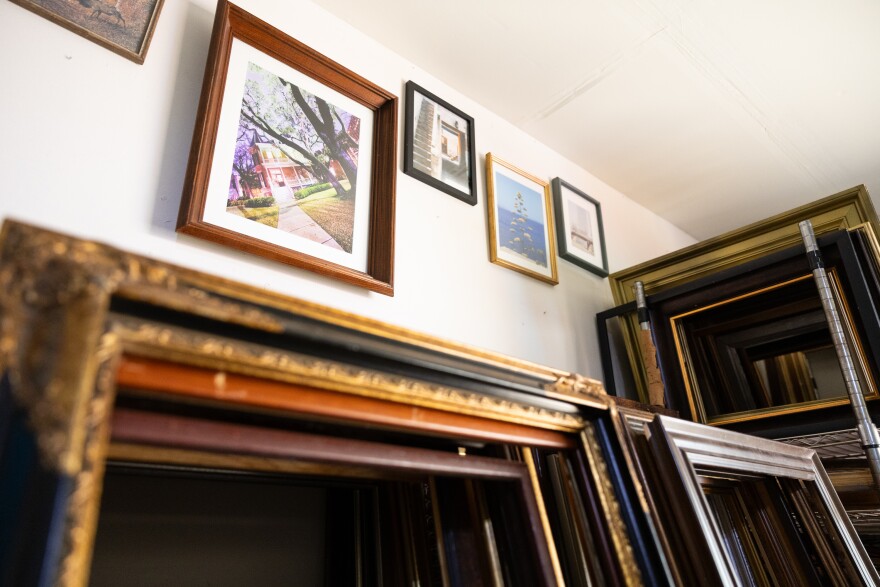
Worth works with each customer to find the right frame to compliment the art they bring to her.
Sarah Faust, who lives in South Austin, said allowing these types of businesses could create hardships for neighborhoods without adequate sidewalks.
“We know that retail business in neighborhoods will increase car traffic,” Faust said. “When we don’t have sidewalks, we’ve got the kids, the bikes, the dogs, the strollers, we’re all forced to walk out in the street…. We won’t survive adding more car trips to our neighborhood streets from retail businesses.”
Mays said the city is taking those concerns seriously and plans to roll out the program in certain areas designated as “pink zones,” before deciding to make it citywide. Staff will monitor things like traffic, parking, and neighborhood sentiment for a year and then review the data.
City rules for residents about noise, trash and pollution would still apply. As well as rules about adding mini sheds and accessory dwelling units on people’s property. The city’s rules will also not override homeowners association rules or deed restrictions, Mays said.
“It’s important to remember that these are your neighbors, too,” she said. “So as much as a person enjoys their neighborhood and enjoys the character of their neighborhood, there is a really good chance that the person on your street that has a dream of becoming an entrepreneur shares that same love of the neighborhood.”
Worth said many of her clients come from referrals or through exposure at local events or spaces, and a lot of people find her through a Google search: “framing near me.”
“That tells me that people want to stay in their neighborhood and find things in their neighborhood,” she said.
As a longtime Austinite and business owner, Worth said supporting local, small businesses is what makes Austin, Austin.
“It might be to keep local [businesses] and ‘Keep Austin Weird’, we need to have these home businesses that people can find,” Worth said. “A lot of us can’t afford brick and mortar and it’s too scary to do that.”