
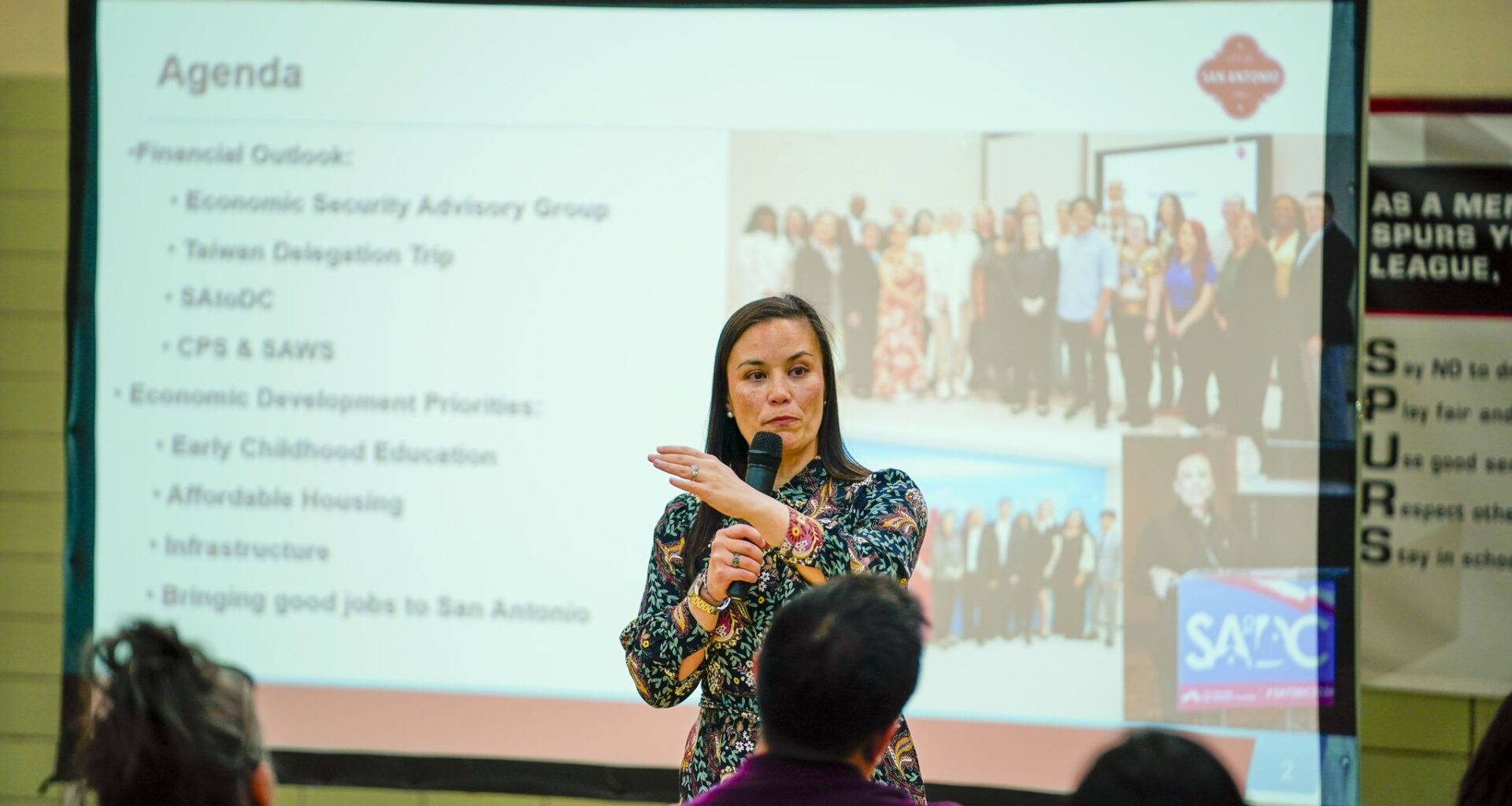
Mayor Gina Ortiz Jones speaks during a District 7 town hall meeting Monday evening at the Garza Community Center.
Robin Jerstad/Contributor
City Council members are pumping the brakes on Mayor Gina Ortiz Jones’ effort to establish a commission to improve San Antonio’s often abysmal voter turnout.

Jones announced in February that she wanted to create a Mayor’s Commission on Voting to get more San Antonians to the ballot box.
Article continues below this ad
On Thursday, council members were supposed to vote on creating the commission. Instead, they voted 9-2 to slow it down with a briefing on the plan in April or May before it returns for a vote.
Council members said they wanted more time to consider her proposal and a potential deadline to sunset the group, though Jones said she wanted the commission to run indefinitely.
The debate was muted and quick, lasting only 20 minutes. But it was clearly a setback for a mayor who’s had a lot of them in her dealings with council.
The commission would advise City Council on how to increase voter participation. Jones had wanted the group to submit a report to the City Council by July 4 with recommendations, according to a draft ordinance outlining how the group would function. The commission would meet biannually after it submits its July report to review and potentially adjust its recommendations.
Article continues below this ad
The commission would have 13 members, with three appointed by Jones and the rest by council members.
Jones sees the commission as a way to respond to legislation being debated at the federal level that could make it harder for people to vote.
“These are very challenging things for us to grapple with as a country, which I think really calls upon us at the local level to identify ways in which we can hear from our and protect our community, and ensure that they’re heard at the ballot box,” Jones said.
City Council was originally slated to approve the item on its consent agenda, a lengthy list of usually noncontroversial matters that often sail through without debate. But District 1 Councilwoman Sukh Kaur yanked the item from the consent agenda and called for a briefing on the proposed commission, not a vote.
Article continues below this ad
She stayed quiet during the ensuing discussion.
In a statement after the meeting, she said she pulled the item to “ensure that Council has the opportunity to provide input on the committee that would address this critically important issue of voter turnout.”
Last month, City Council censured Jones for her “unacceptable conduct” toward Kaur during a Feb. 5 council meeting in which Jones has admitted to raising her voice and cursing at the councilwoman. The public reprimand also called out Jones for “prior inappropriate interactions with councilmembers, city staff and constituents.”
District 3 Councilwoman Phyllis Viagran told her colleagues that she thinks the scope of the commission should be narrowed before City Council OKs it.
Article continues below this ad
After Thursday’s meeting, Viagran said a commission with a broad mission could potentially focus on specific municipal races.
“It’s a slippery slope in terms of how it could be used for elections,” Viagran said. “We as elected officials are blacked out from campaigning, and I think that’s when this committee should be blacked out.”
Viagran said she would support the proposal if its scope were narrower and it stops meeting ahead of the municipal elections, or at least goes on hiatus during campaign season.
District 10 Councilman Marc Whyte said he likes the idea of such a commission, but thinks it should be more fully developed. He said rushing to launch the commission “would be an inefficient endeavor.”
Article continues below this ad
He said council members received only a bare-bones memo outlining the proposal the week that Jones went public with it. She said during the meeting that council members got the proposed ordinance about a week ago.
Jones was calm as she pushed back against the criticism, reading several lines in the ordinance that answered questions about what the commission would do and its timeline.
“I personally don’t support continuing the item to a B Session in April or May because I think that just reduces the amount of time that we have to hear from our neighbors that would serve on the commission about ideas they could have that we could employ around 2026,” Jones said.
Councilman Jalen McKee-Rodriguez was the only council member to side with Jones against delaying the commission’s formation.
Article continues below this ad
He brushed off his colleagues concerns, noting that the scope will be broad at first and narrow as commission appointees work toward the goals Jones laid out.
Her push to create the commission is the two-time Democratic congressional nominee’s second major effort to improve local voter turnout.
Jones narrowly secured her first big win in December when she and the council voted 6-5 to move city elections from May to November. Her main argument was that the move could increase voter turnout.
The shakeup added six months of service to everyone’s terms on City Council.
Article continues below this ad
Only about 12% of the San Antonio’s registered voters cast ballots in last May’s mayoral election. That jumped to 17% for the June runoff, after the overwhelming 27-candidate field became a head-to-head battle between Jones and Rolando Pablos.
Jones has described her focus on voting as a way to fight back against state and federal policies enacted by Republican leaders that harm San Antonio. These include the Trump administration’s cuts to federal grants that bolstered the city’s health department and its immigration crackdown.
Coincidentally, Bexar County has a five-member elections and voter engagement advisory committee that met for the first time on Thursday. The group was set up to make recommendations on how to improve voter turnout and increase voter registration — as Jones’ commission would do.
Board chair Yvonne Pelayo, member Cole Bowles and Commissioner Justin Rodriguez, who pushed for the creation of county committee — none of them objected to the city potentially duplicating their efforts.
Article continues below this ad
“I think the more conversations and the more perspectives at the table are always for our benefit, especially as it relates to voting in Texas, and especially as it relates to voting in Bexar County,” Bowles said.
Bexar County’s five-member Commissioners Court oversees the county elections department, which determines polling locations and hours. San Antonio helps pay for elections when there are municipal races on the ballot.
Reporter Saul Pink contributed to this story.
Article continues below this ad