
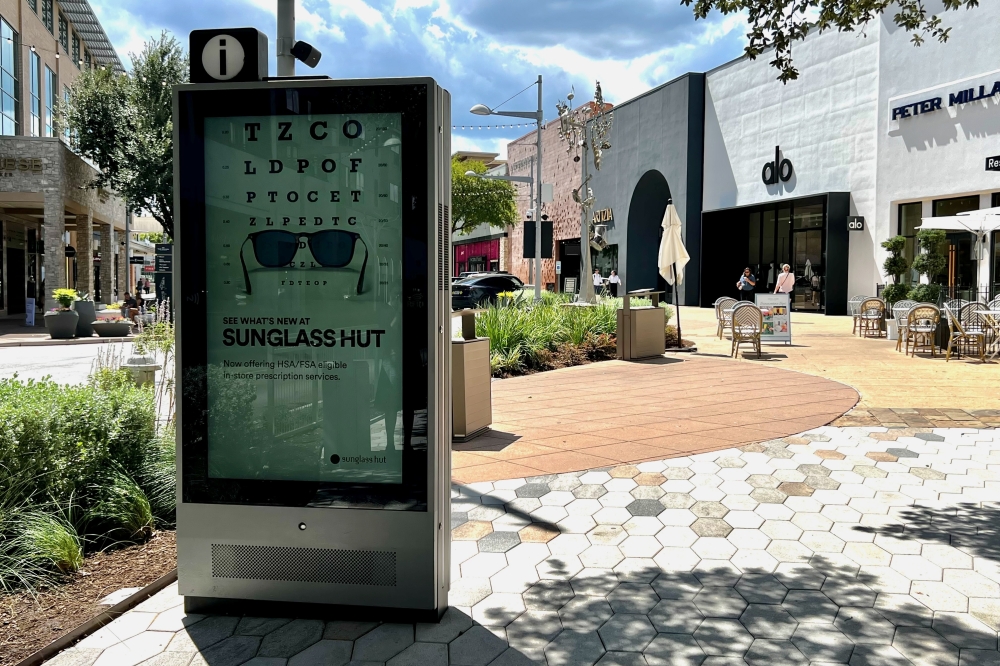
A plan to install dozens of digital advertising kiosks in public places around Austin advanced this spring.
As framed by the city, the new kiosk are meant to help residents and visitors get around and access local businesses, as well as to promote civic messaging and transit information.
“This program represents an important step in Austin’s continued evolution as a connected and innovative city,” Anthony Segura, Austin Economic Development deputy director, said in a statement. “Interactive kiosks will make it easier for residents and visitors to navigate downtown, discover local businesses, and stay informed about City services, all at no cost to taxpayers.”
What’s happening
City Council approved an ordinance allowing off-premises signage in public rights of way March 26. That change to city code will allow digital kiosks with more-than-7-foot screens to be placed around the city.
 Interactive kiosks with screens up to 86 inches across are now allowed in Austin’s public areas. (Rendering courtesy IKE Smart City LLC)The code update was the final step needed to roll out interactive wayfinding tools requested by council in late 2024.
The regulatory change goes into effect this spring, but city officials had previously outlined the kiosk plan and already entered into an agreement for the program with vendor IKE Smart City last year. IKE was the highest scorer in the city’s public solicitation for the project.
The approach
Kiosks will display transit information, maps, public alerts, and listings of local businesses, destinations and events. They’ll also have Wi-Fi, and the ability to share directions or other information with users’ mobile devices. An amendment to Austin’s original contract with IKE also banned kiosks from having cameras and collecting users’ personal information.
While exact kiosk locations aren’t yet finalized, most of downtown and parts of South, East and North Austin are now under consideration. Commercial and pedestrian-oriented corridors, not residential areas, were identified for potential installations, according to Austin Economic Development.
 Digital ad kiosks could be placed in around downtown and several proposed areas in South, East and North Austin. (Courtesy city of Austin)Kiosks will be placed through a multiyear phased process with community outreach and notification of nearby stakeholders, according to the economic development department.
“Prior to engagement, the City will review all proposed kiosk locations to confirm they are within the public right-of-way. From there, proposed kiosk groupings will be shared with Council offices for review, and community stakeholders and adjacent property owners will be notified and invited to provide feedback,” Austin Economic Development spokesperson Carlos Soto said in an email. “Property owners and stakeholders will be contacted at least two weeks before any permit applications are submitted. All feedback received will be considered as part of the City’s review process.”
Final locations will be set by Austin and Capital Metro. The first kiosks could be installed as soon as this fall, starting downtown and along commercial corridors.
Also of note
The scores of new kiosks are also expected to generate new revenue from third-party advertising that the city currently projects at $6.3 million annually, depending on advertising performance. IKE Vice President Anna Baerman told council the company believes demand for ad spots in Austin could outperform projections, and is “higher than in most cities of comparable size and profile.”
The city’s 2025 contract with IKE includes guarantees Austin the greater of:
A minimum $20,000 per kiosk annually—up to $2 million with 100 proposed installations40% of IKE’s net ad revenue from kiosksThe exact use of those funds hasn’t yet been determined; Soto said the added income will “support City services that benefit the community.”
Austin will be provided with dedicated ad space for public service messaging at no cost, while IKE will manage paid advertising subject to local guidelines. The city contract bans ads for drugs, adult entertainment, firearms and lotteries; violent and illegal material; political content, and false or unsubstantiated claims.
Put in perspective
The wayfinding kiosk program was first requested by Mayor Pro Tem Chito Vela, and he supported the code change by highlighting his view that the kiosks will provide a benefit to transit users around Austin.
Despite a majority council vote, some officials and residents expressed reservations about the plan. The code change also wasn’t recommended by the Planning Commission earlier this year during its review, with Chair Alice Woods cautioning against a “seismic change” to Austin’s signage standards.
“I’m extremely concerned that the off-premise advertising portion of this code change does really open the door to digital advertising in our public spaces in a way that it feels like we may never be able to come back from,” she said in January. “It is very nice to not be inundated with digital advertising in our public spaces, and I fear it’s the kind of thing we won’t truly appreciate until it’s too late and we’re locked into a contract that has a lot of digital advertising built into it.”
While the code item didn’t draw much public attention at council’s March 26 meeting, a few residents shared similar sentiments. Maria Morales said the kiosks would bring intrusive and unnecessary visual clutter that changes how the city feels, while Mary Sanger said the update is “fundamentally changing our community’s values.” Council member Marc Duchen also raised concern with Austin’s monetization of public spaces, and introducing a potential double standard where the city and IKE have a separate allowance for public signage than other private companies.
“I don’t know where this ends, but I think it’s potentially opening up a door that we can’t close after we start doing this,” he said.
On the other hand, some groups shared support for the new tools. Representatives with the Downtown Austin Alliance and nonprofit Latinitas said kiosks can provide useful information and improve engagement.
“They enhance the public realm by providing real-time transit and wayfinding tools, amplifying small local businesses—you can’t pay for placement—and serving as a platform for public services, city resources and critical civic messaging,” said Michael Whellan, a lobbyist representing IKE.
One more thing
Officials rejected attempts to limit the spread of interactive signage in Austin. Two proposals from council member Mike Siegel would’ve capped the number of kiosks in town at 200—100 each for the city and CapMetro—and prevented kiosks from being installed next to single-family homes.
“If I had the only vote on this item, I’d vote no,” Siegel said when introducing his amendments. “I’m glad that Austin blocked new billboards back in ‘83. I enjoy driving through our city without the visual clutter you see in many cities. I’m proud that Austin has prevented the further commodification of our vertical space.”
Both additions were rejected 2-8-1, with Duchen joining in favor and council member Zo Qadri abstaining. Vela said the restrictions were unnecessary and could hamper public information efforts.
“Just between the [CapMetro] Bikeshare program, your MetroRapids and your high-frequency routes, we could easily do 300, 400 of these signs just on major stops,” he said. “One hundred is not going to give Capital Metro the capacity to really use these effectively and inform the public of when their bus is getting there, how long they have to wait.”