
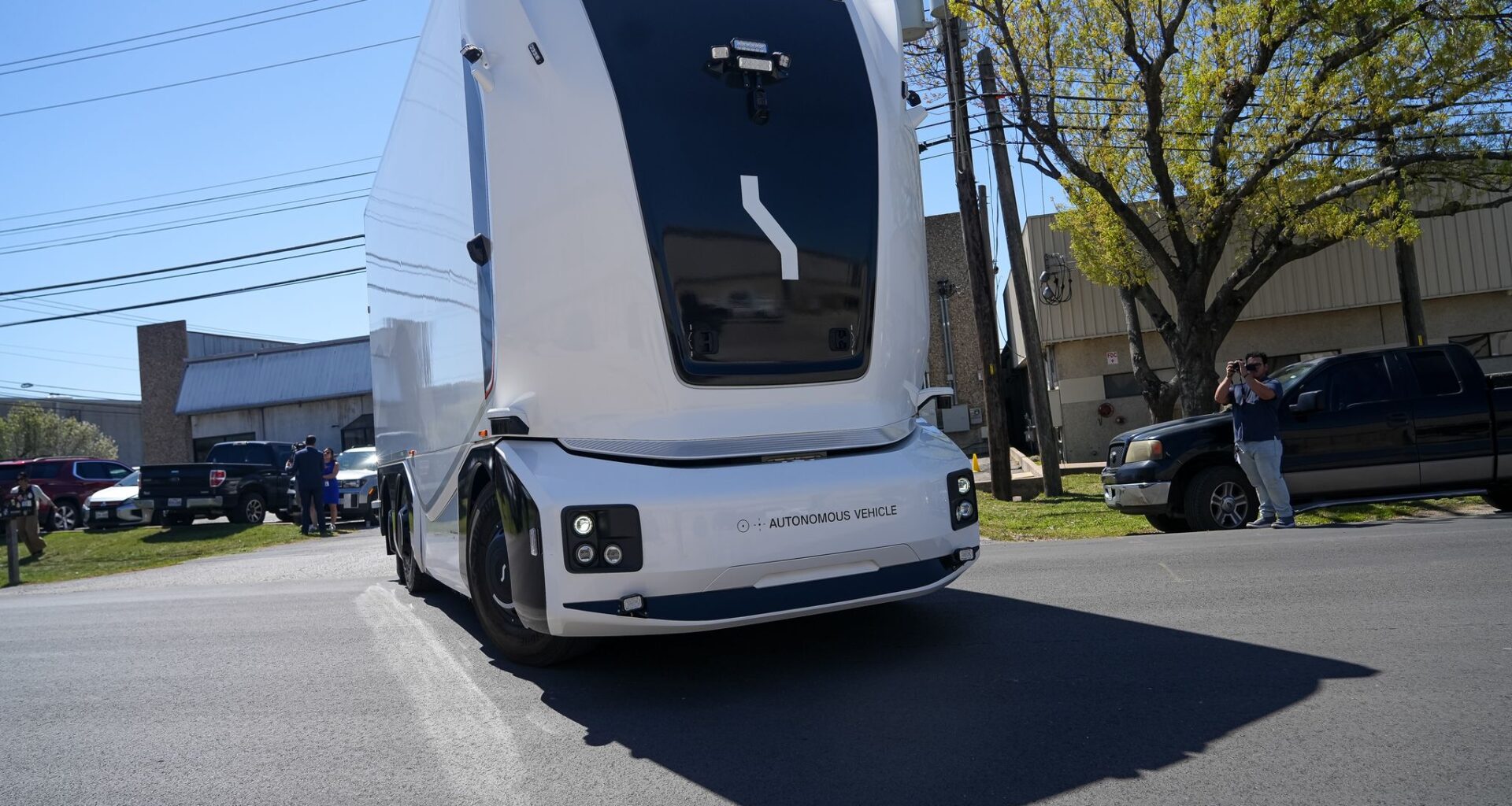
An Einride autonomous truck leaves the parking lot at Austin Beerworks on Thursday, March 19, 2026 in Austin.
Aaron E. Martinez/Austin American-Statesman
The heavy duty cabless autonomous truck pulls out of a lot onto a quiet street outside a North Austin brewery, flexing its ability to maneuver alongside other vehicles on a public street before turning around, coming back and parking.

Einride CEO Roozbeh Charli, whose company built the truck, and other leaders in autonomous and electric trucking say such big rigs soon could be a common sight across Texas.
Article continues below this ad
An Einride autonomous truck turns onto a street near Austin Beerworks on Thursday, March 19, 2026 in Austin.
Aaron E. Martinez/Austin American-Statesman
An Einride autonomous truck is parked at a loading dock at Austin Beerworks on Thursday, March 19, 2026 in Austin.
Aaron E. Martinez/Austin American-Statesman
An Einride autonomous truck is parked outside Austin Beerworks on Thursday, March 19, 2026 in Austin. A LIDAR sensor is visible on the corner of the vehicle.
Aaron E. Martinez/Austin American-Statesman
The interior of a Tesla Semi truck.
Tesla/Courtesy of Tesla
“I’m quite comfortable with the trajectory of the regulatory environment,” he said. “With the environment today, we and other players in industry will be able to deploy tens and maybe hundreds of vehicles.”
Stockholm-based Einride, which became the first company to operate an autonomous truck on a public road in 2019, says it already operates one of the world’s largest electric heavy-duty fleets. Now, the company is putting its self-driving trucks on the road across the U.S.
RELATED: Autonomous big rigs headed to Texas toll road between Austin and San Antonio
Article continues below this ad
In late March, it received approval from the National Highway Traffic Safety Administration to operate its autonomous big rig in Austin — where Einride has U.S. headquarters — after receiving similar approvals for deployments in Arizona, Colorado, South Carolina and Tennessee.
A week earlier, it announced that it’s turning a 41-mile stretch of the Texas 130 toll road between San Antonio and Austin into an autonomous freight corridor in partnership with SH 130 Concession Co.
Roozbeh Charli, CEO of Einride, speaks at an autonomous truck demonstration event at Austin Beerworks on Thursday, March 19, 2026 in Austin.
Aaron E. Martinez/Austin American-Statesman
Charli said the company is aiming to start testing by the end of this year, then gradually increase testing before moving to commercial operations.
Article continues below this ad
Its trucks will join a still-relatively small fleet of electric vehicles operating in Texas. Now, there are only about 250 heavy duty EVs on the road, according to data from the North Central Texas Council of Governments.
But that number could grow rapidly.
Nevoya, Tesla, others
John Verdon, co-founder and chief commercial officer of California-based electric truck operator Nevoya Inc., said the pilot program it began this year on Interstate 45 between Houston and Dallas “will establish its operational blueprint for expanding to other Texas corridors and opportunities.”
Article continues below this ad
“The I-45 corridor is one of the highest-volume freight lanes in Texas, connecting two of the state’s largest distribution and manufacturing hubs,” Verdon said via email. “Given the density of freight and the length of haul (~240 miles), it aligns well with truck capabilities and our operational model that optimizes utilization.”
A prototype of a Tesla Semi truck.
Tesla/Courtesy of Tesla
By next year, dozens of Tesla Semi electric trucks also are expected to be operating in Texas. The vehicle’s specs boast a range of about 500 miles and up to 60% of range after 30 minutes of charging.
“We’re really leaning into the safety side on this and trying to make it the safest truck on the road both for the occupant and for everybody else around,” Tesla Inc. Semi Program Director Dan Priestley said in a recent interview.
Article continues below this ad
Other companies are already operating or testing autonomous trucks in the busy corridor and elsewhere in Texas.
A year ago, Aurora launched its commercial self-driving trucking service without a human safety monitor for the route between Dallas and Houston. By late July, the Pennsylvania-based company was operating three semis piloted by its Aurora Driver technology on trucks equipped with a suite of sensors including cameras, radar and lidar. It later expanded to nighttime operation and added an El Paso route.
A Peterbilt 579 powered by the Aurora Driver.
Aurora/Courtesy of Aurora
In February, Aurora announced driverless operations had been validated on the approximately 1,000-mile route between Fort Worth and Phoenix. It also began supervised autonomous freight deliveries for Hirschbach Motor Lines between Dallas and Laredo for berry company Driscoll’s Inc., and for Detmar Logistics between Midland and Capital Sand’s mining site in Monahans.
Article continues below this ad
In 2024, Kodiak Robotics began testing its system and by early 2025 the California company announced the first deliveries had been completed by its RoboTrucks for Austin-based Atlas Energy Solutions Inc.
Also in late 2024, Houston’s Bot Auto began testing its autonomous big-rig system between its home city and San Antonio. By last fall, it was conducting tests with no human safety monitor present.
Einride’s vehicle, though, is so far the only cabless, purpose-built autonomous heavy truck hitting the road. The other companies’ vehicles are standard semis made autonomous by installation of sensor arrays and computers, the same way Waymo installs its system of cameras, radar and lidar on a Jaguar I-PACE SUV for use as a fully autonomous robotaxi.
An Einride autonomous truck is parked outside Austin Beerworks on Thursday, March 19, 2026 in Austin. A LIDAR sensor is visible on the corner of the vehicle.
Aaron E. Martinez/Austin American-Statesman
Texas boom
So much testing is happening in Texas, Charli said, because the state has been welcoming.
Article continues below this ad
“Texas has been a state that has actively taken a forward-leaning approach to attracting autonomous (vehicles) into the state,” Charli said, pointing as evidence to Austin’s reputation as a testing ground for robotaxis.
It’s also rapidly attracting human-driven electric medium- and heavy-duty trucks, said Lori Clark, senior program manager for the alternative fuels and energy team at the North Central Texas Council of Governments.
She noted that while California is also popular for such activity, electricity is less expensive in Texas, the state has more infrastructure capacity and permitting is generally done more quickly than in California. And, she said, there’s opportunity in the fast-growing Texas triangle, the megaregion that contains the Dallas-Fort Worth, Houston, San Antonio and Austin metro areas.
“I-45 is a very popular route. Everybody talks about trucks that are based in proximity to ports or intermodal facilities, warehousing, where they go back to base, but ports draw a lot of attention,” Clark said. “So we’re excited to see the I-45 deployments start soon and I’m sure I-35 won’t be far behind. And we’ve always heard people talk about I-10 as the answer. So we’ll see which one leg of the triangle wins out.”
Article continues below this ad
An illustration shows a Tesla Semi at a charging station. Infrastructure to support electric trucking is increasing in Texas.
Tesla Inc.
Development supporting electric deployment is growing, too. In January, the Texas Department of Transportation received permission from the Federal Highway Administration to move into the second phase of its plan for EV infrastructure. The next phase will enable investment in county seats, metropolitan planning organization areas and fill gaps across rural Texas for off-interstate travelers, enabling local farm and work trucks to access the charging network.
Clark said her team has had a handful of conversations in recent weeks with companies looking to build medium- and heavy-duty truck charging hubs in the region.
“There’s a kind of a sudden surge of interest in companies that are looking for locations to build the infrastructure,” she said. “They’re asking about the incentives. In some cases, the incentives are great, but they don’t really make a difference. They’re just gravy on top.”
Article continues below this ad
In January, Pilot Travel Centers announced an agreement with Tesla to install its Semi Chargers, saying the move expands on the work it has been doing for the past few years on the passenger vehicle side to build out a coast-to-coast network of EV chargers. The Tesla charging stations will be installed at Pilot truck stop locations along Interstate 5, Interstate 10 and several other major corridors. The first sites are expected to open this summer.
A Tesla map of its planned megacharger network indicated sites would go up in the Texas triangle, to the south of San Antonio and as far west as El Paso.
Other Texas trucking centers also are adding charging capacities for heavy-duty EVs along major interstate corridors.
Emissions reduction
Such moves to increase use of electric vehicles could also help reduce greenhouse-gas emissions, supporters say — and there’s room for improvement in trucking. Though buses, trucks and other heavy duty vehicles make up only 5% of total U.S. traffic, the Environmental Protection Agency says they are responsible for nearly 25% of all transportation-related emissions.
Article continues below this ad
Even if the truck is not electric, backers of autonomous systems say they can help bring down emissions.
Aurora conducted research indicating that autonomous trucking can be up to 32% more energy efficient than human-driven trucking by optimizing highway speeds, employing smoother acceleration and braking, limiting idling while drivers rest and other improvements.
An Einride truck is shown on a screen at an autonomous truck demonstration event at Austin Beerworks on Thursday, March 19, 2026 in Austin.
Aaron E. Martinez/Austin American-Statesman
Professional drivers, too, are increasingly fans of electric trucks, Clark said. With quieter cabs and less vibration, the vehicle takes less of a toll on a trucker’s body. And residents near fuel stops will see improvements, too.
Article continues below this ad
“You don’t have the sound and the pollution that comes from a diesel 18-wheeler idling at the truck stop next door to the neighborhood. It’s going to be silent and you’re not going to have the fumes,” she said. “There’s a lot of benefits in terms of quality of life that everybody can enjoy as a result of that transition.”
Einride’s Charli agreed. But while he’s optimistic about the growth of electric and autonomous trucking in Texas, Einride’s Charli said a more consistent regulatory framework at the federal level will be necessary for the industry to scale further across the U.S.