
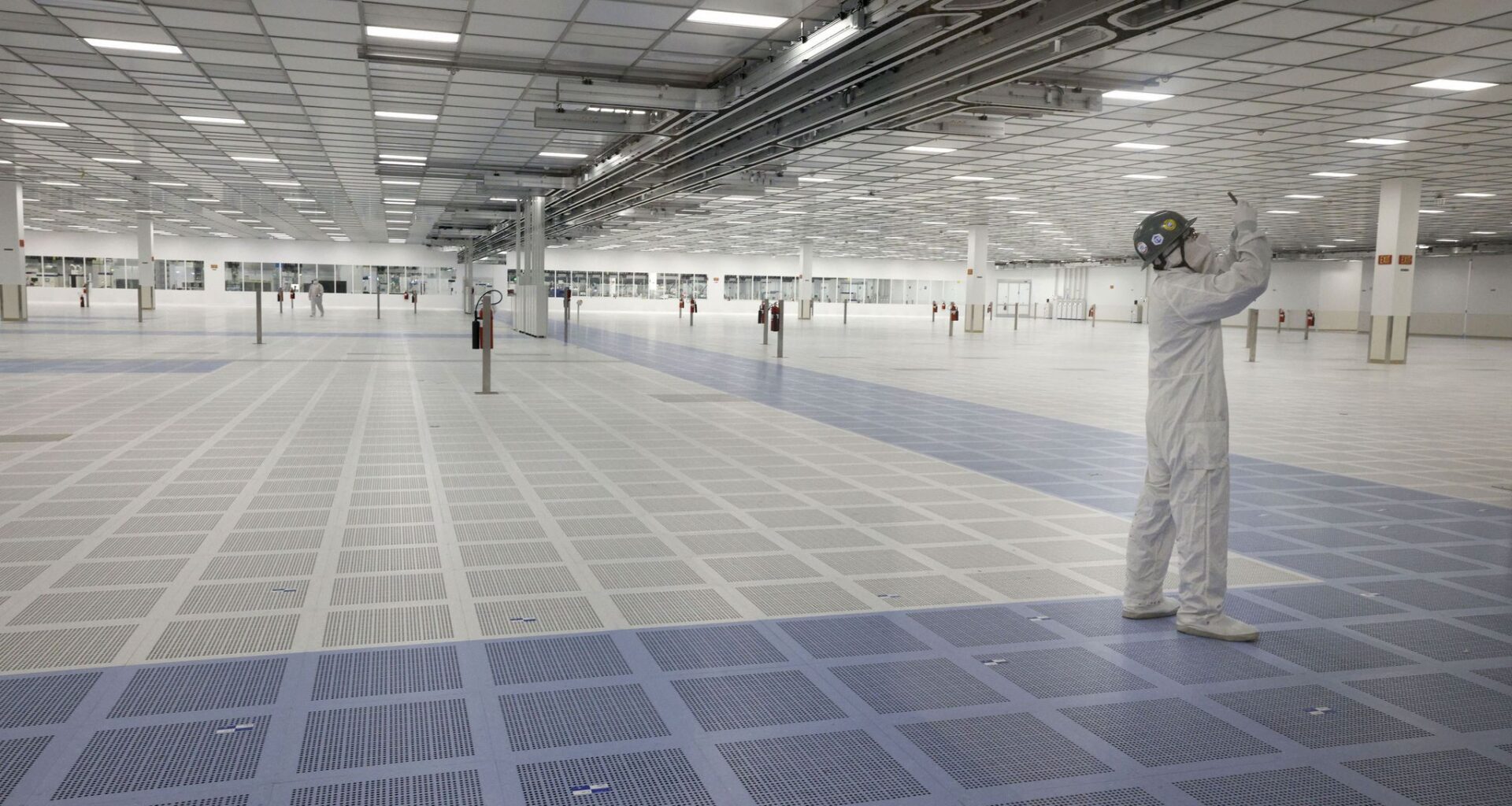
Employees wear smocks and safety gear inside a cleanroom at Texas Instruments’ new semiconductor wafer plant, Wednesday, Dec. 17, 2025, in Sherman.
Chitose Suzuki/Staff Photographer
Output from the Texas manufacturing industry slowed to a “below average” pace in March for the first time this year as the U.S.-Israel war with Iran led to global oil supply disruptions and increased economic uncertainty, according to data from the Federal Reserve Bank of Dallas.

After two months of high growth since the start of the year, the production index fell by almost half from 12.5 to 6.8 points, according to the Texas manufacturing outlook survey released this week.
Article continues below this ad
The index, which measures manufacturing conditions in the state, picked up in 2025 after trending relatively flat through 2023 and 2024 following a period of high growth in 2021 and 2022.
In 2025, manufacturing was more than 11% of the state’s GDP, adding over $300 billion to the Texas economy, according to the National Association of Manufacturers. As of December, the industry employed over 300,000 people in the Dallas-Fort Worth-Arlington metro area, which is nearly a third of the state’s total manufacturing workforce. Chemical, petroleum and coal products and computer and electronic products such as semiconductors are some of the top industries in the sector, according to the Texas Comptroller of Public Accounts.
Jesus Cañas, a senior business economist at the Dallas Fed who analyzes regional economic growth, pointed to the uncertainty index, which rose nearly 20 points and tripled from 6.5 in February.
Make Dallas News a preferred source so your search results prioritize writing by actual people, not AI.
Add Preferred Source
“Business participants in the survey are quite concerned about geopolitical uncertainty, particularly the Iran war and its effects on prices as it relates to transportation costs from the increase in fuel prices,” Cañas said.
Article continues below this ad
He cautioned that the outlook remains unpredictable because the future of the war is uncertain. “This is just one month of slowing from last year where we had a good year in terms of manufacturing output, according to the survey, and which continued in the first two months of this year,” he said. “It’s too early to tell if the trend will continue.”
Other signs of growth in Texas’ manufacturing activity also slowed this March.
The capacity utilization index, which measures the percentage of potential output actually produced, and the new orders index each moved down five points. The shipments index and delivery times each shrank by more than eight points.
These are leading indicators of future manufacturing growth, Cañas said. Alongside production, these grew in the first two months of the year.
Article continues below this ad
“Now everything is low, so it might be an indicator that perhaps we will see slower growth next month,” he said.
Additionally, employment growth in manufacturing stalled in March as the employment index dropped to nearly zero, with 15% of firms reporting net hiring and 16% of firms reporting net layoffs, according to the survey. The number of hours worked similarly slid.
Manufacturing is a key economic development magnet for communities, stimulating employment in related sectors and services, according to the state comptroller. So disruptions in the energy sector because of the war, are likely to impact production output and move down the pipeline of connected businesses and services.
Article continues below this ad
For example, data centers form the demand side of manufacturing production orders in the tech industry. “And given the current environment and the possible increase in prices [per the survey], an additional increase in selling and input prices might have a direct impact on production outlooks,” Cañas said.

By signing up, you agree to our Terms Of Use and acknowledge that your information will be used as described in our Privacy Policy.
In an address to the nation on Wednesday evening, U.S. President Donald Trump said he expected the war to last another two to three weeks, during which time U.S. forces will “hit” Iran “extremely hard.”
If the war ends in April, Cañas said the situation may reverse rapidly for the better. Six months from now, business participants in the survey expect manufacturing activity to increase as the future production index holds steady and remains positive for connected indicators.
Article continues below this ad
Today, however, companies are already paying higher prices for fuel. “That’s already there, and they have to factor that in, so maybe in April we will see the continuation of slowing output, but it’s hard to tell right now,” he said.