
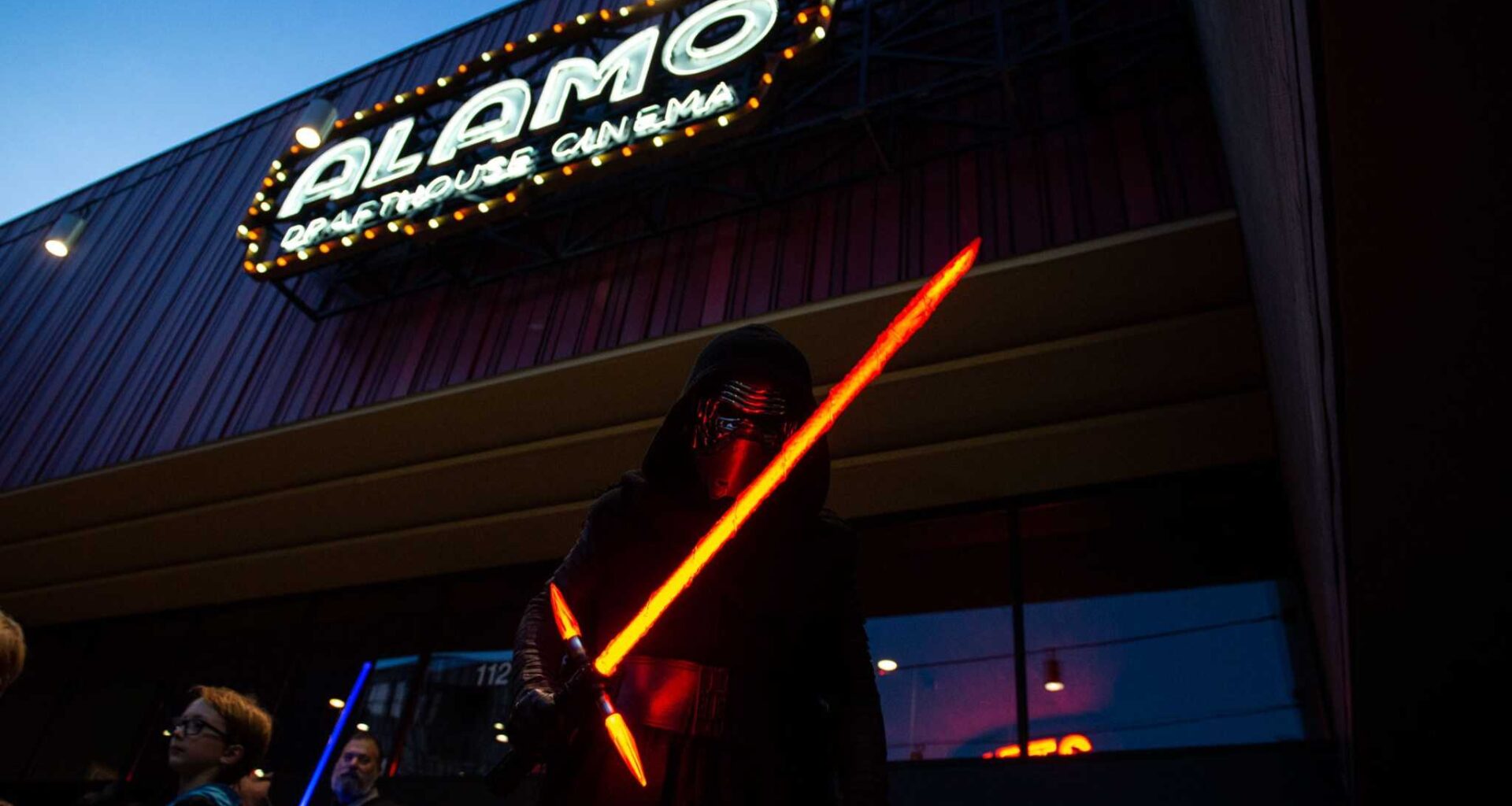
Adam Sweeney, dressed as Kylo Ren, shows off his lightsaber in front of Alamo Drafthouse South Lamar, Dec. 19, 2019, in Austin.
Angela Piazza, Angela Piazza
The first glow isn’t from the screen anymore.

It’s from someone three seats down, chin lit blue, angling their phone just enough to scan a QR code taped to their table. Already the room has fractured into tiny private errands — add fries, flag a server, report a texter by texting.
Article continues below this ad
At Alamo Drafthouse Cinema, these rituals that once felt almost religious now begin with a hyperlink.
From no phones to QR codes: How Alamo’s new rules break the old magic
Alamo Drafthouse South Lamar.
Stephen Spillman for American-Statesman
The Austin-born theater chain, long defined by its strict no-talking, no-texting policy, has shifted to a fully mobile ordering system, requiring guests to use their phones during screenings to order food and drinks. The move replaces its signature pen-and-paper slips and silent service choreography with QR codes and a custom ordering site.
Article continues below this ad
For years, Alamo’s identity revolved around a sense of control. You could be thrown out for a whisper. The mythology mattered: This was a place that respected movies enough to protect them from you. And in return, you behaved. You didn’t check your phone because you couldn’t.
Now, you’re asked to want both things at once: cinema and commerce flickering in the same palm-sized glow.
Staff are trained to distinguish between acceptable and disruptive use. But the logic feels a little like whispering in a library: technically permitted, spiritually beside the point. Then there’s the matter of labor, which the interface politely obscures. The servers are still there, moving through the dark, but you feel them less now — less eye contact, fewer exchanges.
Article continues below this ad
The cost of Alamo’s new convenience
Alamo Drafthouse Cinema employees Paul Blandford, left, Elle Klein and Jeremy Rees enjoy a sampling of the cinema’s pizzas, salads and sandwiches while watching a preview of “Election” at the theatre on Colorado Street Wednesday, July 30, 1999.
Kevin Virobik-Adams for American-Statesman
In the past week, there have been gestures that feel almost apologetic. At select screenings, including “Project Hail Mary” and “Marc by Sofia,” patrons were handed chocolate chip cookies on their way out, like a hotel trying to make you forget the construction.
Among regulars, especially those on the theater’s Season Pass subscription, the response has been less forgiving. On social media and online forums like Reddit, some have discussed canceling outright, calling the shift antithetical to what made Alamo distinct in the first place.
Article continues below this ad
What’s at stake is the erosion of a social contract that Alamo spent years educating its audience to keep. The theater didn’t just enforce rules; it cultivated a sensibility. Movies were to be watched a certain way. Attentively, collectively, without the constant itch of elsewhere. The new system doesn’t abolish that ideal, exactly. It just introduces a loophole you can drive a glowing screen through.
And once you’ve done that, it’s hard to pretend the room is sacred again.
The old way was about believing, for two hours, that nothing else existed. And now, sitting there with a menu open in your lap, watching the light bounce off a dozen other faces doing the same, you realize something small but essential has changed: You’re still at the movies. You’re just not entirely there anymore.