
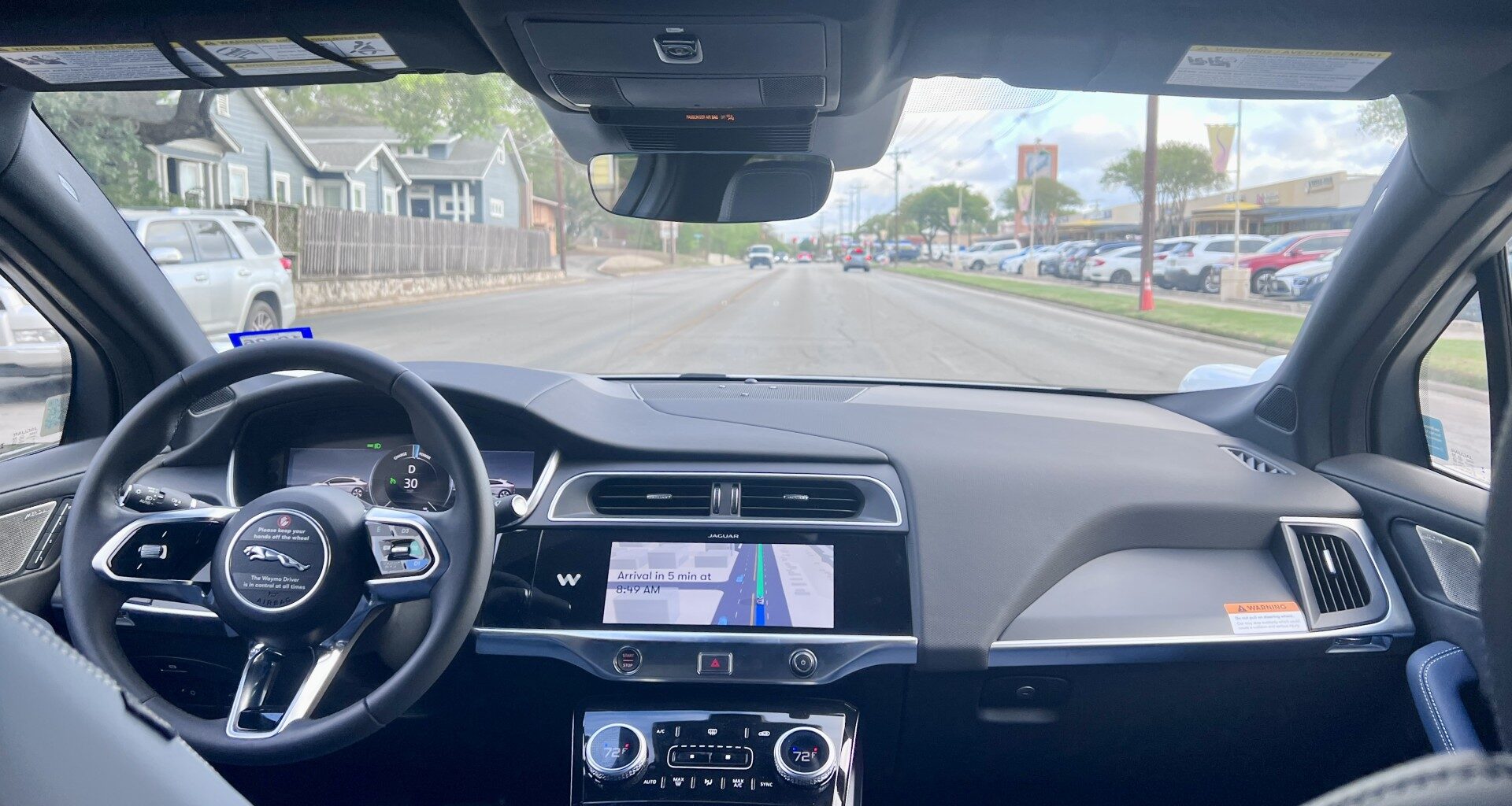
The dashboard of a Waymo Jaguar I-Pace driverless taxi.
Richard A. Marini/Staff
I’d been in the taxi for only a few minutes when my stomach did a flip-flop: Heading to an early morning workout, I realized I’d inadvertently left my gym bag, complete with my wallet and keys, on my car’s hood in the parking lot where the taxi had picked me up. I needed to go back and get them — stat! — before someone grabbed my bag.

But how to do that? In the Before Times, I’d simply instruct the driver to turn around and go back to my car.
Article continues below this ad
But it’s 2026 and I was in a Waymo driverless taxi. There was no driver at the wheel. No one to ask to return me to where we’d started so I could get my forgotten bag — assuming it was still there.
This was my first-ever Waymo ride and prior to taking it, I’d tried to familiarized myself with the company’s smartphone app. But I hadn’t drilled deep enough to find anything like a Go Back command. Instead, I tapped the Pull Over button, an order the taxi dutifully obeyed and, after poking around the app some more, decided my best play was to cancel my current ride and request a new one back to where I started.
Features Reporter Richard A. Marini tests out driverless taxi service Waymo in San Antonio.
Richard A. Marini/San Antonio Express-News
Fortunately, my bag was still there when we arrived. I grabbed it and ordered a new ride — my original car had already disappeared into the darkness — arriving at my destination only a few minutes late.
Article continues below this ad
Quite the beginning to my experiment in autonomous driving. Over the next two days I took five Waymo rides, each time arriving unscathed and mostly more relaxed than if I’d driven myself. I could get used to this.
A Waymo robotaxi arrives outside of San Antonio City Hall.
Brandon Lingle/San Antonio Express-News
Autonomous vehicles appear to be on the verge of some great advances, according to Ashim Bose, professor of practice at the University of Texas at Dallas’ Jindal School of Management.
Article continues below this ad
“There’s a lot of investment being made in the technology, but at the end of the day the adoption depends on whether it’s economically viable,” said Bose, who has studied, taught and worked in both artificial intelligence and transportation. “When you think about the convenience of driverless vehicles, it takes the economics to the next level. So I think these vehicles are here to stay.”
He notes that, while these cars don’t have a perfect safety record, they are generally safer than human-driven vehicles.
A 2024 report in the journal Nature Communications, for example, found that driverless vehicles such as Waymos were 92% less likely to be involved in crashes that result in pedestrian injuries, although they also have a higher risk of crashing in more challenging situations, such as at dawn or dusk or while making left turns.
Still, when unmanned vehicles go rogue, it makes news. On Wednesday, for example, a Waymo robotaxi was recorded driving the wrong way on a temporary one-way street while in a school zone. Chris Bonelli, Waymo’s product communications manager said that after receiving a report about the incident from police, the company has made changes to where the cars can and cannot drive at certain times of the day to account for temporary one-way traffic patterns.
Article continues below this ad
Interior screens update riders about where they are, when they’ll arrive, even nearby vehicles and pedestrians.
Richard A. Marini/Staff
Here’s what you need to know about Waymo.
PIT STOPS: Waymos spotted parking on residential streets between tasks
What is Waymo?
A spinoff of Google, Waymo is one of a number of companies that are, or are working toward, operating fully autonomous robotaxis that can take you where you want to go without the help of a human driver. These include several efforts backed by heavyweights such as General Motors, Tesla Amazon and Toyota.
Article continues below this ad
Waymo cars, which have been around for several months “learning” the lay of the land and have been ferrying paying passengers since February, bristle with technology — light sensors, radar, cameras, AI — to navigate roadways.
The company has dozens of vehicles, all electric Jaguar I-Paces, serving tens of thousands of San Antonio riders, according to Bonelli.
Hands off! This car can drive itself.
Richard A. Marini/Staff
How does it work?
All of your interactions with Waymo, from calling for pickup to adjusting the car cabin temperature, are controlled by the Waymo smartphone app. Because the company is rolling out its service slowly, a redemption code currently is necessary to set up an account. To get a code, you must first set up an account on the app, after which, as the system expands, you’ll eventually get an invitation to join. Valid codes are also occasionally available on sites such as Reddit community r/waymo.
Article continues below this ad
Bonelli said the company hopes to offer open membership “in the near future.”
How much does it cost?
Waymo charges a base fare and then uses dynamic pricing, meaning more during busy times, less when demand is low, to determine a ride’s final cost. One weekday, for example, I paid $16.51 to ride 3.1 miles from Adair Kitchen on Broadway to the Lincoln Heights shopping center. According to the website Taxifarefinder.com, the same ride in a yellow taxi would cost $11.12, including tip. On Saturday morning it cost $30.39 to take Waymo 6.8 miles from Wonderland Mall to the Olmos Soccer Fields. TaxiFareFinder pegs the cost of that trip $20.56.
Waymo’s coverage area recently expanded to include San Antonio International Airport.
Screen grab
Where can you go?
Waymo is currently operating in 10 U.S. cities, including Houston, Dallas, Austin and San Antonio. Locally, the 60-square-mile service area extends roughly from Interstate 10 on the south and west and Loop 410 to the north and east. The company recently expanded coverage to San Antonio International Airport, making it the first Texas airport to have such service. Coverage should continue to expand until, eventually, taxis offer intercity service. In California, for example, you can already take Waymo the 50 miles between San Francisco and San Jose.
Article continues below this ad
At the moment, however, my house sits outside the Waymo service area, so I had to drive several miles before I could summon a taxi. At-home pickup would have been much more convenient.
FIRST IN TEXAS: San Antonio airport gets Waymo robotaxi service
Phone notifications alert you about how long the wait will be before your Waymo car arrives.
Richard A. Marini/Staff
What’s the ride like?
Watching a Waymo silently glide toward you like some sentient, mechanical being is somewhat surreal. Then when the doors unlock and a pleasant female voice welcomes you by name — “Hello, Richard” — it’s like you’ve stepped into some futuristic “Total Recall” world.
Article continues below this ad
In addition to adjusting the car’s temperature and leg room, riders can also connect music apps to the car’s audio system. The default is atmospheric lo-fi from artists such as amies, Meadowzz and Hindrick.
Once the robotaxi starts, however, things begin to return to normal — assuming you can ignore the steering wheel that spins by itself. Currently, all San Antonio Waymos are Jaguar I-Paces and the interior is very comfortable, without being ostentatious. Maps on the two screens — one for the front seat, another for the rear — show the robotaxi’s progress as well as ghostly images of other vehicles and nearby pedestrians.
The all-electric vehicle has quick pickup and the brakes work well, as I was soon to find out.
While the car follows all traffic laws — it didn’t make an illegal U-turn to take me back for my forgotten gym bag, for example — it didn’t stop when the light turned yellow just as we were entering an intersection. Another time, however, it did stop for a yellow when we were farther away, although not so far that I wouldn’t have continued through had I been at the wheel.
Article continues below this ad
The cars appear to be pretty intelligent, even if it’s artificial. At one point, while on the I-10 service road, two lanes merged into one, with my Waymo in the right lane and another car in the left. With two humans behind the wheels, this might have devolved into a game of ego-driven chicken. Instead, the Waymo decided that braking was the better part of valor, slowed down and let the other guy go first.
Waymo Jaguar I-PACE equipped with self-driving technology navigates a city intersection, with visible sensors and cameras, in San Francisco, Calif., in March 2025.
Michael Vi/Getty Images
Was there any unpleasantness?
Beside my forgotten gym bag, for which I blame only myself, two unusual things happened during my Waymo weekend. First, while driving down a dark street near Pearl, I spotted what looked like a broken down cardboard box in the middle of the road. It took the car’s sensors a few moments longer to clock the box, however, and when it did, it had to brake pretty hard to avoid hitting it and then slowly driving around the obstacle.
Article continues below this ad
The second occurred on my ride back to Wonderland Mall. I’d parked in front of the nearby Target store so, when calling for the ride, I entered the store’s address I found online. What I didn’t realize was that the address, 4522 Fredericksburg Road, was for the entire mall, not just the Target. So when the car’s AI decision-making software dropped me off in the middle of a vast parking lot, I was on the complete other side of the mall and was forced to hoof it to my car on my own.
Turns out, Bonelli informed me, I could have adjusted my drop-off spot on the app to have the car let me out nearer my own. Something to look for the next time I call for a robotaxi.