
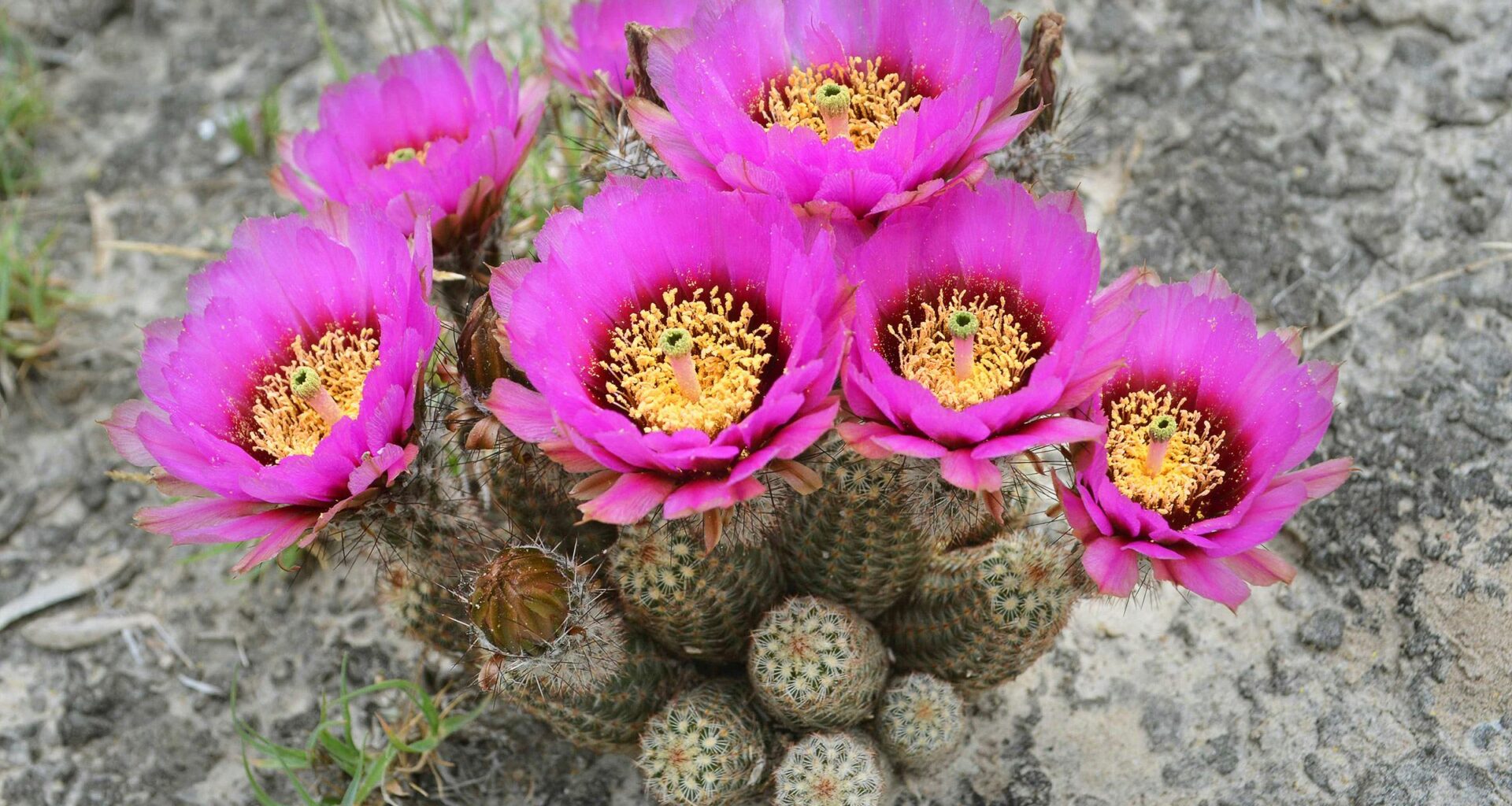
To the untrained eye, the clusters of tiny perennial succulents might seem unimpressive. When they’re not in bloom with bright-fuchsia flowers, the black-lace cactus tends to blend in with the dirt it’s rooted in. One chilly February day at a lignite mining site near Christine, Texas, about an hour south of San Antonio, I find myself wandering around with botanists, cactus lovers, and volunteers who are downright thrilled to be finding so many of these dusty little plants.
“I’ve never done anything close to this scale. It’s a profound thing,” says Michael Eason, vice president of conservation and collections at the San Antonio Botanical Garden. His team has been charged with helping to save this endangered plant species before the land is mined. I don’t tend to associate coal mining or drilling of any kind with conservation, but after the cacti were discovered on the site, the botanical garden, along with environmental consultant Jeremiah McKinney, the Native Plant Rescue Project, and the San Antonio Cactus and Xerophyte Society (SACXS), partnered with San Miguel Electric Cooperative Inc. to remove, propagate, and eventually replant the black-lace cacti.
“San Miguel doesn’t have to do this,” McKinney says. “They could mine right through the plants, and they would not be violating laws. They’re actually trying to learn to do a reclamation and build awareness about the species.”
Early that morning, I met Eason and conservation technician Cory Foshee at the San Antonio Botanical Garden. Eason packed a cooler full of snacks and drinks for the volunteers and showed me rows of plants they’d collected during the first trip to the mine. We left the garden in separate cars and drove down to the mining site. When I arrived, a man in a hard hat took one look at me and said, “Are you with the botanical people? They’re over there.” He pointed to a group of thirteen volunteers and employees surrounded by orange Home Depot buckets. Eason and Foshee arrived right after me, and we gathered with volunteers from SACXS, plus San Miguel environmental and fuels manager Dave Burris and permit compliance coordinator Nellie Frisbee, whose hard hat is adorned with the words “Coal Guns Freedom.”
We listened as McKinney explained the reclamation process. Before any mining could begin on this privately owned land, McKinney, who regularly consults for companies like San Miguel, was brought in with other experts to conduct an extensive baseline study of the environment. It’s his job to make sure native grasses, soils, trees, and plants are repopulated, and that streams, ponds, and creeks are recreated when a mining or construction project ends. He discovered the black-lace cactus population in 2014 while mapping vegetation on the 30,000-acre area. McKinney says finding them there was a big surprise. This species of cactus doesn’t usually live in this part of Texas; since it likes saltier soil, it’s typically found closer to the coast.
McKinney recognized a huge opportunity. What if, out of the approximately 3,000 plants they would gather in those Home Depot buckets, they could propagate 10,000 to 20,000 more plants? “These are natural resources with intrinsic value to us,” he says. “Once we lose it, it’s gone. Some people don’t care and think it doesn’t impact their life, but a person has to decide what’s important to them in this world.”
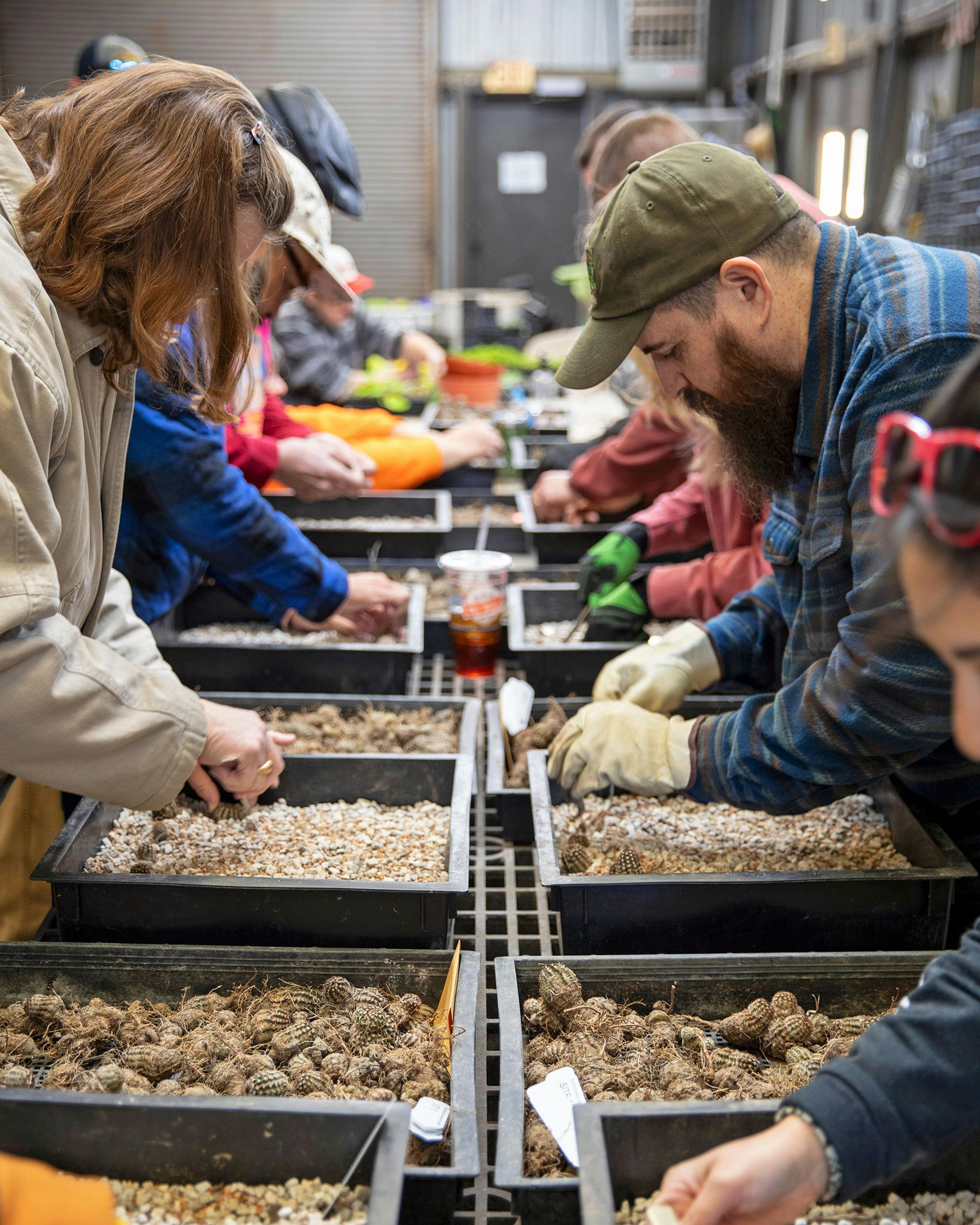 Volunteers, San Miguel staff, and San Antonio Botanical Garden staff working together at a potting event.Courtesy of San Antonio Botanical Garden
San Miguel worked through a comprehensive revision of its mining permit’s Fish and Wildlife Protection Plan and submitted it to the Railroad Commission of Texas Surface Mining and Reclamation Division, which provides a copy to the Texas Parks and Wildlife Department, the U.S. Fish and Wildlife Service, and the U.S. Army Corps of Engineers. The project also required written approval from private landowners to ensure full compliance with the Endangered Species Act. The entire process of reclamation will likely take until the mid-2030s to complete.
Before that happens, there are cacti to collect. McKinney instructs us to watch out for Texas indigo snakes, since it’s their mating season, as well as rattlesnakes and javelinas. “It’s called wildlife for a reason,” says one of the SACXS volunteers. This cohort seems especially excited to get started. They are, after all, part of a cactus appreciation society. One volunteer, Ron Andring, says he’s “old enough and retired enough” to devote his free time to things like this. Alyssa Danna, program director at SACXS and a gardener at the San Antonio Botanical Garden, says, “We’re all like, we’ve got to save them all!”
As this gentle army of cactus gatherers fans out across the land, McKinney, who has a degree in wildlife biology, points out strawberry, horse crippler, fishhook, and prickly pear cacti, the latter species prompting Burris to declare, “I like that prickly pear Shiner Bock.” McKinney crouches to show me delicate beach seepweed and coastal stonecrop, which I never would have noticed on my own. “If you spend enough time looking closely, you’ll see things,” he says. Black-lace cacti only produce those fuchsia blooms one day a year, in mid to late March, and bees, butterflies, moths, beetles, and wasps depend on those flowers to survive. McKinney tells me about a black widow web he found over one of the blooms, marveling that the spider had only one day to spin it. “That spider got fed,” he says.
In under three hours, the group gathers about eight hundred black-lace plants to take back to the garden. At their previous outing, they got close to 2,500 plants. The team plans to make another trip to the mining site this spring to collect seed. The plants will be stored in fifteen-by-fifteen-inch germination trays, which can hold about one thousand seedlings, making it possible for the team to bring thousands, if not tens of thousands, more plants back to the land than they dug up. More will be propagated on-site, too. The mining operation will eventually build a shaded yard to hold the cacti, which will be replanted in biodegradable pots once the mining ends and the land is restored to its natural state.
I spent only a few hours at the cactus-gathering mission, but McKinney and Eason will be working on this reclamation for several years to come. Eason, in particular, will be waiting for the seedlings to sprout, then calling on those volunteers again to help them replant, with a cooler full of snacks in tow. “I could not do this on my own,” Eason says. “It’s definitely a feel-good moment when I see [thousands of] cacti in trays all about to bloom. Whatever you can do to save a species makes you sleep better at night.”
If you were driving along the road in South Texas past the mining site, you’d notice the excavators or massive draglines, but you’d never know about the tiny black-lace cacti nestled among the brush or the people who are patiently working to save them. Unlike a field of bluebonnets, these little prickly bulbs might not inspire families to snap yearly photos or advocate to protect them so they bloom again the next year, but they’re just as important to the state. Just ask the birds, bees, and butterflies that rely on them to survive.
Read Next