
Nine months after the July 4 flood stripped the Guadalupe River of much of its riparian tree canopy, the San Antonio Botanical Garden is rallying Hill Country residents to help bring it back.
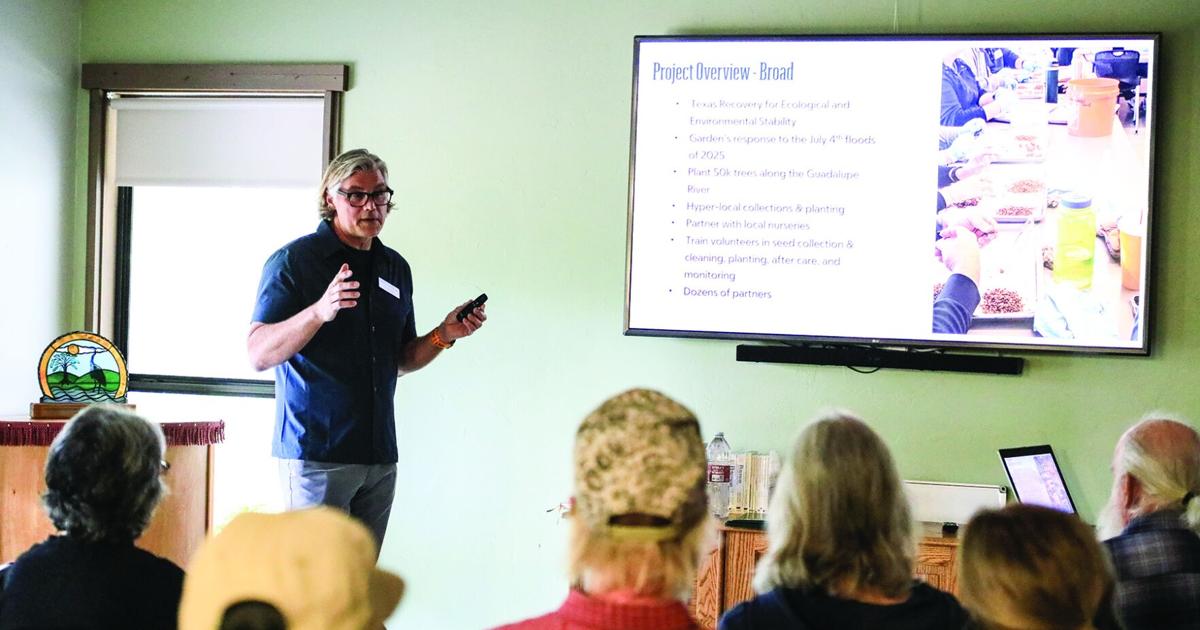
The garden’s Texas Recovery for Ecological and Environmental Stability initiative, known as TREES, held an outreach meeting Saturday at the Riverside Nature Center in Kerrville to recruit volunteers for seed collection, seed cleaning and future planting events.
About two dozen community members attended the session, which was led by Michael Eason, the garden’s vice president of conservation.
The July 4, 2025, flood sent the Guadalupe River surging more than 26 feet in under an hour, killing at least 135 people and devastating the region’s riparian landscape. Beyond the human toll, the flood tore out the native tree canopy that stabilizes riverbanks, filters water and supports wildlife along the upper Guadalupe watershed.
TREES is a five-year, $5 million project aimed at planting 50,000 native trees along the Guadalupe River in Kerr County. Since launching in August 2025, the team has collected more than 250,000 native seeds. Many are already germinating at the garden and partner nurseries.
“This is restoration based in science,” Eason told those gathered Saturday. “It’s experimental, not a landscape project.”
The project follows a cycle of field collection, seed banking, propagation, out-planting, monitoring and data feedback. “Adjust, adapt, repeat,” he said.
The initiative targets seven primary tree species native to the Guadalupe watershed: bald cypress, sycamore, chinquapin oak, black willow, walnut, pecan and ash. A second tier of species, including live oak, lacey oak, box elder, red buckeye and dwarf palmetto, is also part of the effort.
A key principle of the program is keeping genetics local. Seeds are collected within 15 miles of where trees will eventually be planted.
“Our motto is collect local, plant local,” Eason said. “This ensures the most genetically similar and adapted plant material is used and that each seed is tracked from collection to planting.”
Seed collection follows strict conservation standards.
“We take no more than 20 percent of available seed from any site and target 20,000 seeds per location,” Eason said.
Last year, volunteers contributed to roughly 850,000 seeds collected.
Corey Foshee, the garden’s seed lab manager, described the cleaning sessions as laid back and community-oriented.
“We just sit around, eat, listen to music and have snacks,” she said. “It’s been a fun process.”
Volunteer manager Chloe Blumenberg told attendees that seed cleaning sessions are expected to resume in summer 2026, once a new round of spring and early summer collections builds up enough material to process.
A seed collection workshop is planned for May 2, 2026, at the Riverside Nature Center. The first session is limited to 20 participants. A second session may be added if demand warrants it. A planting and monitoring workshop is planned for fall 2026.
About 12 nursery partners across the region are propagating trees grown from locally collected seed. The horticulture approach prioritizes function over appearance: deep root systems, stress tolerance and structural resilience rather than fast top growth. “Slower growth is better,” Eason said.
Planting is expected to begin as early as fall 2026. Monitoring falls to volunteers, property owners, land managers and garden staff, who will track tree survival and growth and adjust the approach based on results.
On watering newly planted trees, Eason said the approach would be flexible and site-dependent.
“We need our landowners to be very adaptable,” he said, describing options that range from landowner-managed watering to backpack sprayers carried by volunteers. “Some plants, the vast majority ideally, are going to be planted next to the river. If you’ve ever dug a hole near the water, you don’t go down very far before you get to moisture.”
The flexibility of the restoration plan highlights its experimental nature.
“That’s where this volunteer monitoring comes into play. If we see that the trees are not responding well, we then have to make those changes,” Eason said.
To join the volunteer program, participants must be 18 or older, complete an online orientation and pay a one-time $30 background check fee. The garden says it can cover the fee for anyone who cannot afford it. The program asks for a minimum of 24 volunteer hours per year but says flexible arrangements are available.
Landowners with property along the Guadalupe River watershed are also encouraged to participate. The TREES team is seeking access to private land for both seed collection from non-flood affected areas and future planting sites.
Upcoming workshops for training volunteers and outreach will be held at nature programs across the Hill Country. For more information about the initiative, visit sabgtx.org/trees.