
The Aurora driverless truck on the road.
Image courtesy of Aurora Trucking
Texas is becoming the Wild West of driverless truck testing, with numerous companies looking to fill the highways with unmanned 45,000-pound trucks near your comparatively tiny manned car. It means that one day if you’re driving down the road, and make that “Pull the horn” motion to the truck driver, there may not be anyone there to honk.

The trucks are just beginning to permeate the highways. Aurora Trucking hauls freight via carrier Hirschbach for Driscoll’s (the berry company) in Laredo, as well as frac sand for Detmar Logistics in the Permian Basin. Kodiak AI, a rival, hauls for J.B. Hunt and Werner Enterprises from a Texas hub. And Houston-based Bot Auto partners with logistics providers like Ryan Transportation on overnight routes between Houston and the Dallas-Fort Worth metroplex.
Article continues below this ad
But why have all these robot trucks descended on Texas of all states? The answer is similar to the reasons that bring many humans here as well.
“Texas moves more freight than any other state in the U.S.,” Gerardo Interiano, SVP of Government Relations and Public Affairs at Aurora, told Chron. “It’s also strategically located—Fort Worth to El Paso represents the middle leg of one of the busiest commercial routes for the trucking industry: Atlanta to Los Angeles.”
This is not to mention that the environment—both in terms of the weather and the regulatory one—is rather friendly to such companies.
The autonomous Aurora trucks aren’t exactly spitballing it. They use a combination of FirstLight lidar, radar, and cameras to create 3D, real-time maps of their surroundings, with the newer lidar sensors able to see twice as far as usual, more than 450 meters down the road. It’s all integrated into an onboard computer with redundant backup systems that can apparently monitor itself for issues. So hopefully no blue screens of death here.
Article continues below this ad
Most trucks still need a lifeguard
As widespread as the rollout is, however, the autonomous tech on those trucks is being implemented in fits and starts. Aurora says it was the first to operate a fully autonomous commercial trucking operation, and it may have been for a few weeks, until Paccar, maker of the trucks, insisted an “observer” be put in the cab. Bot Auto and Kodiak have safety drivers as well for the moment, though Kodiak does a few purely driverless runs off the big highways on rural routes.
That said, it’s generally believed that fully autonomous versions of Class 8 freight trucks (the biggest ones) will hit Texas roads en masse sometime later this year or next. And when they do, entire fleets will be ready to toss out the observer.
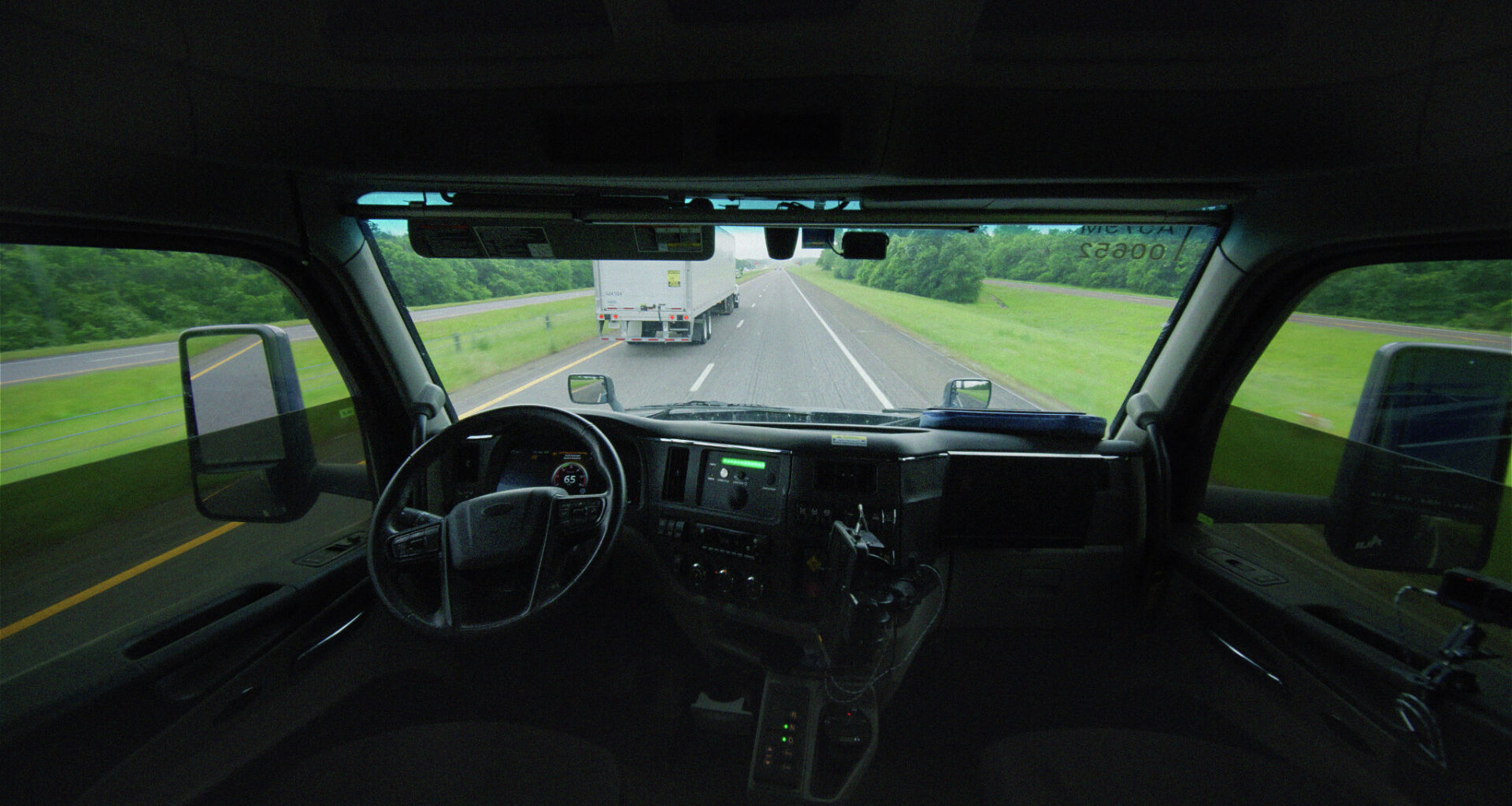
Inside the Aurora driverless truck.
Image courtesy of Aurora Trucking
“We have 30 total trucks in our fleet, including driverless-enabled trucks,” Interiano told Chron. “We expect to deploy hundreds of trucks by the end of this year and begin deploying thousands starting in 2027.”
Article continues below this ad
That’s plenty of semi-trucks in your rear-view mirror without a soul in the cabin. Just what will this all do to Texas’ famously congested highways? Not as much as you think, during the day, at least.
“Drivers will slowly start to notice more trucks on the road equipped with sensor racks on the front of the cab,” Robert Brown, Vice President of Business Development & Marketing at Bot Auto, told Chron. “But it will be a long time before they are as thick on the road as regular semis.”
Counting autonomous trucks at night before sleep
Scary as it may be for the rest of us passing an autonomous truck, the companies themselves are making the opposite argument. They believe they’ll reduce congestion and accidents, as well as ultimately alleviate fatigue for human drivers who may be potentially overextending themselves on long, tiring routes. Why? Because many of them will be operating late into the night while Texas sleeps. Driverless trucks don’t need to pull over to the side of the road and grab a bite or some shut-eye.
Article continues below this ad
It’s a wide open entry point, literally. The roads at 3 a.m. are mostly empty, so as they see it, why not have driverless trucks do much of their driving then?
“Overnight and hard-to-cover lanes are exactly where we see autonomy being the ideal situation to support freight movements,” Brown said. “One of our clients actually proves this point as they have a recurring shipment that requires overnight delivery.”
It remains to be seen whether Texans are comforted by the idea of battalions of autonomous trucks zipping across empty nighttime highways. The concerns otherwise are obvious. There have been safety issues with so-called phantom braking, in which a driverless semi-truck might stop abruptly as a result of its cameras “seeing” obstacles that aren’t actually in the way. And then there are the economic concerns teamsters have expressed about driver job loss, and how this will impact communities along the routes.
Article continues below this ad
Until then, however, we’re still in a calm before the storm stage. Driverless companies, like any other tech brand, tend to make big promises and then have to adjust expectations when their grandiose utopian visions don’t quite pan out. But they’re set to be game changers down the line, whether people want it or not.
It’s unlikely that driverless trucks will have the same fate as robot vacuums, an industry that keeps getting stuck in the corner, literally and figuratively. They’re set to reshape the entire supply line. And when they do, we’ll just have to see how many people call that 1-800 number underneath the “Don’t like my driving?” sticker. That is, assuming they even have those.