
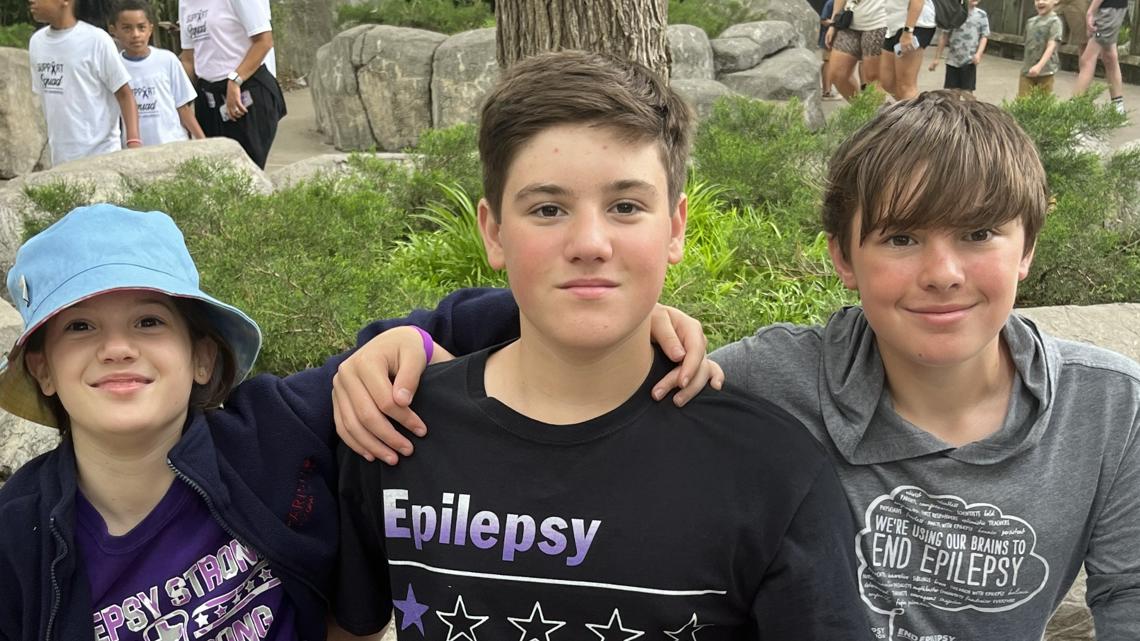
A teen’s seizures vanished with CBD. His Texas family now watches state and federal cannabis policy with growing concern.
DALLAS — When the Fokas family found the cure to stop their son Reagan’s seizures, it was the relief they had been seeking for years.
But now, the family is worried about how much longer they will have access to the only thing that has seemed to help: CBD.
Fokas had his first seizure in 2012 when he was 4 years old.
He had two seizures the first day, five the next, and seven the day after that.
“It escalated very quickly,” his mother, Stephanie Fokas, told WFAA.
Pharmaceuticals weren’t effective in resolving Reagan’s seizures. It seemed medication only made things worse, Stephanie Fokas said.
“Reagan’s epilepsy was so catastrophic that nothing was helping to contain it,” she said.
That same year, Reagan had brain surgery for his epilepsy. That was followed by about 16 seizure-free weeks. In October of 2013, Reagan would be back in the emergency room with epileptic seizures.
All the doctors could recommend, Stephanie Fokas said, was more medication.
During the break in seizures, Stephanie Fokas and her husband saw a CNN documentary titled “Weed” by Dr. Sanjay Gupta.
The documentary focused on a young girl in Colorado named Charlotte Figi, who had a rare genetic epilepsy called Dravet syndrome. Charlotte was essentially facing the end of her life with her condition, and her mother Paige was looking for solutions.
That’s when she discovered that hemp-based CBD was being studied and used in Israel with promising results.
Paige found growers in Colorado who were working on high-CBD, low-THC plants. This is where Charlotte got her first dose of CBD. It stopped her seizures for days.
“It was astonishing to see how dramatically it improved Charlotte’s quality of life,” Stephanie Fokas said of the documentary.
Charlotte died of an upper respiratory illness on April 7, 2020, at the age of 13. April 7 is now known by some as Charlotte Figi Day, meant to honor the girl who became the face of a national movement to expand access to CBD.
After watching the documentary, Stephanie Fokas wrote down the names of the growers on a piece of paper and left it on her desk in August 2013. Two months later, Reagan’s seizures returned.
The Colorado organization Stephanie Fokas learned about through the documentary was called Realm of Caring.
She reached out and heard the organization was being inundated with calls from families across the country searching for access to CBD. It was a different time — years before Texas launched its medical marijuana program and before the federal government would legalize hemp, making CBD widely available in the U.S. The state of Texas legalized hemp in 2019, one year after it was permitted at the federal level.
Some had decided to relocate to Colorado for access to CBD, but that wasn’t an option for Reagan and his family.
“After failing so many treatments, we desperately wanted the chance to try,” Stephanie Fokas said.
So, she traveled to Colorado to get CBD and brought it back to Texas.
“It felt scary and illegal,” Stephanie Fokas said. “My biggest fear was that someone would report us to Child Protective Services,” she said.
Reagan had his first dose of full-spectrum CBD in January 2014.
By April that year, he was seizure-free. Reagan hasn’t had a seizure since, his mother said.
Though Texas now has a medical marijuana program where patients with epilepsy can access CBD and THC, Stephanie Fokas and her son have stuck with what they know to work, the products by the Colorado organization, Realm of Caring.
Reagan is 18 now. He’s a junior in high school and got his driver’s license two years ago, something that may have been unattainable with regularly occurring seizures.
But Stephanie Fokas said she is concerned by the seemingly ever-changing nature of state and federal cannabis laws and worries about what this could do for CBD accessibility.
A federal funding bill signed by President Donald Trump in November cast doubt on the future of hemp and products across the country, according to previous WFAA reporting. The funding bill included a ban on hemp products with THC levels above 0.4mg.
Jesse Williams, administrative director of DFW-based nonprofit Texas Cannabis Collective, told WFAA these new rules could impact CBD products as well.
“The problem is the 0.4mg THC cap on all products,” Williams said. “Even most basic CBD products that aren’t pure isolate are going to have more than this amount.”
Stephanie Fokas said she worries about her son’s access to CBD every day.
“After fighting so hard for access 10 years ago, the fear that it could be taken away again is devastating,” Stephanie Fokas said.