
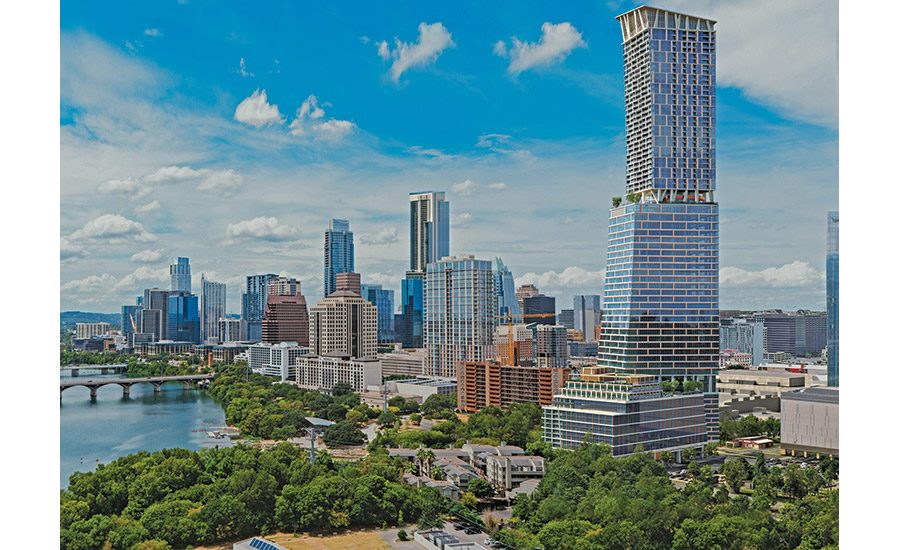
At 1,025 ft, Waterline will become the tallest tower in Texas when DPR Construction finishes it later this year. But it’s not the most important story in the Austin‑Round Rock construction market.
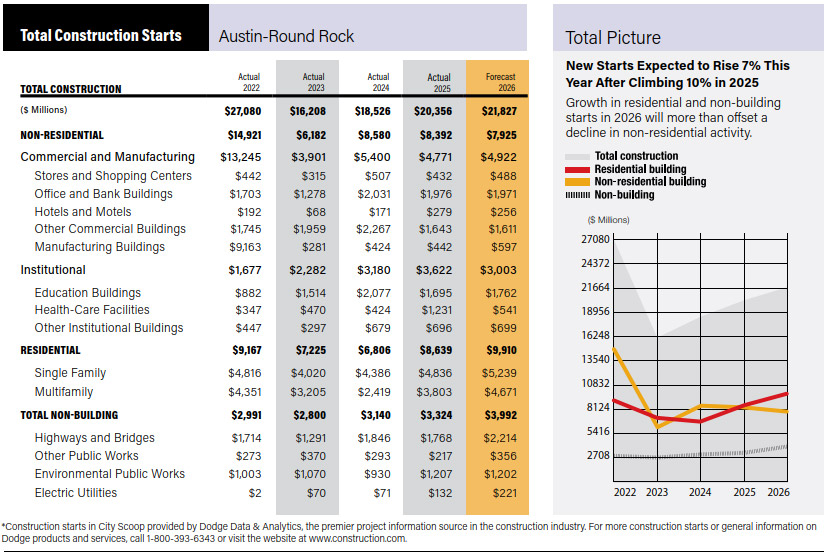
The bigger story is the volume of work spreading across the region—and the labor strain that comes with it. According to Dodge Data & Analytics, total construction starts in the Austin‑Round Rock metropolitan statistical area reached $20.4 billion in 2025, with starts projected to rise to $21.8 billion in 2026. “The influx of megaprojects continues to strain the local market from a skilled‑labor perspective, and general contractors are being continually challenged to innovate and adapt,” says Bryan Kent, DPR Construction’s Central Texas business unit leader.
While fewer cranes may punctuate the downtown skyline than in years past, Kent says the work hasn’t dried up—it’s been redistributed throughout the region. Capital programs like the Interstate-35 expansion and airport additions, alongside major institutional and industrial moves by the University of Texas and Samsung, respectively, have spread activity across the metro area.
Data centers have also arrived in Central Texas at a scale that has transformed the region’s construction profile. The facilities demand massive power infrastructure, precision mechanical and electrical systems and schedules that expose any gap in the trade supply chain. “The list of local and regional megaprojects continues to grow,” Kent says.
That concentration of large, technically demanding work is drawing from the same finite pool of ironworkers, electricians, concrete finishers and pipefitters—simultaneously.
DPR’s response has been to reduce its dependence on available labor via prefabrication and offsite manufacturing. “The reality is that not everything needs to be manufactured here—it can be shipped to Central Texas,” Kent says. What was once an option, he adds, “is in many ways now becoming standard practice,” delivering gains in speed, quality, cost and safety. Earlier preconstruction collaboration and self-performing trade work helps schedules when trades are stretched thin. So does virtual design and construction. “We’re able to build projects virtually to identify roadblocks early and improve workflow, enabling better sequencing and productivity,” Kent says.
“The list of local and regional megaprojects continues to grow.”
—Bryan Kent, Central Texas Business Unit Leader, DPR Construction
That innovation is showing up across sectors—and one sector showing strength in the 2025 data may be the least surprising. Institutional starts reached $3.6 billion last year, with health care facilities alone jumping to $1.23 billion—more than double the $424 million recorded in 2024. Major hospital systems are expanding their footprints, and the UT academic medical center project in North Austin stands as the clearest example of that momentum.
Downtown tells a different story—one of recovery rather than expansion. The 74-story Waterline, with 91 megacolumns averaging 70 cubic yd of concrete each, spread across a 3.25-acre site, ranks among the most challenging self-perform concrete projects in DPR’s history, and it’s running ahead of schedule. Kent sees it as a marker of what’s returning to the downtown market. Interest-rate movement and the Austin Convention Center redevelopment are generating what he calls a “hopeful buzz,” with more private projects expected to follow.
Two regulatory developments are reshaping the operating environment. Texas Senate Bill 840, effective since September, requires cities to allow multifamily and mixed-use development in commercial zones, prompting Austin to set a 350-ft base-height limit in the central business district and revise its Downtown Density Bonus Program. The city is also creating a life sciences zoning category to support biotech and pharmaceutical users. The South Central Waterfront Combining District, a redevelopment framework for land south of Lady Bird Lake, remains stalled at the city council level but, in Kent’s words, “could potentially have a massive impact on the built environment of the Austin CBD.” Permitting has improved, though fire and Austin Energy reviews still make Austin’s process the slowest in the region.
Kent’s outlook is straightforward. “I’m optimistic about where we’re headed. I think with Austin being a well‑established tech hub, the city will continue to drive growth in the technology industry, from data centers to semiconductors and other types of advanced manufacturing—and that’s supported by ongoing growth from a population standpoint, and especially considering Austin’s thriving young population.”