
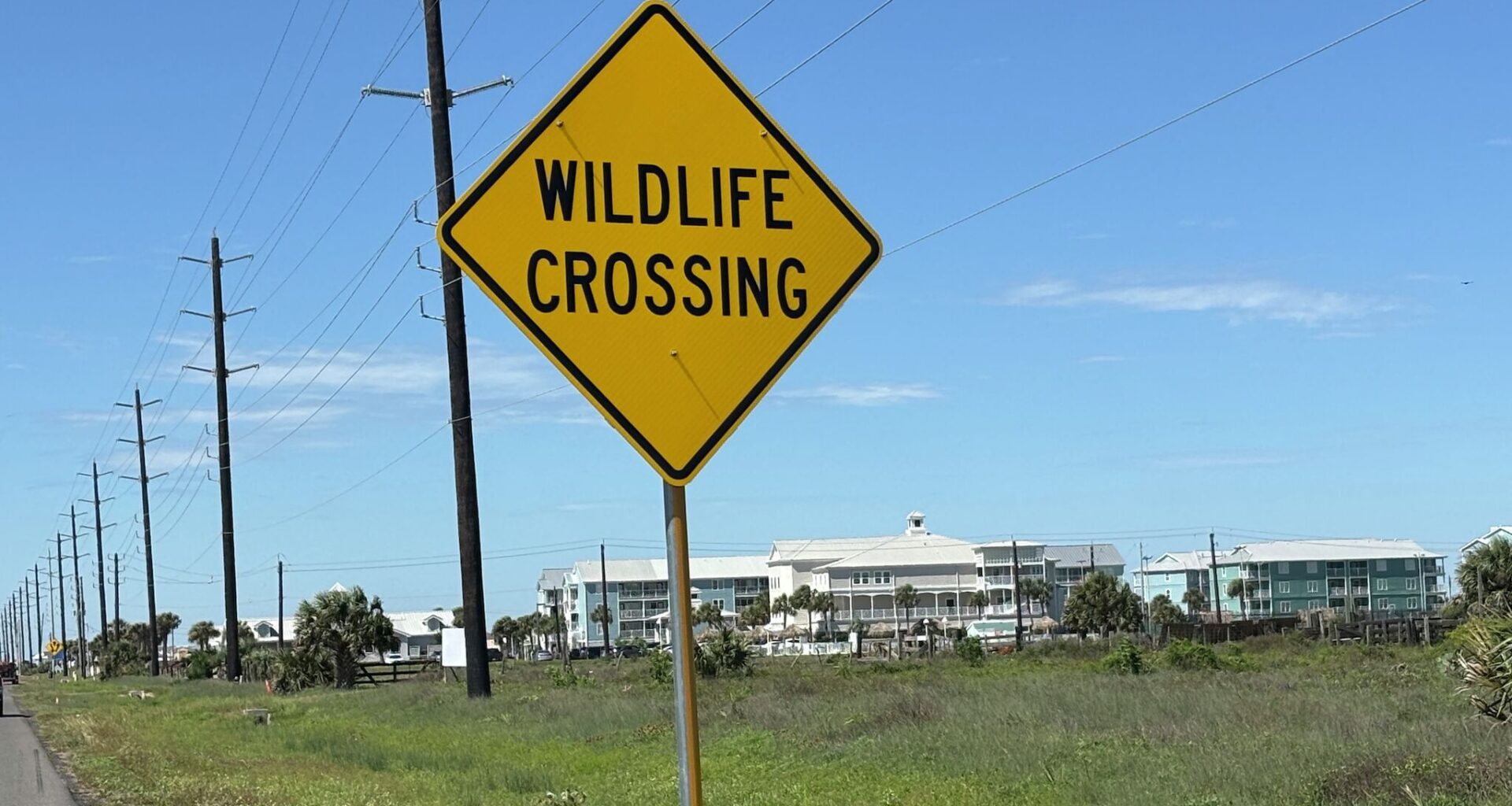
Drivers headed to a vacation rental on Galveston’s West End in the months ahead have 10 new reasons to keep their eyes on the road. Last month, the Texas Department of Transportation installed ‘Wildlife Crossing’ highway signs along 19 miles of FM 3005, Seawall Boulevard’s designation after the seawall itself plays out (and also known as San Luis-Termini Road).
Hypothetically, the signs could refer to a variety of critters. On a recent drive out that way, Chron spied a poor armadillo that didn’t quite make it. But frankly, the public knows they’re really there because of ‘ghost wolves,’ coyotes unique to the island that share an abnormally high amount of DNA with red wolves.
Because red wolves are otherwise practically extinct in North America, that sense of exclusivity (as it were) has helped to fuel widespread public support for Galveston’s coyotes. It has also provided tourism officials with one of the more unorthodox marketing ideas for the island. More and more, dead coyotes just aren’t good for business—a lesson some developers have already learned (Sachs On the Seawall), but others haven’t (Margaritaville East Beach). Yet.
According to a TxDOT news release, the signs materialized after members of the Gulf Coast Canine Project, the local nonprofit founded to support the work of researchers Dr. Bridgett vonHoldt and Dr. Kristin Brzeski, contacted the department in 2024 to express their concerns about the coyotes’ high mortality rate. Researchers believe as many as 100 coyotes could be on the island at any given time, the project’s Josh Henderson told Chron last November.
They are also vulnerable. Recent data shared by Henderson, Galveston’s animal services supervisor in the City Marshal’s office, shows a steady upward trend in ghost wolf deaths: 7 in 2020, 16 in 2021, 13 in 2022, 8 in 2023, 12 in 2024, and 19 in 2025. Importantly, those figures reflect only the animals that officials were able to collect.
“On Galveston Island, wildlife crossing signs are more than roadside markers,” vonHoldt told Chron Monday. “They may look small, but they are a powerful acknowledgment that we share this landscape with species that still carry the ecological memory of this place. For Galveston’s ghost wolves, successful road crossings can mean the difference between survival and death.”
In January 2025, the release said, TxDOT environmental planner Brooke Bowman attended the ‘Ghost Wolf Town Hall’ at Moody Gardens, an annual community forum during which island residents discuss the coyotes’ growing profile and possible ways to help shield their habitat amid growing development. Afterward, Bowman and her team worked with county officials to determine the best locations for the signs—in other words, the places where coyotes’ mortality rate was highest.
Five each in the eastbound and westbound lanes, the signs stretch from just past the end of the seawall to San Luis Pass. Advocates and officials hope their visibility will help prevent scenarios like the most recent recorded coyote fatality: an eight-month-old pup named Dozer, who had only been tagged for a little over three months when he was killed at the base of the Interstate 45 causeway on New Year’s Eve.
Even grimmer is the fate of Dozer’s four littermates, who were unwittingly run over by a bulldozer as it moved a pile of telephone poles. Obviously, the new signs probably won’t prevent every coyote death. But they do represent a political milestone of sorts: once widely regarded as a pet-menacing nuisance, the ghost wolves are now popular enough to merit at least some measure of official protection.
“When we reduce vehicle collisions, we are protecting each individual animal and their genetic diversity, which will in turn support the resilience of a critical coastal ecosystem,” vonHoldt said. “Thoughtful infrastructure, even something as simple as a crossing sign, reflects a broader commitment to coexistence and to safeguarding the evolutionary potential of wildlife in a rapidly changing world.”