
Texas is widely regarded as the most lucrative untapped gaming market in the nation. And Dallas-Fort Worth might well be the crown jewel — the nation’s most opportune area for a Las Vegas-style casino resort.
A growing number of interests are pushing hard to expand gambling in Texas, including business leaders, developers, local government officials and some local and state lawmakers — who all see economic and employment boosts — and gambling enthusiasts who desire a thrill closer to home.
Perhaps no one is pushing more strategically than the Native American tribes in Oklahoma.
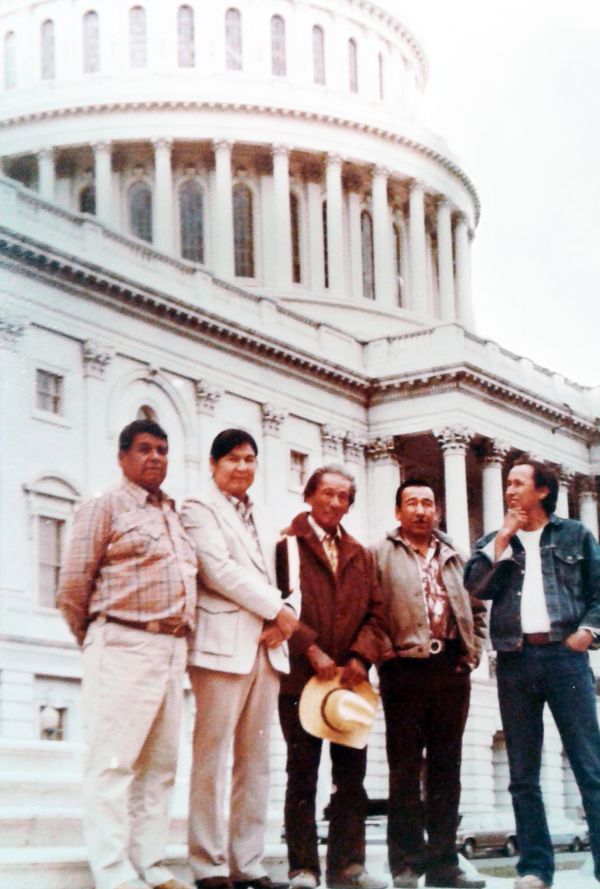
The Kickapoo Traditional Tribe of Texas successfully obtained federal recognition and was provided with a sovereign reservation in Eagle Pass in 1983. Here, members of the Kickapoo Tribal Council made their first trip to Washington, D.C.
Visual by Traditional Kickapoo Tribe of Texas.
For decades, those tribes, as well as the three federally recognized tribes in Texas, have been growing in political clout and trying to position themselves to open Texas’ first Las Vegas casino if and when the state broadly expands gambling.
The Choctaw and Chickasaw, in particular, have been working behind the scenes to build trust with North Texas leaders and city officials. That effort has been occurring on multiple fronts, where the trend is partly driven organically by the region’s proximity to Oklahoma, one of the nation’s largest tribal gaming markets — and home to some of the nation’s most respected gaming operators.
“I’d put our industry’s innovation and efficiency up against anyone,” said Matthew L. Morgan, special envoy for the Chickasaw Nation of Oklahoma and chairman of the Oklahoma Indian Gaming Association. “We do a really great job.”
The tribes’ slow and deliberate long-game strategy sits in stark contrast with their most fierce competitor in the race to build Dallas-Fort Worth’s first casino and expand gambling throughout Texas: the Las Vegas-based Sands Corp.
The international gambling superpower made its intentions clear over the last two consecutive legislative sessions, wooing influential state leaders with overt displays of wealth and power.
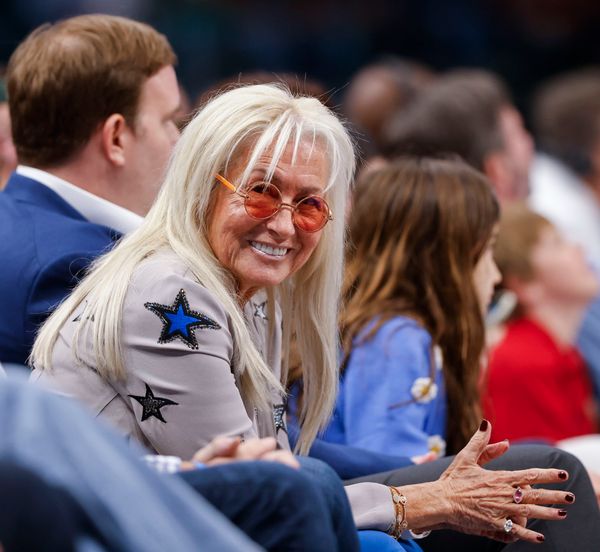
Las Vegas Sands Corp. controlling shareholder Miriam Adelson has spent about $29 million on Texas political activity aimed at opening the door to casino resorts. The company became more tied to Texas when Adelson purchased a majority stake in the NBA’s Mavericks in late 2023.
Visual by 2024 File Photo | Shafkat Anowar.
A hundred lobbyists strode into Austin’s chambers and made lawmakers flush with campaign contributions. The company became even more tied to Dallas when its controlling shareholder Miriam Adelson purchased a majority stake in the NBA’s Mavericks in late 2023. Adelson has spent about $29 million on Texas political activity aimed at opening the door to casino resorts, including contributions to candidates who support gaming.
Multiple Texas governors and other high-profile leaders since 1994 have fended off any attempts to expand gambling in Texas, pointing to the well-documented harm of gambling addiction. The pushback is especially true of any effort to allow casino gaming such as blackjack, table poker, traditional slot machines and other house games.
“A lot of really bad things come with casinos and legalized gambling,” said state Rep. Matt Shaheen, R-Plano, “and Texans don’t want it.”
Now the state is reckoning with what some leaders and officials say is an unprecedented confluence of forces to legalize gambling in Texas.
“Texas is a state where you have a large population, a large untapped market, a large appetite in big-time sports, with so many different franchises, and with that burgeoning interest in sports betting after the pandemic just like there’s been across the U.S.,” said Steven Andrew Light, a professor of political science and public administration in the Indian Nations and Gaming Governance Program at the Boyd School of Law at the University of Nevada, Las Vegas.
“Then there’s that growth of tribal markets in border states nearby, like Oklahoma of course, alongside that, you have vocal proponents of the spread of legalized gambling and sports betting with some of those very high-profile team owners and other folks like Mark Cuban, Jerry Jones or Adelson.
“So that creates the big picture question: If Texas expands gambling, what would that look like? What could it look like? How much of that would be a commercial market? What opportunities for tribes would there be and so on?”
The pressure to expand is coming from multiple directions, but is driven largely by money — the money that Sands Corp., or another private operator, could pump into the economy, but also by the economic example set by the tribes.
Casino gambling does exist in Texas, but it is largely confined to the three reservation casinos operated by tribes under federal law: the Alabama-Coushatta Tribe of Texas’ Naskila Casino in Livingston; the Kickapoo Traditional Tribe of Texas’ Lucky Eagle Casino Hotel in Eagle Pass; and the Ysleta del Sur Pueblo’s, or the Tigua’s, Speaking Rock Casino in El Paso.
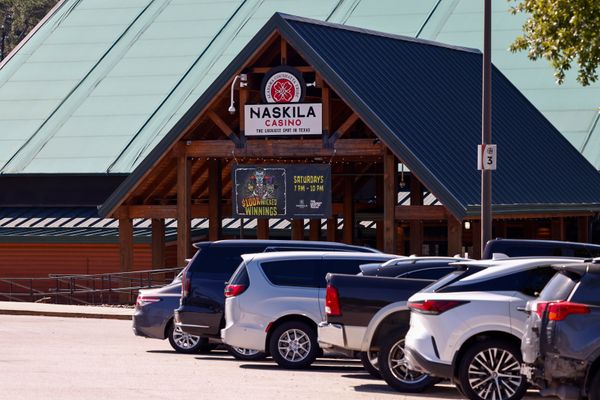
Casino gambling in Texas is largely confined to the three reservation casinos operated by tribes under federal law, including the Alabama-Coushatta Tribe of Texas’ Naskila Casino in Livingston.
Visual by 2025 File Photo | Elías Valverde II.
The federal government has approved a request by the Alabama-Coushatta to build a second casino in Leggett.
The three current casinos — two of which are located on the border with Mexico — generated more than $300 million in 2024, according to Casino City Press, a Massachusetts-based research organization that specializes in every aspect of the gaming industry and collects data from tribes, economic impact reports and other sources.
So far, the three tribal casinos in Texas have a designation of Class 2 under federal law. Those casinos limit games to slot machines that operate on a mechanism based on bingo, a game that is legal in Texas.
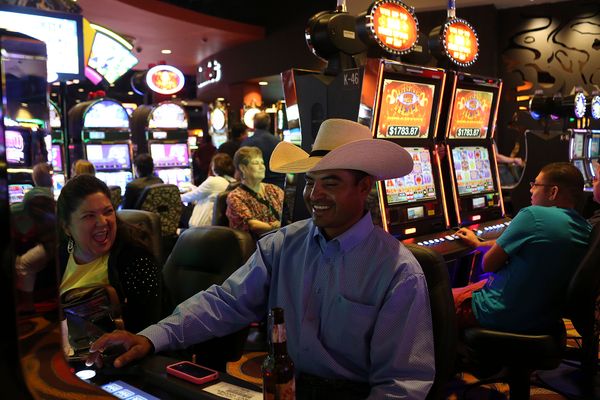
The Kickapoo Traditional Tribe of Texas, which operates the Lucky Eagle Casino in Eagle Pass, is a top employer in Maverick County that each year ranks among the poorest in Texas. The tribe employs more than 1,000 people at its casino, adjacent hotel and restaurants.
Visual by File Photo | San Antonio Express-News.
What Sands wants to build are casinos that feature Vegas-style games — blackjack, table poker, randomized slot machines — that can lure more gamblers and their dollars. Such a casino would be considered Class 3 if operated by a tribe under the federal rules.
Federal law limits tribes to Class 2 casinos unless the state in which they operate allows the equivalent of a Class 3 casino. In other words, if Texas lawmakers were to allow Sands or any other private interest to create a Vegas-style casino, the tribes would have a compelling legal argument to be granted a Class 3 designation.

High Stakes
North Texans are just several months away from learning just how much wealth a Las Vegas-style casino — where Class 3 games exist — could generate for the region. A yearlong study commissioned by a 33-member committee of city officials, developers and business people — including a member of the Choctaw Nation — is expected to serve as a basis for discussions at the legislative session beginning in January.
For comparison, the 87 tribal gaming establishments in the California region generated $12 billion in 2024, according to the National Indian Gaming Commission. Oklahoma tribes generated more than $6 billion in revenue in 2023, based on the most recent economic impact study of tribal nations in Oklahoma, a good portion of which comes from Dallas-Fort Worth visitors. The North Texas study could create even more pressure to move forward.
There are powerful forces that oppose gambling in general, much less any expansion.
Opponents worry families will be adversely affected by gambling, which has among the highest rates of suicide among addictive substances. Also, studies show gambling can increase the rate of divorce and alcoholism and create financial hardship.
State Sen. Bob Hall, R-Edgewood, who was among the first lawmakers to demand scrutiny of the Texas lottery in 2025, fears gambling will only hurt the most vulnerable.
“If you take a look at where the money is coming in from lottery sales,” Hall said, “there’s a tremendous difference in the amount of money coming from the poor communities.”
Other opponents fear the decision will come down to the vast economic impacts casinos can have on local, regional and state economies, rather than on the negative consequences for gamblers and their families.
Jonathan Covey, director of policy for Texas Values, a conservative nonprofit organization that opposes a gambling expansion in Texas, notes some states that have joined with tribal governments to share in revenues from casinos have faced deficits in their budgets. On the other hand, Texas boasted a $30 billion surplus in 2024.
“Not only do we not need the money,” Covey said, “but we’re economically the strongest state in the nation.”
A major component of the North Texas study to be shared with legislators in January is an exploration of how to mitigate the social ills of casinos, said Henry Bryan, director of state advocacy for the North Texas Commission, the organization that is sponsoring the impact study.
“We’re going to look at what are the risks (of casinos) and how much those might cost,” Bryan said, “the potential increase in crime, the potential educational downturns, and addiction certainly is a big part of it.”
Lt. Gov. Dan Patrick has steadfastly supported the prohibition of casino gambling in Texas for many of the same reasons. He did not respond to two calls and three emails requesting comment, which were placed with his offices in Austin.
Texas Gov. Greg Abbott did not respond to more than 10 phone calls and emails requesting comment, which were placed with his offices in Austin over several months beginning last spring. He also did not respond to written questions by email.
Abbott has indicated publicly he would be open to discussions for a casino resort, but hasn’t provided details for how that could happen.
The News reached out to tribal leaders, tribal judges and Indian gaming law experts in Louisiana, Michigan, Arizona, California, Oregon, Connecticut, North Dakota, Minnesota and Oklahoma. It spoke with lobbyists for tribes, commercial casinos and sports betting operators as well as gaming foes, including the Texas Baptists’ Christian Life Commission and Texas Values.
In North Texas, The News spoke with a handful of city managers and local elected officials. It also reached out to business groups that support economic development in the region.
Legislators on opposing sides of the casino debate also weighed in, as well as those who represent tribal constituencies.
The News also reached out – over many months – to various executives, as well as spokespersons with Sands. The company declined to comment.
Winning it all
Various scenarios could play out if Texas lawmakers agree to expand gambling and allow Class 3 casinos.
The state could reach an agreement with a commercial operator, such as Sands Corp., to provide licenses to build casinos in and near metro areas of the state. Bills have been presented in the Legislature to do just that, but all have failed. Some of those bills would require voters to pass a constitutional amendment to expand gaming.
The state could reach a similar agreement — called a compact — that gives the existing Texas tribes the authority to build more and larger casinos. The tribes are eager to negotiate such a deal, which would provide them with greater protection and the opportunity to expand.
No such talks have begun, but the discussions could lead to a bigger cut of tribal gaming revenue for the state and give Texas greater control over the number of casinos and what they offer.
In exchange, the tribes would likely seek exclusivity, much in the same way that it works in states such as California and Oklahoma.
None of the existing tribes’ casinos serve the Dallas-Fort Worth area, nor is it likely any of the three tribes, with tribal lands in remote areas, would open casinos in North Texas.
But the tribes of Oklahoma would be eager.
Currently, the closest Las Vegas-style casino is the WinStar World Casino and Hotel. Located 80 miles north of downtown Dallas on Interstate 35 just across the Red River, it is the world’s largest casino with over 10,000 slot machines.
And it is operated by the Chickasaw Nation of Oklahoma.
If Texas lawmakers chose to issue private casino licenses, outside tribes could compete, and some say nobody is better suited than the Oklahoma tribes, especially the Chickasaw and Choctaw.
The Choctaw Nation, in particular, considers North Texas an extension of its reservation, said Gary Batton, its chief. The tribe operates a casino 90 miles north of downtown Dallas in Durant.
“We’re more familiar with the Texas market than we are any other market,” Batton said. “We’ve been planning and been prepared for this for years.”
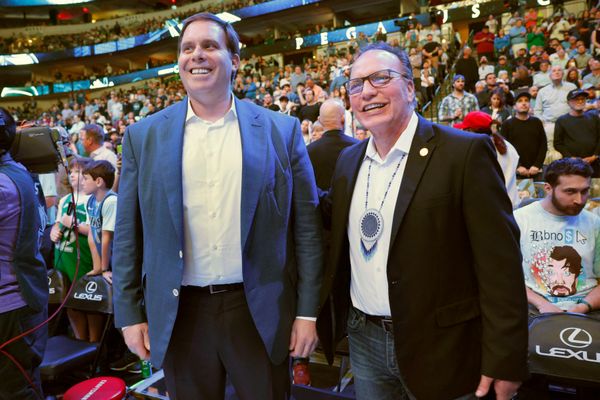
Patrick Dumont (left), chief operating officer of Sands Corp. and governor of the Mavs, and Gary Batton, chief of the Choctaw Nation of Oklahoma, stood courtside at the start of the game against Oklahoma City on March 1. Batton says the tribe considers North Texas an extension of its reservation.
Visual by Chitose Suzuki | Dallas Morning News.
Several additional Oklahoma tribes on the border with Texas are exploring work-arounds for how to enter the North Texas market, not as commercial license holders, but in the same manner as the three existing Texas tribes.
Under federal rules, the tribes would have to provide evidence to the federal government that their lands once existed in North Texas and then establish a reservation, upon which they could legally build a Class 2 casino.
One piece of evidence could come from a governmental process that has nothing to do with gaming. Federal law requires Texas to consult with tribes anytime the Texas Department of Transportation has a highway project that could disturb tribal remains or religious or cultural artifacts.
Many of the tribes TxDOT consults are in southwest-central and southeast Oklahoma, an acknowledgment of their Texas roots.
The Delaware Nation, which also operates casinos, is among those tribes that would be interested in trying to provide evidence of its presence in Texas over a century ago, president Michael McLane said.
“It would definitely be on the tribe’s radar,’’ McLane said. “We don’t want to enter into something that’s not going to be beneficial for both parties, the state and the tribe.”
In the 10 years that he’s been part of tribal leadership, McLane said his tribe has pursued two separate efforts to try to identify some of its ancestral lands in New Jersey and Illinois. Those discussions are part of a process, he said, that could take a year or as long as 12 years.
The Comanche, Kiowa, Tonkawa, Pawnee, Apache, Caddo, and Wichita and Affiliated tribes all have historical roots in North Texas. About 200 distinct Native American groups lived in Texas at the time of the European arrival, but not all are originally from Texas, said Tim Seiter, assistant professor of history at the University of Texas at Tyler, who specializes in colonial Texas with an emphasis on Spanish and Native American histories.
Any tribe from anywhere in the U.S. — including those tribes on the border with Texas — could open a gaming establishment in Texas by obtaining a state commercial license similar to what a commercial operator such as Sands Corp. would do. They would simply have to acquire the land in Texas.
That scenario has played out elsewhere. In Arkansas, the Quapaw Tribe of Oklahoma operates a Las Vegas-style casino under a license in Pine Bluff.
Neighbors
The specter of Sands raises the stakes for the tribes by not only creating a possible opportunity to expand but also because it introduces a potentially lethal competitor.
Sands has very publicly created a stake in North Texas and said in a recent prepared statement that it is “playing to win.” The company’s resolve is clearly visible in its donations to legislative races — even local mayoral campaigns.
Sands also owns a 100-acre parcel near the old Cowboys Stadium in Irving.
“There is nowhere else in the U.S. we would ever go,” Andy Abboud, senior vice president of government relations for Sands Corp., told the North Dallas Chamber of Commerce earlier this year.
Las Vegas Sands Corp. was founded in 1988 by Sheldon Adelson and his partners on the Las Vegas strip and has become the third-largest casino company in the world by revenue. In 2010, the company expanded to resorts in Asia, with several properties in Macau.
Sands isn’t the only interested party that has moved into Dallas-Fort Worth.
Hundreds of thousands of Rangers fans can’t help but notice that the old Ballpark at Arlington, home to the Texas Rangers until 2019, is now named after the Choctaw.
At Lake Texoma, the Choctaw is helping build a $6 billion mixed-use development in Denison. The project, which broke ground last year, includes 7,500 homes, a Margaritaville resort hotel, a 900-slip marina and retail dining.
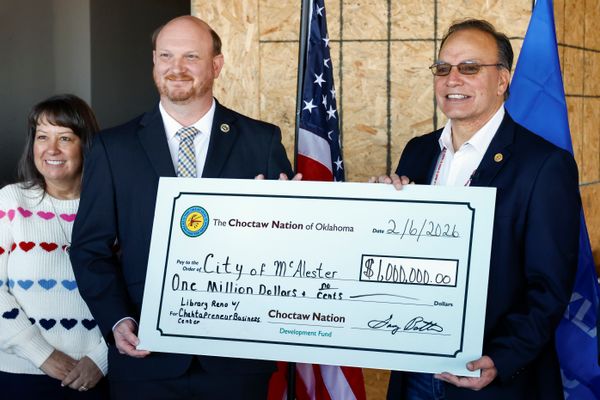
Gary Batton (right), chief of the Choctaw Nation of Oklahoma, presented a check for $1 million dollars to McAlester Mayor Justin Few in February for the renovation of the city library in McAlester, Okla.
Visual by Elías Valverde II | Dallas Morning News.
The Chickasaw Nation has a Dallas-based private equity firm, Pennington Creek Capital, that invests in non-gaming sectors such as aerospace and manufacturing.
It also already has a place for slot machines to live — Lone Star Park in Grand Prairie. Global Gaming Solutions, a subsidiary of the tribal nation, purchased the facility in 2011 after its owners faced bankruptcy.
Whether Sands or the Oklahoma tribes have the upper hand in this race to build Dallas’ first casino remains to be seen. The News spoke with a number of local officials, experts and lawmakers, but few were willing to wager. Or risk the wrath of being on the wrong side.
Three of the city managers who were willing to discuss the matter said they had a preference for tribes. The primary reason, they said, is because they had good experiences in working with tribal leaders when they served in similar positions in Oklahoma.
Tribes build relationships for the long term, said Troy Powell, city manager of The Colony, which is in Denton County, one of the fastest-growing counties in the nation.
“Our relationships are not a one-night stand,” and tribes understand this, Powell said, “because they have a good long history of forming strong partnerships with the communities they’re in.”
They reinvest a lot of money back into areas that see their developments, he said. So, for example, they will pay for the roads, the utilities and other infrastructure around multi-million dollar projects such as a casino resort.
Further, Powell said, “they have a good record of how they spend their money. You can trace back the improvements they’ve made in a community.”
The Colony is home to one of the area’s largest entertainment venues: Grandscape. The 433-acre development includes an immersive multi-story LED dome, indoor electric go-karts, a Tiger Woods-inspired golf course and more than 28 restaurants and shops.
Powell is open to discussions for one further amenity: a casino resort.
Judy Mahoney, a Tarrant County real estate broker, would be game for such a local place where she could do a little gambling and watch big-time performers.
“I’d definitely check it out,” she said.
Mahoney often visited WinStar, she said, until her career became too busy and she started working multiple jobs. She recalls taking home $200 playing slots on more than one occasion.
But what does she enjoy most? The restaurants, shops and entertainment.
She saw legendary rocker Rod Stewart perform several years ago. In fact, she might return to see him this month. Stewart is scheduled back at WinStar on April 24.
The last frontier
Ultimately, it’s not local officials who will decide whether such a casino resort comes to Dallas- Fort Worth. It’s lawmakers — and Sands has its supporters.
Bills supported by the company introduced during two consecutive legislative sessions would require the state to permit commercial casinos in metro areas throughout the state, including Houston, San Antonio, Dallas, Corpus Christi and Hidalgo County in south Texas.
The bills vary but make clear each casino operator would have to pay $1.25 million to $2.5 million in application fees for each license for one of seven or eight casino properties. Those casinos would have to feature a luxury hotel and an entertainment venue for concerts and recreational facilities. The developer also would have to commit to a minimum $2 billion investment and agree to provide 15% in gross gaming revenues to the state.
None of the bills made it out of committee, but more bills are expected to be presented when the Legislature convenes again in January. All sides say there is just too much money at stake for the push to not continue.
“My motive has been purely economics,’’ said state Sen. Carol Alvarado, D-Houston, who has authored various bills over the years to establish casino resorts.
The casinos would draw billions of dollars in economic impact to those regions. Lawmakers already have seen the impact the existing three casinos have had on their regions.
The establishments have plugged hundreds of millions of dollars into their local economies, drawing people who would never otherwise travel there and bringing thousands of jobs.
The Kickapoo Traditional Tribe of Texas is a top employer in Maverick County that each year ranks as among the poorest in Texas. Local economic development leaders credit an uptick in tax revenue and real estate development to the casino. State and local sales tax revenues have jumped $10 million to $15 million due to the casino’s impact on tourism, said Adislada Mendoza, interim economic development director for the city of Eagle Pass.
Casino expansion could make a significant financial contribution across the state. It also could have a devastating impact on the Texas tribes.
Most of the gamblers who visit tribal casinos today are from the Houston, San Antonio, Austin and El Paso areas. Alvarado’s bill would create commercial licenses in each of those metro areas, creating direct competition.
That’s why Alvarado’s bill — in addition to other gambling bills — requires the state to come to the table to negotiate a compact with Texas’ three tribes, Kickapoo, Alabama-Coushatta and the Ysleta del Sur.
“We would certainly invite that process to happen,” Alvarado said.
The state might not have a choice. Federal law protects tribes’ right to self-sufficiency — often achieved through gaming — from the actions of states. Allowing competing commercial gaming would be a consideration.
The remedy is to have the state negotiate with the affected tribes by reaching a compact that would, in some way, protect the tribes by perhaps allowing them to expand their casinos or limiting competition.
State Rep. Eddie Morales, D-Eagle Pass, wants to take it a step further. He wants the Kickapoo Traditional Tribe of Texas to have exclusive rights to the San Antonio market, where 75% of its customers reside.
“Somebody like Sands would just overpower these smaller Native American tribes,’’ Morales said.
Sands “is the big corporation,’’ said Nita Battise, vice-chairwoman of the Alabama-Coushatta Tribe of Texas. “They have the money. They have the backing. They have the international market as well.
“Texas is the last frontier. Sands can quadruple anything and everything. But they need to work with the tribes.”
If a commercial casino were allowed in Dallas-Fort Worth, it could have a similarly negative effect on the Oklahoma tribes.
It would have an impact, said Morgan, the special envoy for the Chickasaw Nation who is also chairman of the Oklahoma Indian Gaming Association, which represents 28 of the state’s tribes that operate 142 gaming facilities.
“The reality is that it’s coming,’’ said Batton, chief of the Choctaw Nation, “and we have to be ready for it.
“Texas will have to embrace it. We just want to be a part of it as it comes. We’re not going to push it. We don’t believe in pushing our values on other people, but as it happens, we think we would be a great partner and we want to be part of it.”
If Sands is viewed as a competitor, there are signs it’s a cautiously cordial competition.
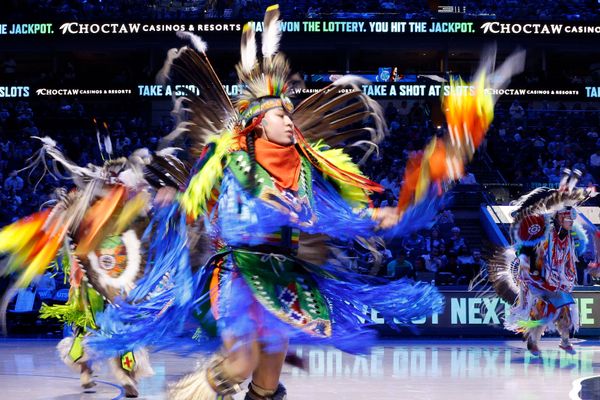
The Dallas Mavericks hosted Native American Night on March 1, featuring Choctaw Nation dancers performing during halftime at the game against the Oklahoma City Thunder at American Airlines Center. Above the dancers are words beckoning visitors to the casino, 90 miles north of downtown Dallas in Durant.
Visual by Chitose Suzuki | Dallas Morning News.
The Dallas Mavericks recently hosted a Native American Night. At courtside, Batton stood alongside Patrick Dumont, chief operating officer of Sands Corp. and governor of the Mavs, while Choctaw dancers performed on the court at halftime.
A sign above the dancers beckoned fans to consider another entertainment opportunity — a visit to the Choctaw Casino and Resort.