
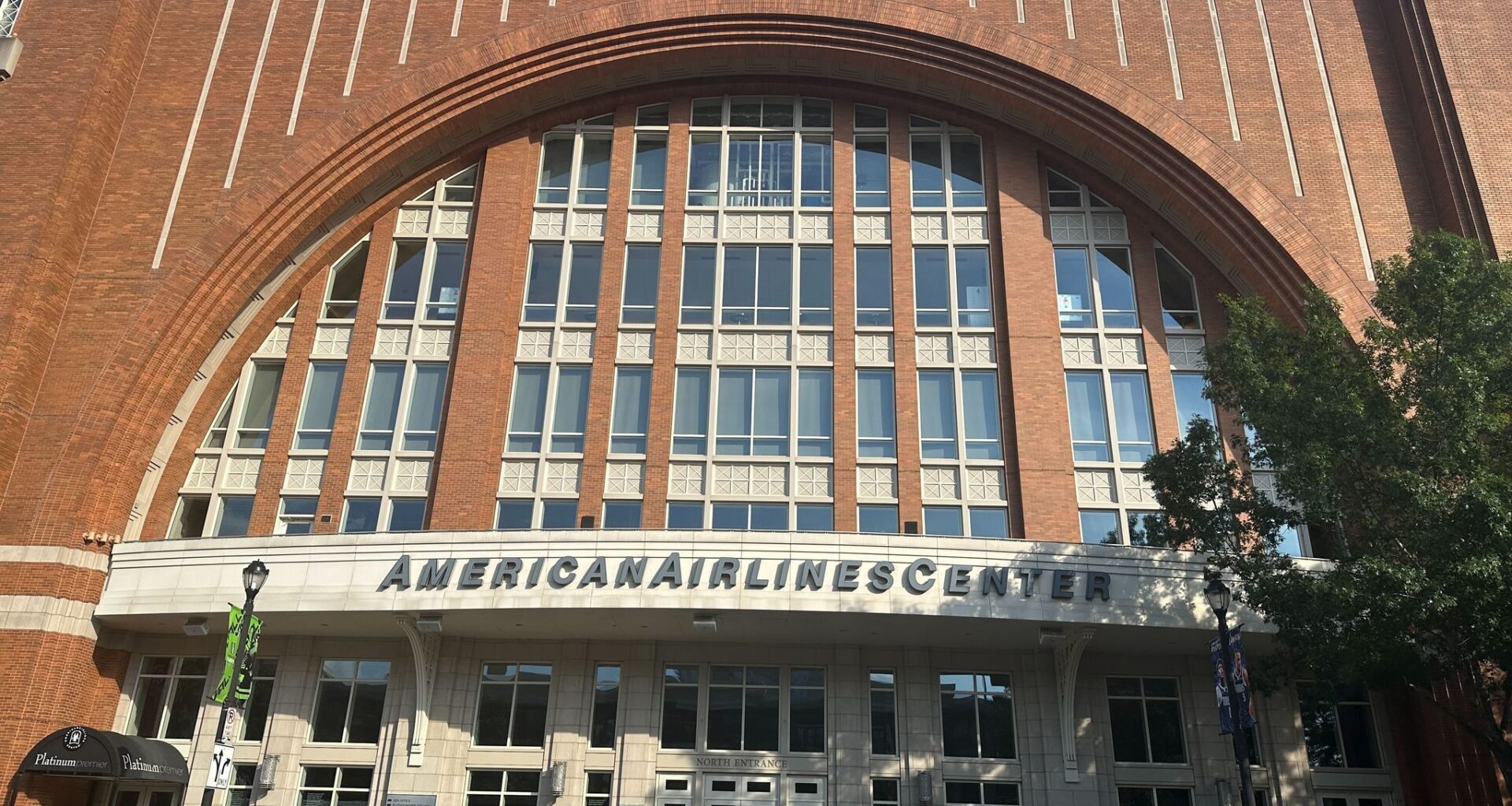
Dallas Stars fans congregate May 29, 2024 outside American Airlines Center before watching Game 4 of the Western Conference Finals. The Stars are playing the Edmonton Oilers in Canada, but fans gathered at the team’s home stadium for a watch party.
Civic vision is a hard thing to come by, even when your first responders’ pension fund was never in jeopardy and your City Hall passes inspection and your potholes are all filled. Think how hard it must be when none of the above is true, critics are howling, developers muscling in, and the mayor’s left it all in your lap.

Not only that, but you’ve got until July before the Mavs let you in on the site of their next home, a decision with ripple effects for decades on end.
Article continues below this ad
For instance, think what Dallas’ downtown would look like if in the early ’90s the Rangers had built their new home next to the Farmers Market instead of in Arlington.
Consider a little history: Back in the early ’90s, when the Rangers were shopping local precincts to build the club a new stadium, it was my job to keep up with the comings and goings. One day a local developer invited me and David Dillon, The News’ eminent architecture critic, to look at plans he’d commissioned for a Farmers Market site.
As I recall, the unique blueprint came complete with a riverwalk of sorts encircling the stadium. Dillon, who forged a formidable reputation before his untimely death in 2010, explained to the developer where the plans were at odds with the region’s history and why it didn’t work aesthetically. I respected David, and I wanted him to respect me, so I didn’t tell him that I kind of liked the idea of a stadium with a moat.
Make Dallas News a preferred source so your search results prioritize writing by actual people, not AI.
Add Preferred Source
Anyway, the idea of Dallas as home to the Rangers never got any legs for a couple of reasons. For one thing, the Rangers never really intended to leave Arlington, as Tom Schieffer, the man in charge of building the Ballpark in Arlington, told me recently.
Article continues below this ad
“We told Arlington officials, ‘If we can make a deal with you, we’ll make a deal,'” he said.
“‘It’s yours to lose.'”
Tom Schieffer sits in his chair at his desk in front of home plate at the Ballpark in Arlington, Texas, on June 22, 2000.
David Woo, staff photographer
Schieffer, who knew a little about politics as a former state representative, visited Dallas’ mayor, Annette Strauss, who told him she was “very interested.” Bob Bolen, Fort Worth’s mayor, wasn’t. Told Schieffer the Rangers ought to remain in Arlington after all the work Tom Vandergriff did procuring a big league team for the area in the first place.
Article continues below this ad
Schieffer visited officials in Frisco and Irving and didn’t find any takers. The mood in Dallas was only slightly elevated. Officials may have gotten the idea that Schieffer, a proud Fort Worth native, wasn’t really serious about moving the club 20 minutes further east.
Whatever the case, no city wanted the Rangers as much as Arlington did. Vandergriff, a county judge, and Richard Greene, Arlington’s mayor, made their aspirations clear when Schieffer invited them to a Saturday morning meeting. Schieffer had visited ballparks across the nation and compiled a list of 18 negotiating points on a new stadium.
The two sides talked for an hour before Vandergriff and Greene told Schieffer they were good on 17.
“To tell you the truth,” Schieffer told me, “I don’t even remember what the 18th point was, but I told them, ‘If you’re prepared, we’re prepared.’”
Article continues below this ad
Arlington’s city council and the Rangers’ multiple partners agreed, and that was that. No fuss, no muss. Ray Davis’ deal with Arlington to build the Globe across the street was made even quicker. Of course, we were used to it. Jerry Jones had already made a perfunctory pass at Fair Park, and when Laura Miller blinked, he bolted for Arlington, too.
Now, you can make the case that it was easier for Arlington to win stadium deals because it had 147 acres and the access, and it didn’t have as many factions to please. Hard to beat that upside. But, as I wrote at the time, there was no one banging a drum for Dallas like Vandergriff and Greene did for Arlington. They weren’t about to lose. A moot point, really, because no one in Dallas was up for a hard fight.
No one made it hard for Schieffer, anyway.
“So we built it,” he said, “and we enjoyed it and think it was a win-win for everybody.”
Article continues below this ad
Arlington – and the area around its stadiums, in particular – has changed greatly in the decades since. The entertainment district long delayed has finally come to fruition. When the Rangers hosted the All-Star Game in 1995, most of the visitors stayed in Dallas or Fort Worth. When it came back two years ago, they holed up in Arlington.
Schieffer, 78, retired after a long public and private career that included stints as ambassador to Australia as well as Japan, has no idea what’s next for Dallas in its latest dealings with a pro sports team. Like everyone else, he assumes the Adelsons want to build a casino. He knows the Mavs have reportedly narrowed their search to downtown and the old Valley View site on 635. Everything else remains a mystery.
But this much he knows: The U.S. Census projects that, at the turn of the century, Dallas-Fort Worth will be the largest metro area in the nation. Greater Houston and the Austin area will be second and third.
“When I say that,” he said, laughing a little, “I can’t get my arms around it. That’s bigger than New York City, Los Angeles and Chicago.
“Now the question is, how do you plan for it?”
Article continues below this ad
Planning around stadiums and arenas is controversial because of arguments over the economic impact. Public sentiment also runs against anything done to benefit billionaires. Schieffer argues that you have to look past that to see the benefit to the city. Pretty clear what the Rangers have done for Arlington. Same for American Airlines Center, built on what was once a contaminated dump site.
“People had to see down the road and what’s possible and what can come out of something,” Schieffer said, “and that’s a hard thing for people to see.”
He hopes someone in Dallas has that vision now.

By signing up, you agree to our Terms Of Use and acknowledge that your information will be used as described in our Privacy Policy.
“I wish ‘em well,” he said. “I want ’em to do what’s best for the area. I don’t want ’em to make a mistake, because it’ll mean a lot to the city.”
Article continues below this ad
This much I know: It’d have been fun the last 30 years to leave the office and walk a few blocks to the stadium instead of fighting the traffic. Check out restaurants and nightlife springing up in its wake. Look out from the pressbox and take in a Dallas skyline. And if it was the only stadium in baseball with its very own moat, so much the better.
Twitter/X: @KSherringtonDMN