
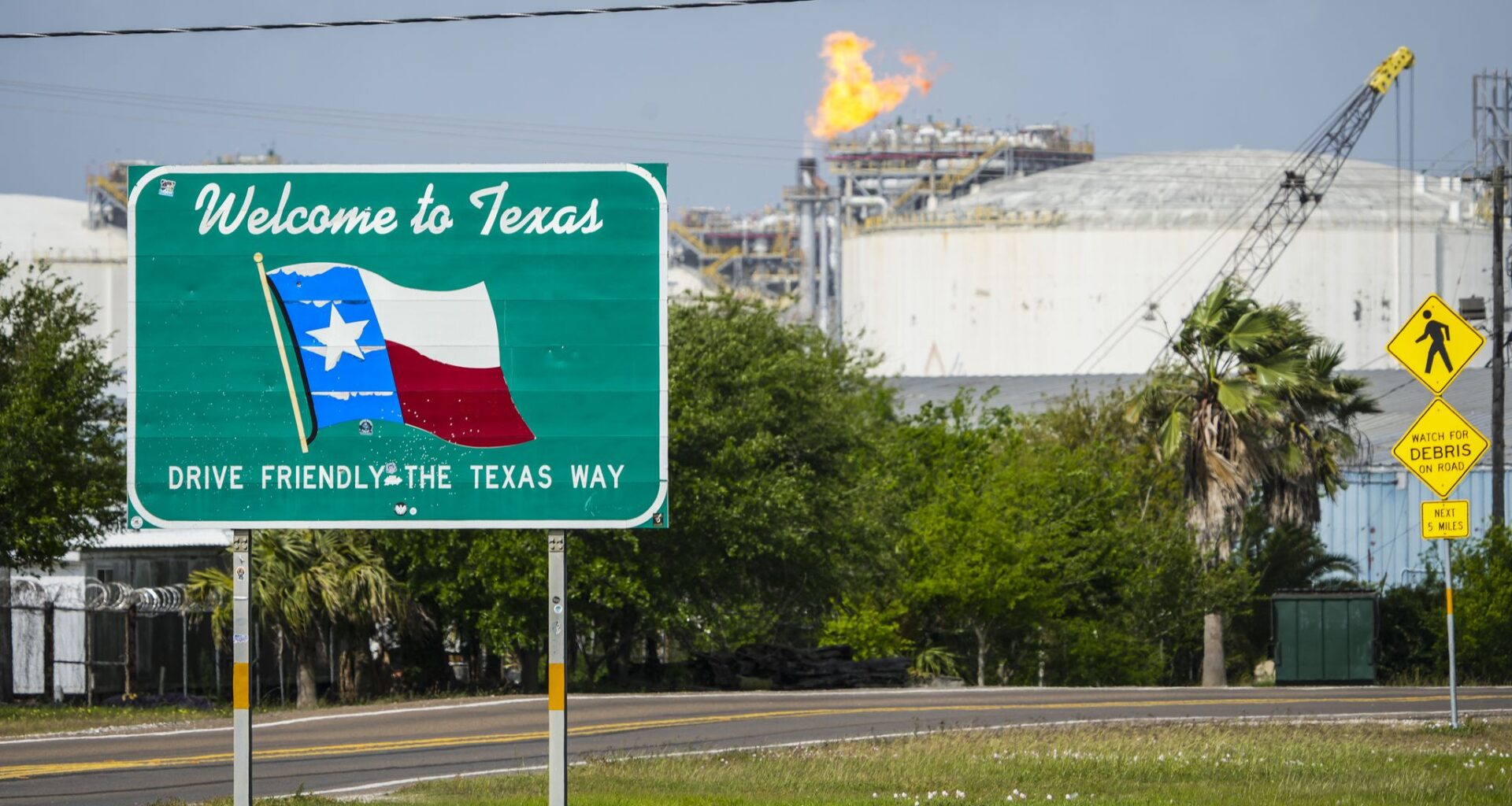
Exxon and QatarEnergy’s new Golden Pass LNG facility is shown near the Texas state border in Port Arthur, Thursday, April 2, 2026.
Brett Coomer/Houston Chronicle
A graphic showing spikes of earthquake activity by the Texas and Louisiana border.
Katherine Oung/Houston Chronicle
Drilling and natural fracking wells in the Haynesville shale in East Texas lead by Exxon Mobil and XO Energy on Tuesday, July 19, 2016.
Elizabeth Conley/Staff photographer
A record-breaking earthquake rattled western Louisiana last month, drawing attention from Texas researchers and geologists.
Scientists suspect the 4.9-magnitude temblor in the Haynesville shale formation — a natural gas-rich area that straddles East Texas and Louisiana — was triggered by oil and gas operations.
The cause of the quake, believed to be the largest in Louisiana history, remains under investigation by the U.S. Geological Survey and the Department of Energy and Natural Resources. USGS researchers attributed a series of earlier near-border earthquakes in the area to fracking and associated wastewater disposal.
Article continues below this ad
LNG DOMINANCE: New East Texas LNG facility is launching at ‘the right time’ as Iran war reshapes global gas markets
The earthquakes are a destabilizing force for the Haynesville shale area, where production has increased in recent years as liquefied natural gas export facilities proliferated along the Gulf Coast.
President Donald Trump has deepened interest in the area by making American LNG a cornerstone of his “energy dominance” plans. And Haynesville rig counts have nearly doubled over the last year.
Article continues below this ad
The worsening earthquakes have puzzled researchers and scientists — even those well-versed in the science of oilfield tremors. Seismicity in the Haynesville formation is not as well studied as in the Permian Basin, where years of research established a link between a rash of earthquakes and the disposal of oilfield wastewater.
“Nobody’s done a lot of studying in that area, because there just hasn’t been a lot of historic seismicity,” said Laura Capper, principal of the consulting firm EnergyMakers Advisory Group and a director of the Produced Water Society. “It’s probably kind of new for even people that know what they’re doing.”
Without more research, determining the cause is a guessing game, Capper said. Her best guess: Natural gas extraction is triggering the subsurface trembling.
“I’d say production could be as much of the culprit as anything else, just years of producing and removing fluids, and maybe it’s settling,” she said.
Article continues below this ad
TEXAS EARTHQUAKES: Inside the fight over what — and who — is causing earthquakes near Texas oilfields
Rob Skoumal, a USGS seismologist who is researching the high-magnitude earthquake that occurred March 5 in the Coushatta area of Louisiana, said similar clusters of quakes in the region “were induced by a mix of wastewater disposal and hydraulic fracturing.”
Skoumal said the agency deployed additional monitors in the area to help it investigate the underlying trend.
“Determining whether an individual earthquake is induced by human activities and, if so, its cause, requires a detailed scientific investigation,” Skoumal said in a statement. “Working together with local collaborators, the USGS has deployed additional instruments in the area that would aid that future scientific investigation.”
Wastewater disposal “immediately jumps to mind” as a possible cause, given the long history of disposal-related earthquakes in West Texas and elsewhere, said Patrick Courreges, a spokesman for the Louisiana Department of Energy and Natural Resources. But researchers have not found “a clear-cut connection.”
Article continues below this ad
“Our scientific staff and field agents have been following up on these earthquakes with investigation and site visits to gather data such as injection volumes, nearby faults and pathways that could provide a possible link,” Louisiana’s Conservation and Energy Secretary Dustin Davidson said in a statement. “Several factors must align for us to determine the causation, as we know these earthquakes could have originated from miles away and at different depths from an injection site.”
Paul Britt, a longtime East Texas geologist, said wastewater disposal operations likely triggered the earthquake. But validating that with any scientific certainty would take time and effort he hasn’t spent.
“That turns into a pretty big research project,” he said.