
TEHRAN, Iran., April 8, 2026: Late yesterday the Trump administration and Iranian Supreme Leader, Mojtaba Khamenei, agreed to a two-week ceasefire to allow time to negotiate the of hostilities. Israel has agreed to stop its bombing campaign in Iran during the ceasefire but says that it will continue to fight Hezbollah in Lebanon. This morning Hezbollah announced it will halt its attacks. The pause in fighting came hours before the Trump administration’s deadline for Iran to reopen the Strait of Hormuz if it wanted to avoid American attacks that would lead to Iran’s “civilization will die.”

The ceasefire and continued negotiations are being facilitated by the Pakistani government. The Chinese government encouraged the Iranians to seek “an offramp” in the war.
The Trump administration said that Iran has agreed to reopen the Strait of Hormuz as a condition of the ceasefire. The Iranian government said that passage through the Strait of Hormuz “would be allowed under Iranian military management.”
The first signs of a ceasefire emerged yesterday at around 7:00 in the evening when Pakistani Prime Minister, Shehbaz Sharif, announced on social media that the U.S. and Iran had “agreed to an immediate ceasefire including Lebanon and elsewhere, EFFECTIVE IMMEDIATELY.”
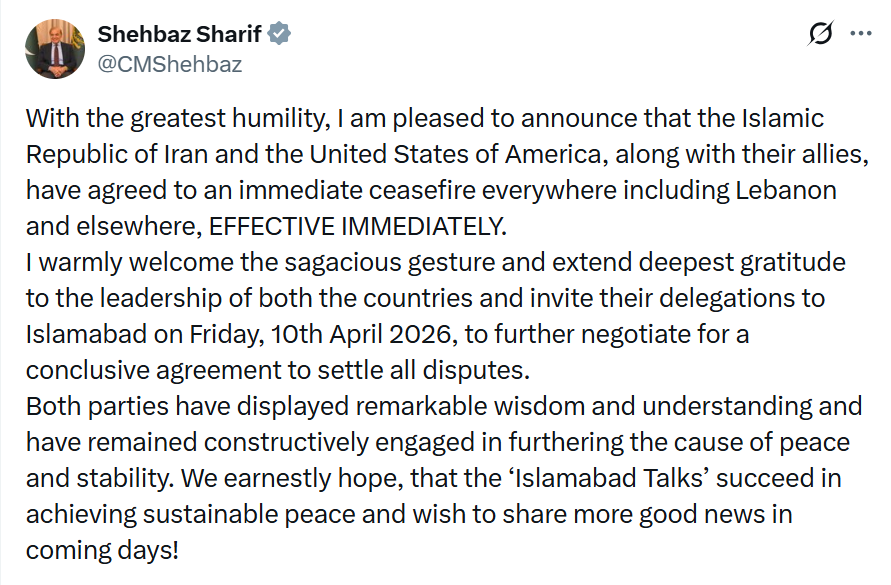 Screen grab of Pakistani Prime Minister Shehbaz Sharif post to his official X account on April 7, 2026, Martín Paredes/El Paso Herald Post
The Trump administration followed with its own social media post stating that the U.S. agreed to the ceasefire if Iran agreed “to the COMPLETE, IMMEDIATE, and SAFE OPENING of the Strait of Hormuz.” The administration added that the U.S. received a 10 point proposal from Iran, adding that the U.S. government believes “it is a workable basis on which to negotiate.”
Pakistan is set to host the Islamabad Talks peace negotiations in Islamabad starting on Friday, according to Shehbaz’s post.
Although Sharif’s social media post said that the ceasefire included Lebanon, Israeli officials said that they will continue their military operations against Hezbollah in Lebanon.
Iran’s Ten Point Plan
Iran’s ten-point plan, as released by the Iranian government, calling for end to the war includes the lifting of all sanctions against Iran. It also includes the withdrawal of the U.S. military from the Middle East, as well an end to attacks against Iran from the U.S. and its allies. Iran’s plan also calls for the release of Iran’s frozen assets and a United Nations (UN) resolution binding any deal the countries agree to.
An important point in Iran’s plan, which the U.S. government has said is a “workable basis” for a solution includes the requirement that Iran continues to have “control of the Strait of Hormuz.”
The Trump administration previously rejected many of the points in Iran’s 10-point peace plan.
The Strait of Hormuz
Since the U.S. and Israel began bombing Iran on February 28, the Strait of Hormuz has largely been closed to marine traffic by Iranian military forces. As a result, oil prices have spiked leading to high gasoline prices for American consumers and economic problems for countries in Asia and the Middle East after around 20% of oil was stranded in the Persian Gulf.
The rising oil prices led the Trump administration to relax oil sanctions on Russia and allowed Iranian tankers to deliver oil to China, India and other countries unimpeded.
Iran exported around 2 million barrels of oil per day in February, making it one of the highest exports since 2018, even as the U.S. and Isreal bombed Iran.
Although not officially outlined in the peace negotiations, there are indications that the peace plan may include a fee of up to $2 million for each vessel allowed to transit the Strait of Hormuz to be collected by Iran and Oman. The proposed fee would be used by Iran for reconstruction purposes. Reports suggest that Iran has been collecting the $2 million fee to allow some vessels to transit the Strait in recent weeks.
Traffic in the Strait of Hormuz this morning remains stopped with oil and cargo vessels congregating around Larak Island and west of the Strait. Iran has used Larak Island as a “toll booth” to collect around $2 million from vessels that want to transit the Strait and to inspect the vessels before allowing them through in recent weeks.
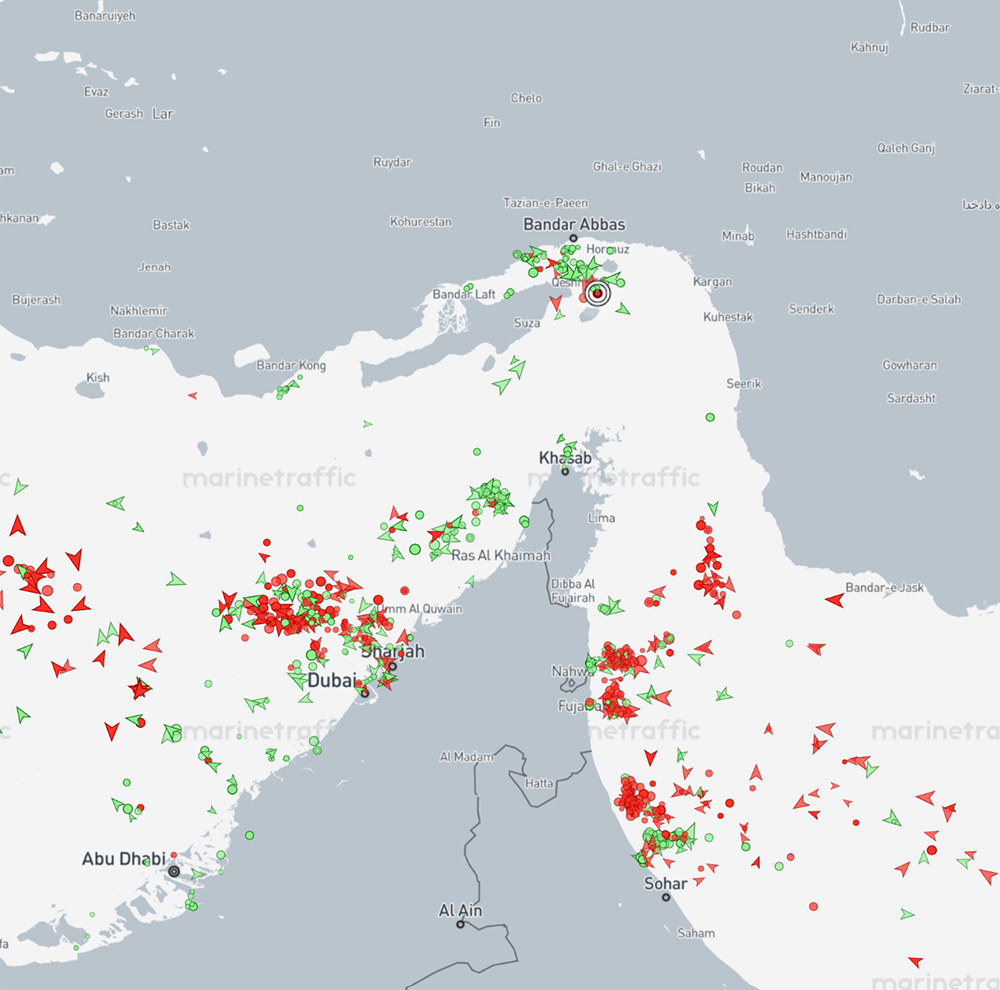 Screen grab from Marine Traffic showing Strait of Hormuz shipping, April 8, 2026, at 13:54 UTC, tankers in red and cargo vessels in green, Martín Paredes/El Paso Herald Post
It is not yet known whether the Iranian government is congregating vessels at Larak as part of its plan to “manage” the opening of the Strait of Hormuz as part of the ceasefire, and whether it will continue to collect fees for allowing ships through.
Both the U.S. and Iranian government have hailed the ceasefire as a victory.
Like Us and Follow Us On Our Social Media!
Visited 4 times, 4 visit(s) today