
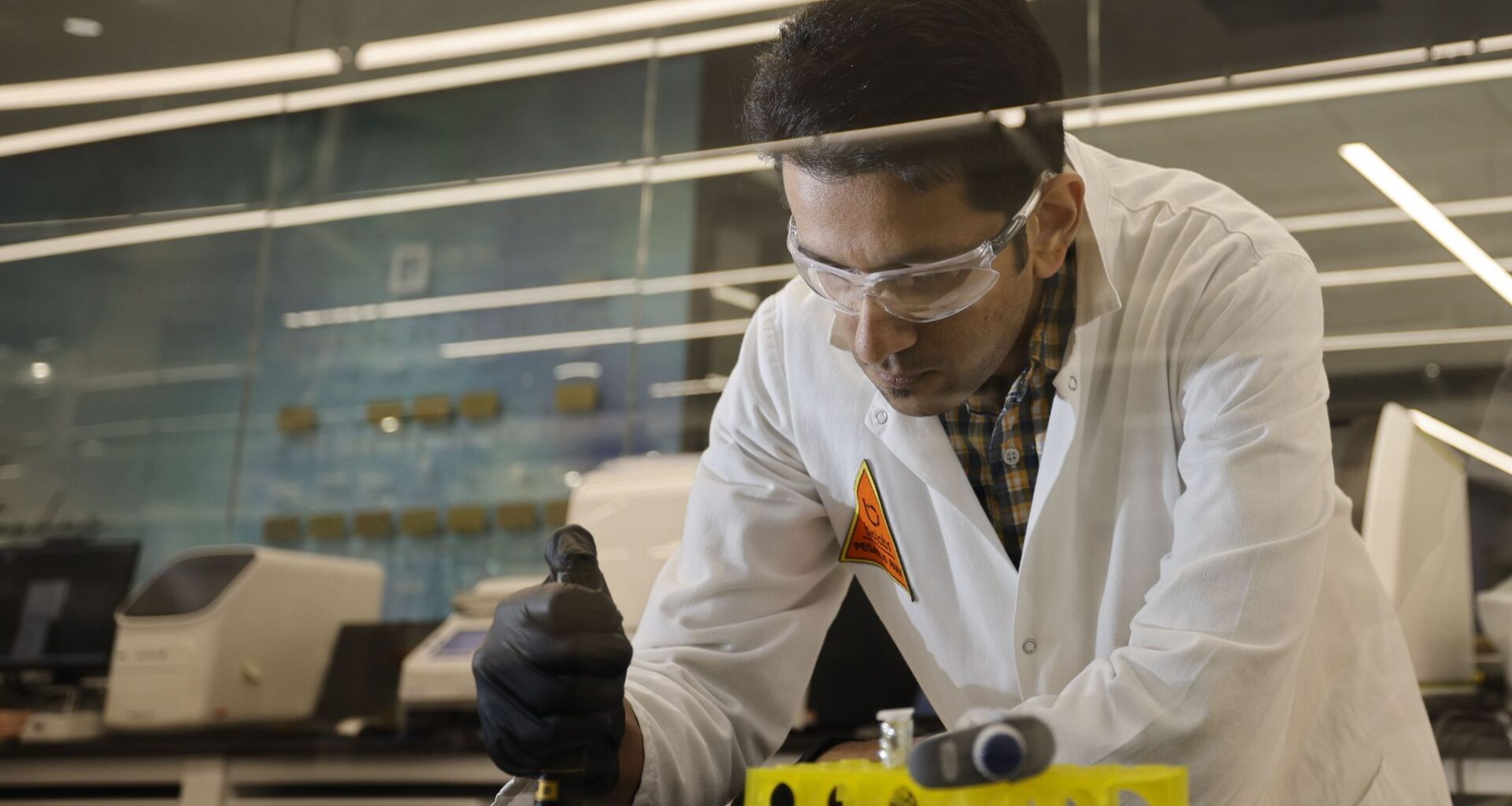
Husain Kagalwala, chief technology officer of BioLum Sciences, works in BioLabs’ shared lab space in Dallas. Texas now ranks among the top states in bioscience investment, with North Texas playing a central role, writes Thomas Graham.
Chitose Suzuki/Staff Photographer
Just over three years ago, Texas did something few thought possible.
In securing a national investment from the newly launched federal Advanced Research Projects Agency for Health, or ARPA-H, our state outmaneuvered competitors not just with assets, but with something far more rare: alignment. As The Dallas Morning News reported at the time, Texas “licked partisan politics and regional rivalries” to land one of the most coveted bioscience hubs in the country, which now calls Pegasus Park home.
Article continues below this ad
That moment should not be viewed as an exception. It should be understood as a model.
Earlier this month, at the Texas Healthcare & Bioscience Institute Life Sciences Summit in Austin, the state’s rising stature as a biosciences powerhouse was on full display. And notably, Dallas continues to lead the way.
When asked to highlight recent developments in the Dallas economic development landscape, the Dallas Regional Chamber’s Kelly Cloud paused and responded with a telling question: “How much time do I have?”
Make Dallas News a preferred source so your search results prioritize writing by actual people, not AI.
Add Preferred Source
It was not a throwaway line. It was a reflection of momentum.
Article continues below this ad
From advanced pharmaceutical logistics and cold-chain infrastructure to major expansions from global companies and a deep bench of research institutions, North Texas has become one of the most dynamic life sciences markets in the country. According to the latest statewide data, Texas now ranks among the top states in bioscience investment, with North Texas playing a central role in that rise.
But what stood out most in Austin was not any single announcement or statistic. It was the tone of the conversation.
Across Houston, Dallas, Austin and San Antonio, there was a clear recognition that Texas wins when it acts as one.
“We compete, but we also collaborate,” Cloud said, noting that major projects like Eli Lilly’s $6.5 billion investment were pursued by multiple regions but ultimately represent a win for the entire state.
Article continues below this ad
That spirit was echoed by Craig Rhodes of the Greater Houston Partnership, who described Texas’ approach as something closer to “co-opetition” — a balance of healthy competition paired with intentional collaboration to win against other states, not each other.
That distinction matters.
The competition is not Dallas versus Houston or Austin versus San Antonio. And while we have for some time framed the economic development race as Texas versus California, it is more likely that the United States wins when we, as a state and nation, collaborate in pursuit of medical, bioscience and healthcare breakthroughs.
And increasingly, Texas is leading that charge.
Article continues below this ad
The ingredients are there: world-class medical institutions, a growing venture capital ecosystem, unmatched population growth and a workforce pipeline that is being built — deliberately — to meet the needs of advanced manufacturing, therapeutics and emerging technologies like AI-driven medicine.
But sustaining that momentum will require continued discipline.
It means continuing to invest in proven models like the Cancer Prevention and Research Institute of Texas and advancing new initiatives like the Dementia Prevention and Research Institute of Texas. It means strengthening workforce partnerships between universities, community colleges and industry. And it means continuing to show up — as we did with ARPA-H — as a unified state.
Perhaps most importantly, it means telling the story better.
Article continues below this ad
As several panelists noted, perception still lags reality. Texas is no longer an emerging player in biosciences. It is a national leader. But leadership must be reinforced through consistency, collaboration and clarity of purpose.
The lesson of ARPA-H was simple. When Texas aligns its people, its policy and its priorities, it can compete with anyone in the world.
The opportunity now is to make that the rule, not the exception.
By signing up, you agree to our Terms Of Use and acknowledge that your information will be used as described in our Privacy Policy.
The future of biosciences in Texas is not just promising. It is already here.
Article continues below this ad
And if we continue to work together, it will be even stronger tomorrow.
Thomas Graham is the CEO of Crosswind Media & Public Relations. He facilitated a discussion with economic development leaders from Texas’s major cities during the recent Texas Healthcare & Bioscience Institute Life Sciences Summit.