
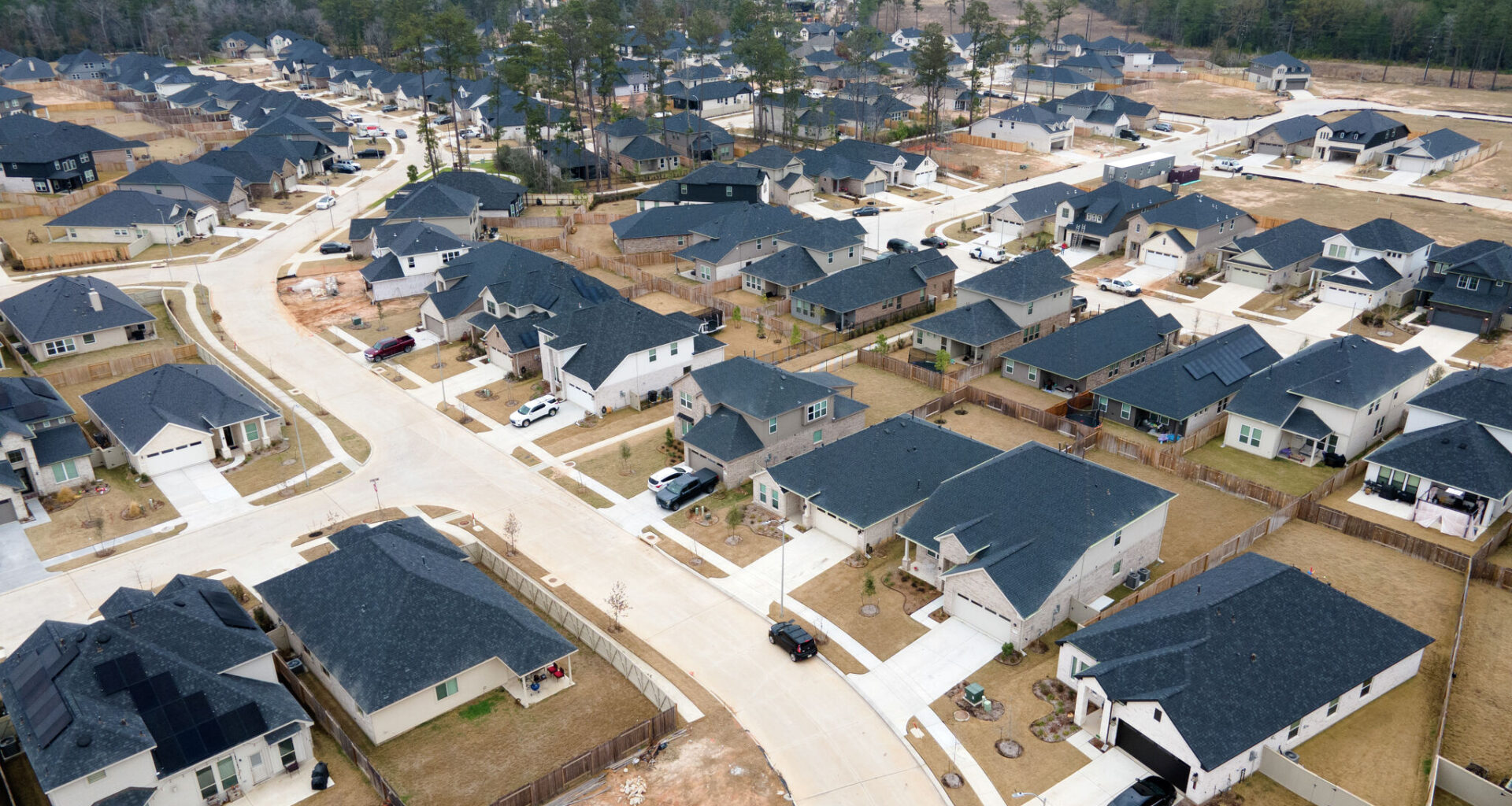
Homes in the Audubon subdivision are seen in January 2023 in Magnolia. Construction was underway for more than 200 homes in a Magnolia community that was expected to have nearly 5,000 homes at completion.
Jason Fochtman/Staff photographer
For years, the Houston area’s growth as a region has been defined by the continued expansion of its suburbs, which consistently rank among the fastest-growing areas in the country.
That continued to hold true last year. Waller County’s population increased by 5.7% — the second-highest rate in America. Montgomery and Fort Bend counties were both in the top 10 for raw population growth.
Yet even Houston’s booming suburbs weren’t completely immune to national trends that caused sluggish growth or outright population declines in 80% of American counties that had grown the previous year.
Article continues below this ad
Houston’s suburbs are still growing, but not at their usual pace.
SLOWING GROWTH: Texas led U.S. in population growth in 2025, but gains slowed amid Trump immigration crackdown
The latest census figures illustrate the difficulty of predicting Houston’s future amid a historic immigration crackdown and fewer domestic movers from elsewhere in the country. Whether the Houston area can withstand external forces that are hindering growth in other major cities across the country will define the region’s direction for years to come.
“The post-pandemic years were this period of high growth that wasn’t going to be sustained, so this is bringing us closer to our pattern before the pandemic,” said Holly Heard, senior vice president of research at the Greater Houston Partnership. “So this might be considered coming back down to earth, but if you’re comparing the Houston metro to other metros in the rest of the country, we’re still ahead of the game.”
Article continues below this ad
Suburbs’ shifting trends
Apart from Waller County, every county in the greater Houston area grew less in 2025 than in 2024, as fewer people moved to the region from both the rest of the country and the rest of the world.
“We saw a pretty dramatic decline in international migration,” said Texas Demographer Lloyd Potter. “And domestic migration didn’t really pick up either to address the balance.”
Compared with the city of Houston, the suburbs will likely be somewhat insulated from further declines in international migration caused by President Donald Trump’s immigration crackdown. Last year, immigration accounted for just 19% of suburban Houston’s population gains, whereas in Harris County, immigration was the primary driver of growth.
The suburbs, traditionally, have been more reliant on domestic migration — or the movement of people within the United States. But data shows that domestic migration has been gradually declining for several years as well, not just to the Houston area but to Texas as a whole.
Article continues below this ad
The greater Houston area, encompassing both Harris and suburban counties, netted just over 7,000 residents from domestic migration last year, a drop of nearly 83% from its gains in 2023. Some experts don’t expect it to significantly increase anytime soon.
“Domestic migration is down across the country for a number of reasons,” said Pia Orrenius, a labor economist and vice president of the Federal Reserve Bank of Dallas. “We’re getting to really low levels of domestic migration … so I don’t see that it would pick up.”
Greater Houston is still drawing more movers than every metropolitan area except for Phoenix, Dallas and Minneapolis. The Chicago metro, for example, lost over 33,000 people to domestic migration. New York and Los Angeles both lost more than 100,000.
Domestic migration to Houston has historically been linked to job growth, which is down across the country, according to researchers at the Greater Houston Partnership. Colin Baker, manager of economic research at the partnership, noted that domestic migration to the region dipped into the negatives during the fracking bust of the mid-2010s, but recovered within a few years.
Article continues below this ad
MORE COVERAGE: Texas demographics map shows which counties had the most population growth in 2025
“It’s not unusual to see lower rates of domestic migration when you have that low rate of job creation, since so many people move here to work,” Baker said. “We think that whenever national economic conditions improve, we’ll be in a really strong position to see those domestic numbers bounce back.”
Men build houses Thursday, Nov. 21, 2024, near the Cross Creek West subdivision near Fulshear.
Jon Shapley/Staff photographer
Harris County’s uncertain future
Harris County, which has grappled with negative domestic migration every year for the past decade, cannot count on an influx of movers to boost its population gains anytime soon. The county is entirely reliant on international immigration and childbirths to balance the losses of thousands of residents every year.
Article continues below this ad
Last year, immigration to Harris County declined by 40,000 people, and the county’s overall growth was less than half of what it was in 2024. Despite the slowdown, Harris County led the nation in raw population growth.
Other major metropolitan counties, including Dallas County and historic immigrant strongholds such as Miami-Dade and Los Angeles counties, saw their overall populations decline.
“We’ve talked about that trend of people moving out to the suburbs, but really Houston stands out in that the central area is continuing to grow at a healthier pace than what we see elsewhere,” Baker said.
LOCAL FOCUS: Houston, Harris County led U.S. population growth, but gains slowed amid Trump immigration crackdown
Questions remain, however, about how long the urban core will continue growing in the short term, given the restrictions on new immigrants coming into the country under the Trump administration.
“Houston has been the number one destination during the surge in migration between 2021 and 2024, so that’s what really pushed the numbers up,” Orrenius said. “But that’s also what’s going to make Houston vulnerable to this decline in international migration, because that’s what’s going to fall away.”