
Alex Hartley has been playing and working as a musician for years, but he’s never been quite sure whether there was a manageable way for him to get paid for it.
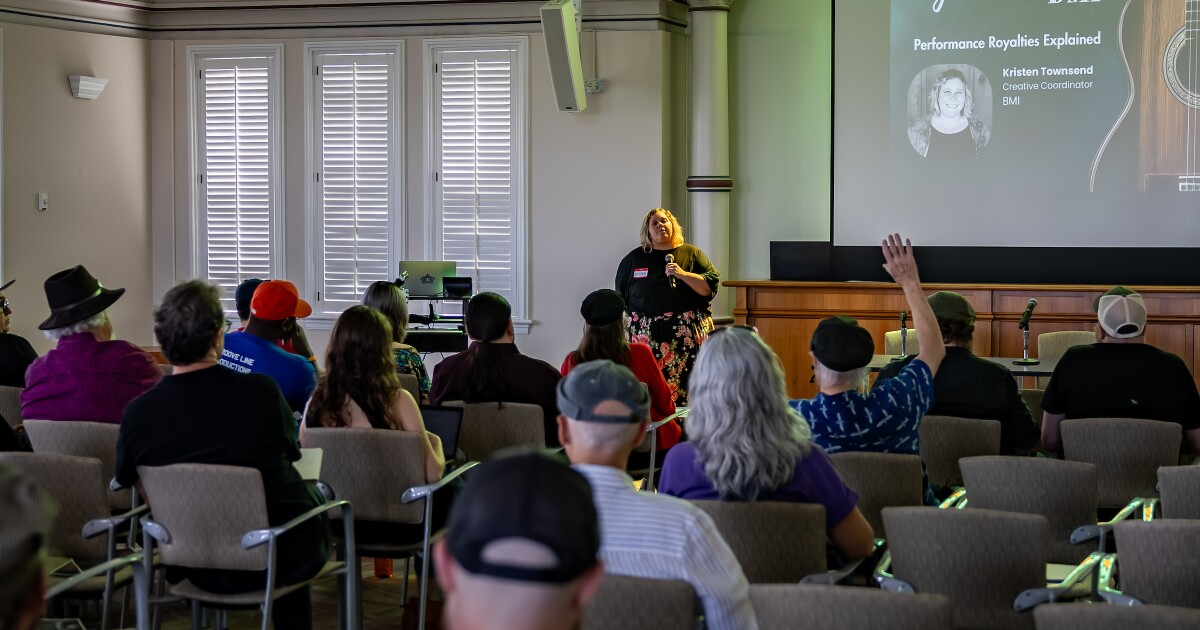
That frustrating “How can I?” quandary was answered somewhat at a recent crash course held at St. Edward’s University. The free class focused on royalties, publishing and the tangled web of organizations that track and distribute music income for live performances and recorded works.
By the end of the session, Hartley had a list of accounts to create and systems to learn.
“I’ll be on the computer tonight,” said the piano player and songwriter who released an album last year. He hadn’t yet signed up with professional organizations that can help him receive royalties for his music.
“It’s gonna be nice if I register and find some money there that is waiting,” he said.
“It’s a very complicated system in the United States. When you write a song and record it, you have to register it in multiple places to make sure you’re collecting everything you’re owed.”
Pat Buchta, executive director of Austin Texas Musicians
Hartley’s experience is hardly unusual for many of the thousands of working musicians in Austin who spend years focused on writing songs and performing without fully understanding how to get paid beyond a gig fee or streaming payout.
The modern music economy relies on a patchwork of systems that track different types of income, from live performance royalties to the “mechanical rights” money that is paid for digital streams and other uses of recorded music. Accessing that money often requires artists to register their work across multiple organizations, each responsible for a different slice of revenue.
For musicians who are primarily focused on creating and performing, those administrative steps can be easy to overlook, delay or avoid altogether.
That gap is what Austin Texas Musicians, a local advocacy group, is trying to address through a new series of free master classes developed in partnership with St. Edward’s University.
“It’s a very complicated system in the United States,” said Pat Buchta, executive director of Austin Texas Musicians, who helped set up the sessions with university staff. “When you write a song and record it, you have to register it in multiple places to make sure you’re collecting everything you’re owed.”
That registration can be with performance rights organizations, digital distributors and licensing groups. Even for experienced musicians, Buchta said, the process can be difficult to navigate.
“I’ve been doing this stuff for years now, and I still don’t fully understand all of it,” he said, adding that many artists are likely missing out on income they’ve already earned.
The kickoff class Hartley attended, which featured an audience of about 40 people, was the first of four sessions this year, each focused on a different aspect of the music business. Representatives of the BMI performance rights organization, which has an office in Austin, and The MLC mechanical licensing organization gave lessons and tips on royalties.
Michael Minasi
/
KUT News
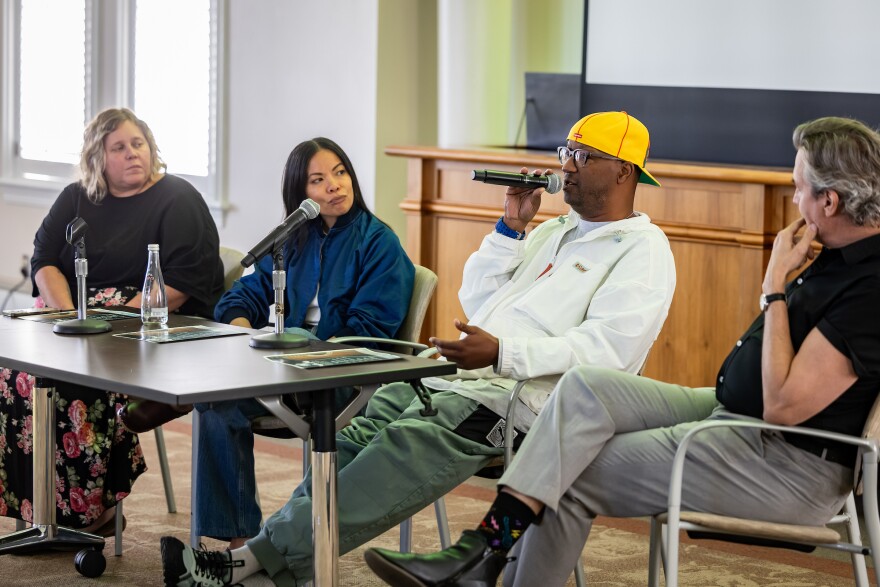
Kristen Townsend, Jamie Dominguez, Terrany “Tee Double” Johnson and Pat Buchta lead a discussion on collecting royalties from music.
Future sessions are expected to cover topics such as entertainment law, sync licensing of music for film and television, and marketing, which collectively are areas organizers say are as critical to building a sustainable career as writing and performing.
The partnership is part of a broader effort for the university to connect its academic resources with Austin’s working creative community.
Collin Gillenwater, director of partnerships and professional studies for St. Ed’s, said the idea grew out of a push to build more real-world collaborations that reflect the city’s identity and economic landscape. After connecting with Austin Texas Musicians through a mutual contact, Gillenwater said it became clear education could play a role in addressing gaps in how artists navigate the industry.
“As long as education is a solution for some type of opportunity, that’s where the university can step in,” he said.
While music programs at institutions like the University of Texas and Austin Community College offer technical training in performance and production, Gillenwater said, the partnership is designed to focus more directly on the business side of a musician’s career.
“What’s not happening is kind of this holistic approach to support the artist entrepreneur,” he said, listing off crucial business skills such as managing finances, understanding contracts, building professional networks and making strategic decisions about how and where to release music.
The master class series is being treated as a pilot, with organizers using the initial sessions to test both content and format before expanding into a longer-term program. That could eventually include a low-cost, certificate-style offering combining online coursework, in-person instruction and small-group coaching.
Michael Minasi
/
KUT News
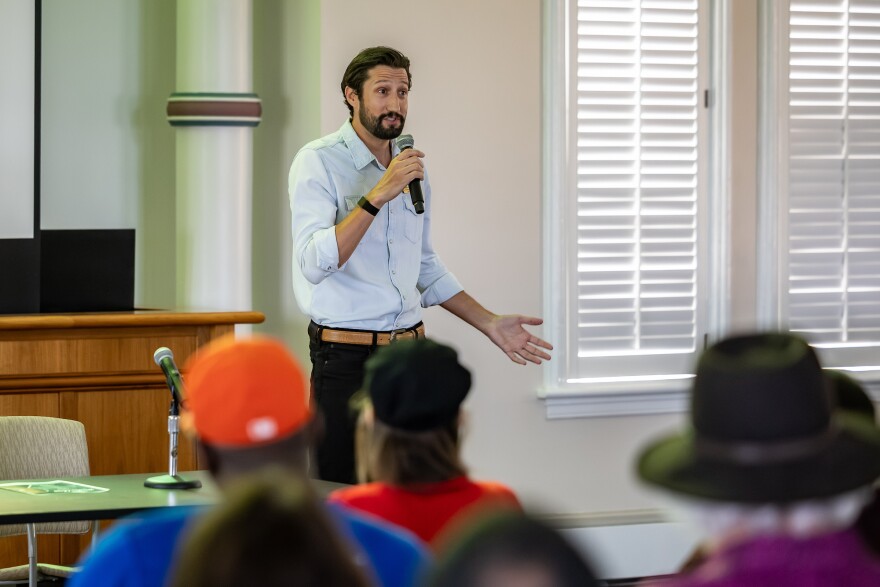
Collin Gillenwater, director of partnerships at St. Edward’s University, said organizers will adapt the pilot sessions as they learn what’s most useful.
Unlike courses in traditional degree programs, the free classes are open to the public and designed to accommodate musicians at different stages of their careers, from students to midcareer artists looking to better understand the business side of their work.
“We don’t know what we don’t know,” Gillenwater said. “We want to build something that can adapt as we learn what’s most useful.”
For Buchta, the effort is part of a larger attempt to help musicians navigate an industry that has become increasingly difficult to sustain a career in. Performance pay rates, he said, have remained largely stagnant for decades, while streaming has reshaped how artists earn income from recorded music.
That combination has made it more important for musicians to understand and access every available revenue stream, even if doing so requires navigating a complex and sometimes opaque system.
After the first session, that complexity was still evident for some attendees.
Kevin Jones, a live sound engineer who is looking to expand into recording and releasing his own music, said the session helped clarify some of the basics, but also underscored how much there is to learn.
“A lot of it is still a bit over my head,” he said, adding that his years as an engineer have brought him more consistent pay than he’d likely command as a just-starting-out performer. “I have the music. This is the part I need to learn… to build the system so it makes sense when I’m ready to release it.”