
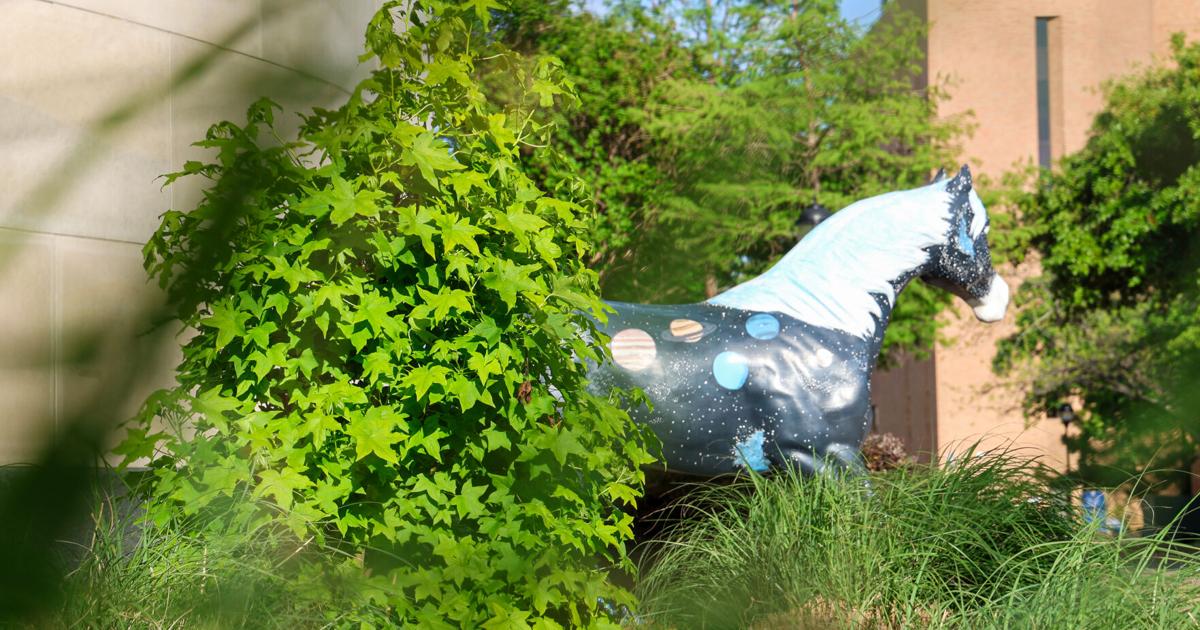

A sweetgum sapling peers through bushes near the entrance of the UTA Planetarium. UTA was one of 50 institutions across the country to receive a tree from the first batch of seedlings.
On April 1, the Artemis II Orion spacecraft launched for the first crewed lunar flyby in over 50 years; meanwhile, the success of Artemis I remains on the ground at UTA in front of the Planetarium.
UTA’s moon tree was part of the research conducted on Artemis I, allowing the university to take part in the Artemis legacy.
In November 2022, Artemis I completed a successful unmanned lunar orbit mission. The mission marked the first integrated flight test of the Orion spacecraft and Space Launch System rocket, which logged more than 270,000 miles before returning to Earth, according to previous Shorthorn reporting.
UTA received one of the sweetgum seedlings aboard the Artemis I craft after NASA opened up applications for educational institutions to apply to be moon tree custodians, Planetarium coordinator McKenna Dowd said.
“It’s quite literally a living artifact of space exploration,” she said. “As a seed, it was one of many of thousands that went into space on the Artemis I Orion spacecraft that went a similar path that the astronauts are now on.”
These seedlings can provide insight on how zero gravity and radiation in space affect seed germination, she said. The seedlings have also led to outreach between universities.
Artemis II is the second mission in NASA’s Artemis program to lead to space exploration to the moon and beyond, said Julio Benavides, mechanical and aerospace engineering professor of instruction.
The biggest goal of the Artemis II mission, Benavides said, is to ensure the Space Launch System, along with the Orion crew exploration vehicle where the astronauts live, functions properly.
Graduate teaching assistant Thomas Ledford said this mission is meant to demonstrate that the U.S. can still to go to the moon and show the effort NASA puts toward technology development and research on launch vehicles and rocketry.
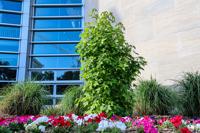
A sweetgum sapling sits outside the Chemistry and Physics Building. The plant was launched as a seedling on the Artemis I lunar mission in 2022.
“This is not the first time that any launch has been done going to the moon,” he said. “It’s meant to demonstrate that we still obviously have the capability, just as was done in the 60s and 70s.”
While it is unknown if UTA will receive a sapling from Artemis II, Dowd said she is curious to see what happens.
“We may not all go to the moon, but we have a very tangible representation of that here on campus, which is incredible,” she said.
The tree stands at over 50 inches and grows, on average, an inch a month, Dowd said.
“Knowing we have a physical living piece of science that is directly related to Artemis, I think, is really inspiring,” she said. “We are literally watching history unfold before our eyes.”
The four Artemis II astronauts, Reid Wiseman, Victor Glover, Christina Koch and Jeremy Hansen, are set to return Friday.
Following Artemis II, NASA plans to have two more missions, in 2027 and 2028. According to their website, Artemis III will test rendezvous and docking capabilities between Orion and the spacecraft that will land on the moon.
Artemis IV will establish a presence on the moon. Two crew members will spend a week on the surface near the South Pole of the moon, conducting observations and collecting samples and data before making the return trip back to Earth.
“We have to take gradual steps,” Ledford said. “Going to the moon, building a base is what gives us a foothold in outer space, which we’re not there yet.”
@atclements03