
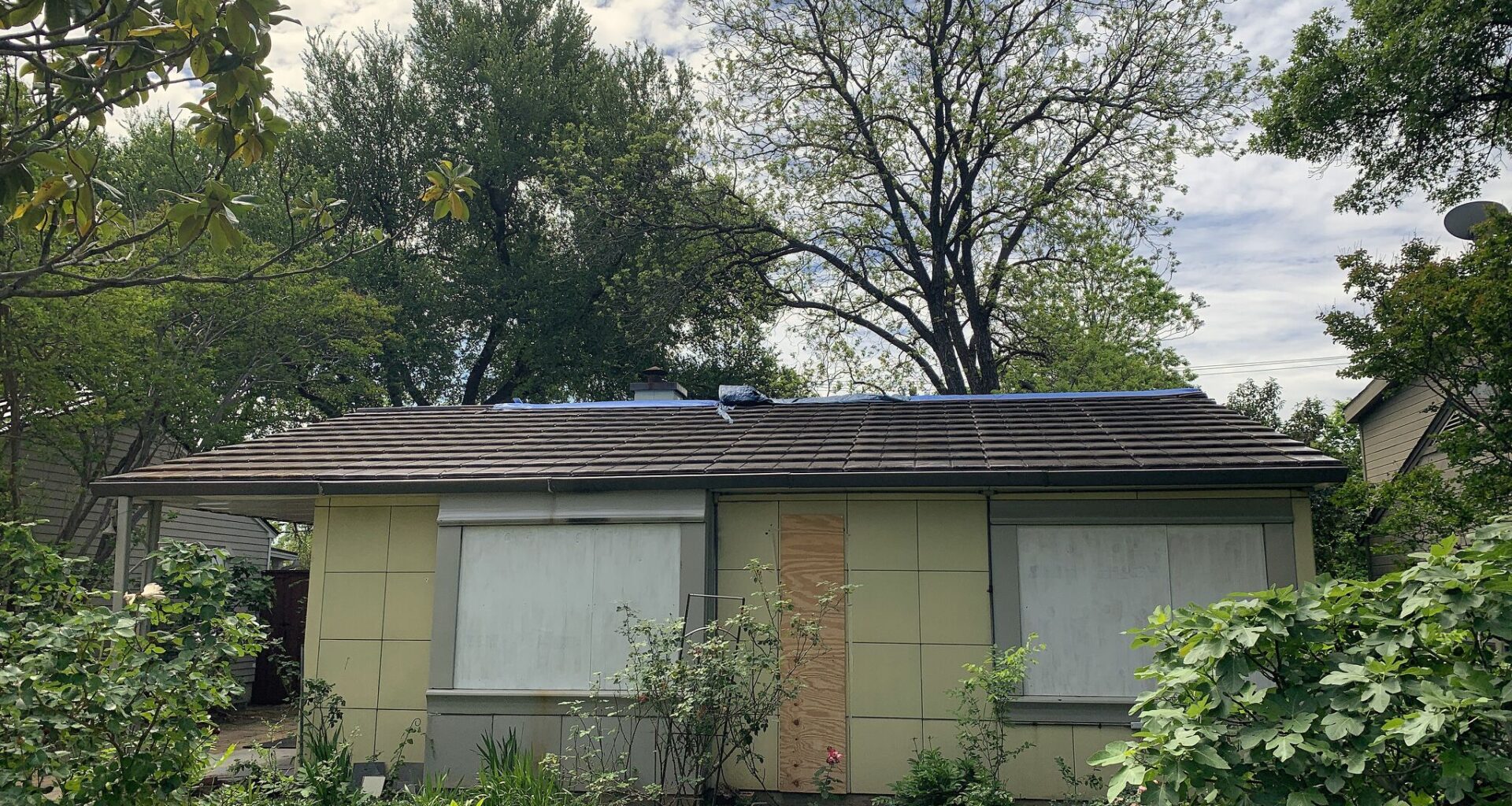
Sooner than later, this tiny prefabricated steel house on West Amherst Avenue — made by the Lustron Corp. and snapped together in 1949 — will become a Dallas landmark, likely the city’s smallest.
Robert Wilonsky/Staff writer
The fire in June likely would have claimed any other home, especially one so small – 1,040 square feet, to be precise. If the flames hadn’t devoured it, the firefighters most assuredly would have destroyed it entering through windows and attacking through the roof. Yet the house on Amherst Avenue still stands, its stark interior scorched, yes, but its maize-yellow exterior little altered save for windows filled with white-painted plywood and a roofline adorned with strips of blue tarpaulin.
“The only damage,” preservation architect Ron Siebler said a few weeks ago, “was caused by firefighters just doing their job.”
Article continues below this ad
I met Siebler at Dallas City Hall on the first Monday of March, the day the City Council’s Economic Development Committee took public comment on the billion-dollar price tag placed upon the salvation of I.M. Pei’s building. Siebler was there on behalf of the house he’s about to begin repairing; there also to show his support for a building in jeopardy of demolition.
City Council chambers were stuffed that afternoon; it would have been standing-room-only if such a thing were allowed. Lined up behind the open mic were former council members and ex-appointees decrying the rush to flee City Hall, relocation experts and business owners scoffing at inflated costs, regular citizens angry about even the possibility of razing The People’s House so a billionaire could build a basketball arena.
At the very same time, around the corner, in the smaller, far emptier briefing room on City Hall’s sixth floor, the Landmark Commission was meeting. On its agenda was that little house on Amherst spared from last summer’s conflagration because it’s made of metal. Entirely of metal, too, from its exterior siding to its window sills to its kitchen cabinets and bedroom vanity.
A fire last year scorched the interior of the Luston House on West Amherst Avenue. It should be easy enough to clean. That was the point of making a house out of steel, after all.
Robert Wilonsky/Staff writer
The Lustron House is so named for the long-defunct Ohio-based manufacturer that, from 1948 to 1950, offered inexpensive, (relatively) easily assembled homes made from prefabricated porcelain-enameled steel sheets. Of the tens of thousands promised to post-warriors in need of fast, affordable housing, fewer 2,500 were ever made, according to the website Lustron Research, with an estimated 1,500 having endured. Of those, only a handful still stand in Texas, most in El Paso. There’s just the one in Dallas, around the corner from the restaurant José on Lovers Lane.
Article continues below this ad
Make Dallas News a preferred source so your search results prioritize writing by actual people, not AI.
Add Preferred Source
Built in 1949 for a mere $9,741, according to old newspaper accounts, that sole survivor is now bound to become a Dallas landmark, making it nearly impossible to raze. It will likely be the smallest historic landmark in town.
Dallas Central Appraisal District records show it to be owned by a revocable trust. But here’s a secret: The house was last purchased in October 1988 by philanthropist Margaret McDermott, whose name remained on the deed until April 2008. Mary McDermott Cook said this week her mother bought it for Rosie Mendoza, who worked for Margaret for more than 40 years. It has remained in the Mendoza family ever since.
“It was – it is – an amazing little house,” said Cook.
Article continues below this ad
In his request, made at Cook’s urging, former Preservation Dallas executive director and current Landmark commissioner David Preziosi hailed the house as “a rare remaining example of manufactured housing from the 1940s [that’s] certainly worthy of consideration for landmarking.” With little discussion, his fellow commissioners unanimously agreed.
Afterward, I said to Siebler that it must have been odd to have come to City Hall to protect this tiny metal house on the very day the council was beginning its debate about the possible end of the mammoth concrete public house on Marilla Street. He said he’d just been looking out at downtown through the giant windows in City Hall’s Flag Room, outside council chambers. He said that “we have lost our desire to be awed,” by things both great and small.
The Lustron House stands as our local testament to Chicago industrialist Carl Strandlund’s dream of making homes easy to afford and even easier to build following World War II. There are some 50 Lustron homes on the National Register of Historical Places; there’s also an oft-cited book devoted to the study of the “postwar prefabricated housing experiment.” Even its name has a ring of antiquated magic about it: Lustron, short for “luster on steel.”
Article continues below this ad
“It’s extremely unique,” said Siebler, whom I first met years ago, shortly after he’d reconstructed the World War II-era German boxcar on display at the Dallas Holocaust and Human Rights Museum.
“I was not even aware that type of house existed, though it makes perfect sense given the housing demand following World War II,” Siebler said. “It’s a combination of IKEA and an Erector set, a house screwed and bolted together.”
There were supposed to be tens of thousands of houses across the country like this Lustron home in Dallas. But in the end, only a few thousand were made. And even fewer survive today.
Robert Wilonsky/Staff writer
Which took about two weeks, give or take, using the Lustron Corp.’s 207-page “erection manual” as a guide.
Article continues below this ad
Locals first heard of the Lustron House on March 27, 1949, when The Dallas Morning News ran a story about its construction beneath the headline, “First All-Steel Prefab House Being Erected Here.” The piece advertised the house on Amherst as a “demonstrator” that could be built within five days, complete with built-in bookshelves, a dishwasher and a hot-water heater.
The story promised tens of thousands more just like it for under $10,000 (around $130,000 today). Deep Ellum-based Vilay Co., co-owned by the Vilbig family for whom the West Dallas street is named, was offering “almost immediate delivery” on the “fireproof, ratproof, termite-proof and decay-proof” homes.
On May 1, 1949, a front-page Dallas Morning News story heralded: “All-Steel House Open to Visitors,” from 1 to 8 p.m. every day. It cost the curious a quarter to enter, with all the money going to the Disabled American Veterans. In the same edition, Ford Radio in Oak Cliff took out an ad touting that it had furnished all the Frigidaire appliances that filled “the home America has been waiting for” at 5006 W. Amherst.
America would have to keep waiting: By 1950 Lustron was bankrupt, despite having received $37 million from the federal government. By June of 1950, this paper was running stories about how taxpayers had helped “subsidize” Sen. Joe McCarthy, who’d taken $10,000 from Lustron to write a 7,000-word booklet on housing.
Article continues below this ad
When the Lustron House was built in 1949, everything inside was made of steel, including the sinks, vanities and bookshelves. A fire last year damaged the house. But it couldn’t destroy it.
Robert Wilonsky/Staff writer
The Lustron House’s owners have been few: first, Disabled American Veterans national executive committee member P. Dale Jackson, according to a 1958 letter to the editor of the Dallas Times Herald; then, I Love Flowers owner Ed Malinoski, who told the Herald in 1987 that his renovations included scrubbing off “layers of yellowing from cigarette smoke on the light gray steel-paneled walls.”
By signing up, you agree to our Terms Of Use and acknowledge that your information will be used as described in our Privacy Policy.
Malinoski eventually sold it to McDermott, but he always regretted it. “I wish I had it back,” the florist told David Dillon, then this newspaper’s architecture critic, in 1989. Dillon compared the house to the works of Frank Lloyd Wright and Buckminster Fuller, and noted that “it looks as good today as when it came off the truck 40 years ago.”
Article continues below this ad
The same can’t be said of the house today — not yet, anyway. Siebler has begun restoring the window frames damaged by the firefighters, and will soon start work on replacing the roof panels. He’s just waiting on city permits to begin rewiring the house and installing new heating, air conditioning and plumbing.
Sometime after that, the Lustron House will become a Dallas landmark. Which means that tiny prefabricated steel house on Amherst may well outlive the brutalist colossus on Marilla. What a time to be alive.