
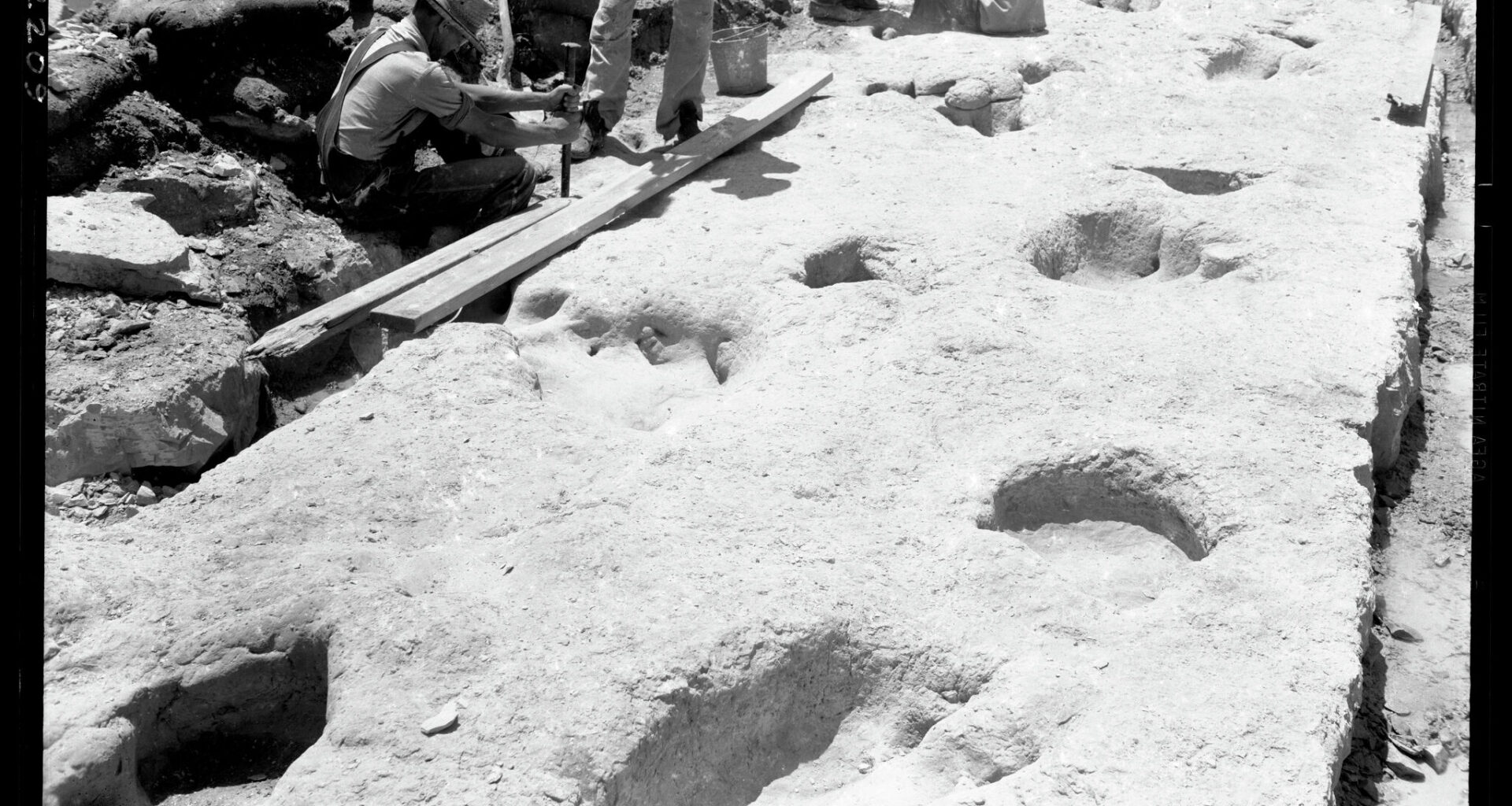
Workers excavate incredibly rare dinosaur tracks from the Paluxy River near Glen Rose, Texas, during the 1930s.
American Museum of Natural History
Upgrading a Texas paleontology treasure, Austin philanthropists Sarah and Ernest Butler have given $5 million to build a new home for the famed Paluxy River dinosaur tracks at the Texas Museum of Science and Natural History.

The 113-million-year-old dinosaur trackways were discovered near Glen Rose, Texas, during the 1930s.
Article continues below this ad
In thanks for the gift, the University of Texas museum will name the new structure the Sarah and Ernest Butler Dinosaur Trackways Building. It will house the conserved fossils and create a new visitor experience on the grounds just north of the museum.
Thursday night, the couple was saluted in the museum’s soaring atrium by about 100 museum followers as designs for the new building were unveiled.
“We’ve watched the footprints over the years and knew they were threatened,” Sarah Butler said. She and her family helped pay for the initial conservation survey that guided what would happen to the fossils.
The project will preserve and showcase the fossilized footprints of a massive sauropod dinosaur and a theropod predator that were preserved in limestone along the Paluxy River — 160 miles north of Austin — during the early Cretaceous period. The trackways represent one of the most significant dinosaur footprint discoveries in North America.
Article continues below this ad
“This project represents a once-in-a-generation opportunity to safeguard one of Texas’ most iconic fossil discoveries,” said Carolyn Connerat, the museum’s managing director, who announced that fundraising will continue for the $10 million project. “With the Butlers’ support, we will preserve these remarkable fossils while creating new ways for visitors, students and researchers to engage with Texas’ deep natural history.”
What exactly are the dinosaur tracks?
Paleontologist Roland T. Bird first identified the trackways in the 1930s, at a time when Texans felt the state’s scientific and cultural artifacts were being to sent to distant cultural capitals. He oversaw the removal of two large limestone slabs containing the tracks. One slab was sent to the American Museum of Natural History in New York, while the other was brought to Austin through a Work Projects Administration effort and installed at UT’s Texas Memorial Museum, today known as the Texas Science & Natural History Museum.
According to museum materials, the sauropod trackway preserved across the slabs includes fore- and hind-foot impressions scientifically described as brontopodus birdi, named in Bird’s honor. These fossils remain designated reference specimens for this type of dinosaur footprint and continue to play an important role in paleontological research.
Article continues below this ad
A scientific and cultural museum back in business
An artist’s render of the new Sarah and Ernest Butler Dinosaur Trackways Building to be built at the Texas Museum of Science and Natural History.
Texas Museum of Science and Natural History
Right-sized when it was built as part of the 1936 Texas Centennial, what was formerly known as the Texas Memorial Museum became a hidden retreat on campus during the late 20th century. From 1940 to 2013, the Texas slabs of tracks were housed in a small stone building adjacent to the museum, approximately where the new structure will go.
Schoolchildren continued to arrive in buses to see the exhibits, but many UT students and visitors had no idea how the art deco building functioned. It seemed that the Texas Memorial Museum was a musty afterthought on the burgeoning UT campus.
Article continues below this ad
“It was like a mausoleum before they redid it,” said backer Rita Kreisle. “Before they took down those dark curtains and let the light in.”
After Statesman editorial columnist Bridget Grumet campaigned during the early years of this decade for a brighter museum future, the Texas Legislature and the university devoted $8 million to give it a complete facelift and new marching orders.
In 2023, it reopened to rapturous reviews as the Texas Museum of Science and Natural History. Swimming with light and enhanced with improved exhibits, the museum has returned to the forefront of Austin’s cultural and educational consciousness.
Since it reopened, it has attracted more than 200,000 visitors a year, up from 38,000 the year before it closed.
Article continues below this ad
What will happen to the tracks?
The Sarah and Ernest Butler Dinosaur Trackways Building will not only preserve and protect the dinosaur tracks at the Texas Museum of Science and Natural History, it will give visitors a close-up view of the iconic fossil discovery.
Texas Museum of Science and Natural History
Following advice from a national firm in 2024, the museum relocated the slabs to a controlled laboratory environment for conservation. Specialists prepared the fossils for installation in the new trackways building, designed by Kinney York Architects, which will provide a protective environment and allow visitors to walk around the trackways for the first time since they were lifted from the riverbed.
In May 2025, a UT design and construction team began to take apart the original stone shelter. Fossil-bearing limestone blocks from the small building were saved to be incorporated into the new building. Construction is slated to start in early August 2026, and the building is projected to open in October 2027. An ADA-compliant walkway will be built from San Jacinto to Trinity streets, where multiple stairways now stand.
Article continues below this ad
The trackways building is meant to complement the museum’s new “Epic Encounters” paleontology exhibit, which explores the state’s prehistoric past, as well as its “Discovery Center” for young visitors.
With new interpretations on display, the paleontology gallery traces how Texas has changed over thousands to millions of years through real fossils, immersive design and interactive technology. Many of the real fossils — 80% are not replicas — were collected during a statewide paleontological and mineralogical survey conducted between 1939 and 1941.
“I first came here as a schoolchild in the 1950s,” said Richard Craig, longtime supporter of the museum. “Lately, it has just gotten better and better. UT has really stepped up.”
“I’ve seen stuff here I’ve never seen before,” said Jill Wilkinson about Epic Encounters. “And words I’ve never read before. The way it is laid out makes it so easy to understand.”
Article continues below this ad
Among the visitor favorites:
● Onion Creek Mosasaur — massive marine predator discovered in the Austin area
● Shoal Creek Plesiosaur — locally significant marine reptile
● Full skeletons and exceptional specimens showing how extinct animals moved, fed and survived
Yet the main subject of Thursday evening was the trackways building and the astonishing dinosaur tracks.
Article continues below this ad
“I can still remember seeing the tracks and being connected to something bigger than myself,” said David Vanden Bout, dean of the UT College of Natural Sciences. “It helped turn a boy into a scientist.”
Museum associate director Pamela Owen: “Seeing these tracks makes deep time personal.”