
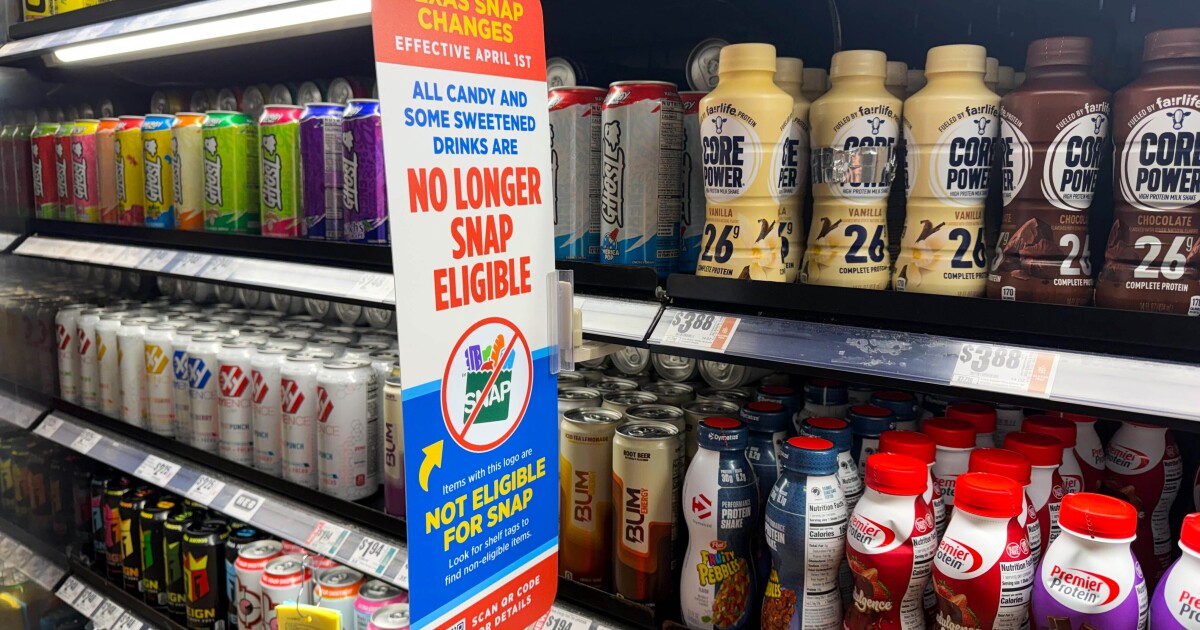
On a grocery run in early April, Sandra Allen added a Welch’s juice product to her grocery basket at Target in Pflugerville. She had often used her SNAP benefits to buy juice for her 9-year-old daughter in the past. But this time, she couldn’t make the purchase: Texas implemented a new law that prohibits Supplemental Nutrition Assistance Program benefits from being used to buy candy or sweetened beverages.
Allen knew this change was coming. She just didn’t expect it to apply to apple juice.
“It’s the embarrassment of taking it to the counter and them saying, ‘Well, you can’t get this,’” she said. “It’s embarrassing enough to have to pull out a SNAP card, so everybody behind you really knows, ‘Wow, she really can’t afford anything. She had to put half her basket back.’”
Texas Senate Bill 379 was passed last year, and the U.S. Department of Agriculture granted a waiver to make the change, which became effective April 1. The law was one in a slate of legislation dubbed “Make Texas Healthy Again,” influenced by the agenda of U.S. Health and Human Services Secretary Robert F. Kennedy Jr.
In the weeks following the law’s implementation, shoppers like Allen are navigating what it means for their regular grocery runs — as are the retailers tasked with enforcing the changes at the checkout counter.
Retailers interpret the law
Leading up to April, Texas Health and Human Services released guidelines on what types of items should be excluded from SNAP. They include candy bars, taffy and gum as well as chocolate or yogurt-coated raisins and nuts and crystallized dried fruit. Drinks that include more than five grams of added sugar are also off the table, as well as drinks with any amount of artificial sweetener. Exceptions included milk-based products and medical-grade electrolyte drinks, like Pedialyte.
Not all sugary items are affected by the change. Pantry staples like baking sugar, chocolate chips and sprinkles aren’t affected. Neither are sweet cereals or snack foods like granola bars, ice cream and trail mix.
The guidelines stopped short of providing an itemized list. Individual retailers have to interpret the guidance and apply it to items they stock.
At Austin’s locally-owned Fresh Plus grocery stores, that task fell to John Robertson, who updated the stores’ point-of-sale system to reflect the items that were newly ineligible.
“You use Google a lot to get the internet’s interpretation. You look at the law and how it’s written,” Robertson said.
Going through individual items in the stores’ inventory was time-consuming, he said. Even though he said Fresh Plus processes relatively few SNAP transactions, the process took around three days to complete. In some cases, the answer was clear-cut, like with traditional sodas. But sometimes he had to scrutinize nutrition labels: for instance, what about newer prebiotic sodas that use natural sweeteners?
“I found myself going out and having to look at basically every single can to see how much added sugar was in that particular line,” he said.
Aside from prebiotic sodas, some drinks that many folks might think of as healthy — like juice and sports drinks — don’t pass a close label check: while Welch’s 100% Grape Juice doesn’t have added sugars, a 10-ounce bottle of Welch’s Grape Juice Cocktail has 20 grams. A 12-fluid-ounce serving of Mountain Berry Blast Powerade has 21 grams of added sugars.
Retailers can face penalties if they allow SNAP benefits where they shouldn’t, including fines and even prison time. Robertson said Fresh Plus erred on the side of marking items as ineligible when there wasn’t a clear-cut answer.
‘It’s expensive to eat healthy’
Gary Huddleston, a grocery industry consultant for the Texas Retailers Association, said most retailers began preparing for the change last summer when the USDA granted Texas’ SNAP waiver, and that the state had provided a template for in-store signage alerting people to the change.
Some stores, like H-E-B, posted signs in sections of the store near items that might be affected — like the energy drink aisle. But Allen said several stores she visited, including Target, didn’t have any signs. Interview requests from KUT to large chain retailers, including H-E-B and Target, went unanswered.
“The clerk [at Target] had no idea what I could and could not buy,” Allen said. “No one could guide me on, ‘OK, is this not an approved item?’”
Mina Davis runs a grassroots organization called Valley of Hope, which works to connect residents in Del Valle and the rural outskirts of Austin with food resources. Davis said many of her clients who are SNAP recipients had similar experiences to Allen, and that implementation and training about the new law has been more consistent by some retailers than others.
She said that can cause hiccups that can be hurtful to customers.
“It’s disempowering and it’s frustrating, because you want to buy something that’s fun … and maybe you’re not really the person that this media paints you out to be,” Davis said. “But all of a sudden, there’s that stop, and the [store clerk’s] just as confused as you are.”
Allen said she has relied on SNAP benefits — around $400 loaded onto her Lone Star Card each month — since losing her job as a project manager around a year ago. Since then, she’s been looking for full-time employment while doing hair and selling T-shirts to make ends meet.
“It’s the economy,” Allen said. “I’m a professional, and it’s just been really hard to land a job, so I’m using [SNAP] to feed my child and myself.”
When Allen learned about the new restrictions to SNAP, she wasn’t concerned at first; she said she doesn’t often buy candy, sodas or energy drinks. But when she realized many juices were affected, she wondered if the new law could also apply to things like fruit snacks and granola bars, depending on what store she visits. And she noticed that many of the organic and 100% fruit juices that were still eligible under SNAP were more expensive.
“[It’s] having to have someone quickly tell you that you need to change the way you eat, because basically that’s what it is: ‘You need to change the way you feed your family,’” she said. “It’s very expensive to eat healthy.”
Other challenges facing SNAP
The new restrictions to SNAP come amid a mounting national conversation about the supplemental food benefit program. A number of Republican-led states, including Louisiana and Florida, have made similar restrictions. Democrat-led Colorado will also restrict soft drinks at the end of this month.
But Celia Cole, CEO of Feeding Texas, a statewide network of food banks, said the restrictions on candy and sweetened drinks are ultimately a small change compared to what could be coming for the program. A provision of U.S. House Resolution 1, also known as the “One Big Beautiful Bill Act,” will require states to take on more of the administrative cost of running their SNAP programs. Additionally, if states have a high error rate for SNAP spending — mistakes in how the program’s money is issued — they could be required to take on a portion of the cost of benefits, which are currently entirely federally funded.
“For Texas, that could mean having to put up tens of millions of dollars just to keep the program whole,” Cole said in a March 25 interview. “Any reduction in access to benefits or eligibility, or simply walking away from the program, would be obviously really devastating for the 3.5 million or so Texans that participate and that use these benefits to put food on the table.”
In an April 8 presentation to the Texas Senate Committee on Health and Human Services, Texas HHS Commissioner Stephanie Muth said that Texas currently has a roughly 9% error rate for SNAP payments as of 2024. That means the state would have to pay an additional $708 million to fund the program moving forward.
In order to avoid that outcome, Texas would need to shrink the error rate to 6% by September, the end of the current fiscal year. However, that data won’t be finalized until June 2027. That falls just after the end of the next Texas legislative session, when the state’s next budget must be set.
In a news release following the April 8 presentation, representatives for Feeding Texas emphasized that most of Texas’ SNAP error rate doesn’t come from fraud by people receiving benefits, but from overpayments or underpayments caused by miscalculations by case workers or households that struggle to report a fluctuating income.
Support for KUT’s reporting on health news comes from St. David’s Foundation. Sponsors do not influence KUT’s editorial decisions.