
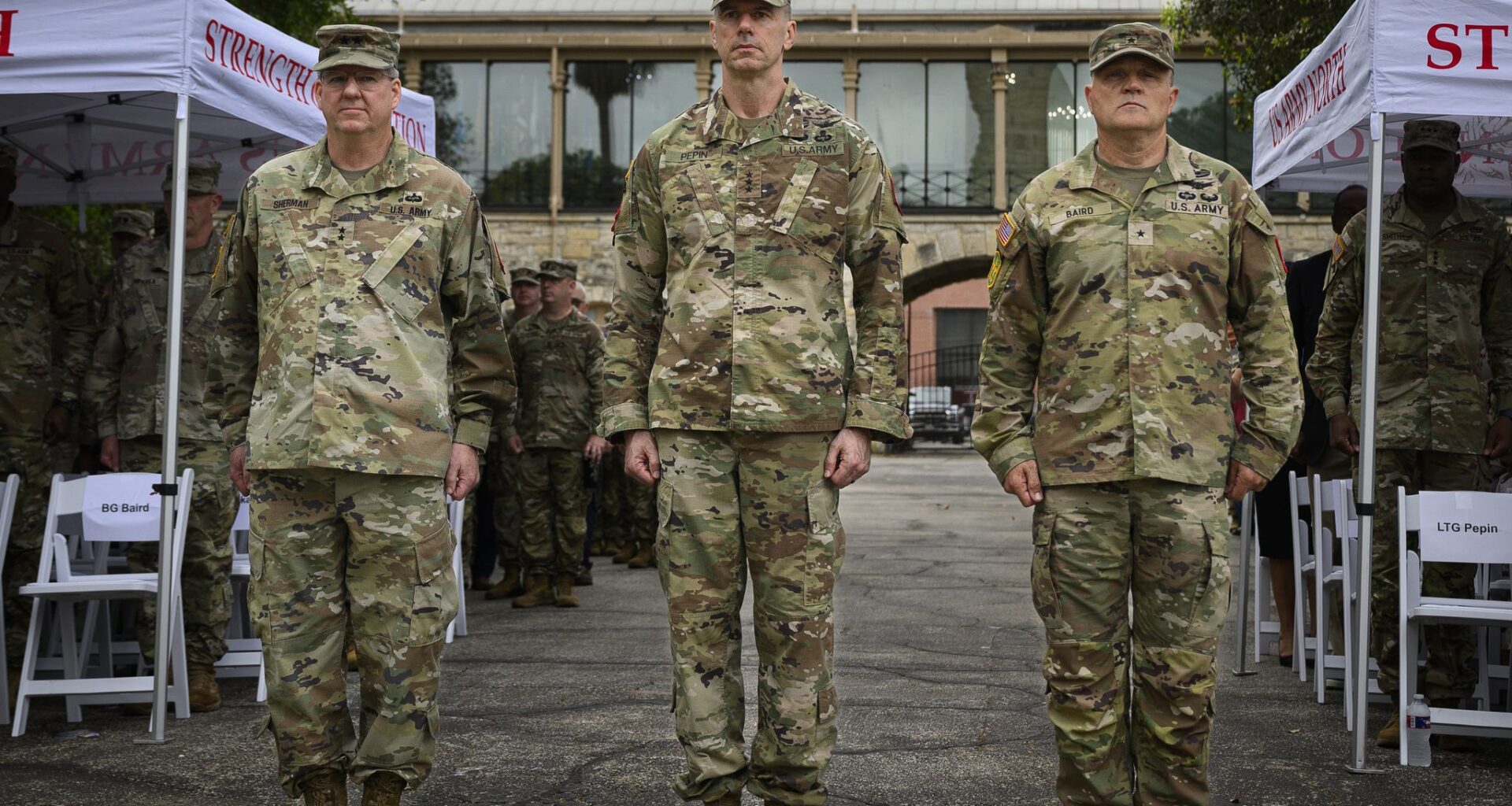
Brig. Gen. Jerry E. Baird Jr., right, takes command of Task Force 51 in a ceremony Friday at Fort Sam Houston. The outgoing commander, Maj. Gen. Scott Sherman, is at left. The head of U.S. Army North, Lt. Gen. Allan M. Pepin, stands between them.
Ethan E. Rocke/Contributor
Lt. Gen. Allan M. Pepin, commander of U.S. Army North, passes a saber representing the unit colors to Brig. Gen. Jerry E. Baird Jr., right, who took command of Task Force 51 in a ceremony Friday at Fort Sam Houston. Maj. Gen. Scott M. Sherman, left, who is retiring, left, had passed the saber to Pepin after receiving it from Sgt. Maj. Bridgette Bankhead.
Ethan E. Rocke/Contributor
Lt. Gen. Allan M. Pepin, left, commander of U.S. Army North, returns a salute from Maj. Gen. Scott M. Sherman during a change-of-command ceremony Friday at Fort Sam Houston. Sherman is retiring as head of Task Force 51, part of Army North.
Ethan E. Rocke/Contributor
Lt. Gen. Allan M. Pepin, commander of U.S. Army North, speaks during a change of command ceremony for Task Force 51 at Fort Sam Houston on Friday.
Ethan E. Rocke/Contributor
With the symbolic handing over of a cavalry sword, the Army formally transferred command of a unit called Task Force 51 from one general to another on Friday morning.

Senior officers made speeches to a crowd of more than 200, and the 323d Army Band played “Hail, alma mater dear,” the West Point anthem. It was a ritual like many others held at Fort Sam Houston’s historic Quadrangle over the years, but a tone of finality set it apart.
Article continues below this ad
It was the final change-of-command ceremony that will be held in San Antonio for U.S. Army North, one of two commands that are moving to Fort Bragg in North Carolina as part of a streamlining ordered by Defense Secretary Pete Hegseth.
RELATED: San Antonio to lose two Army commands to North Carolina
Army North and Army South are being folded into a new Western Hemisphere Command headquartered at Fort Bragg. Between them, the two units have more than 1,000 uniformed and civilian personnel in San Antonio. Many of them will be leaving for North Carolina, although the Army has not specified a number.
Army North’s mission is the defense of the U.S. homeland. It is part of the Colorado-based Northern Command, created by then-President George W. Bush after the Sept. 11, 2001, terrorist attacks.
Article continues below this ad
Army South supports multinational operations, security assistance, drug interdiction and humanitarian aid in Central and South America and the Caribbean. It is part of Southern Command.
Army North is expected to shutter its San Antonio headquarters sometime this summer. At that time, the command’s leader, Lt. Gen. Allan M. Pepin, will furl the Amy North colors in a ceremony known as “casing,” which marks the end of a mission or the relocation of a military unit.
On Friday morning, Pepin presided over a ritual of more modest significance: the transfer of Task Force 51 from Maj. Gen. Scott M. Sherman to Brig. Gen. Jerry E. Baird Jr. The task force is a mobile command center that oversees soldiers responding to wildfires, hurricanes and other disasters throughout the continental U.S.
In an interview after the hand-over, Baird said Task Force 51 would stay in San Antonio, with the same name and duties as always.
Article continues below this ad
“Army North as a titled headquarters will be retired,” he said. “However, that mission, that responsibility of our nation’s protection, goes up under Western Hemisphere Command. I will pick up a new title, and I will still have Task Force 51 because of its mission. It is truly the only Army contingency command, and it will remain because it’s proven. It’s valued.”
Baird’s new title will be deputy commanding general for the homeland in the western hemisphere. “I will be here,” he said. “I have spoken with the leadership, and they want to retain this footprint as best we can.”
In his speech, Baird vowed to focus less on the task force’s needs and “more on what we can do with what we have.”
“And when that crisis hits, and it will … and those local and state leaders have reached their limits and they make that call for help, that call will come here to Task Force 51. And when we answer, we will not have to get ready, because we will already be ready,” he said.
Article continues below this ad
The demise of Army North as a separate formation was mentioned only briefly on a cool, mostly cloudy morning when the cries of peacocks, a fixture at the Fort Sam Quadrangle, pierced the air and at times drowned out the amplified voices of the generals.
RELATED: San Antonio to lose two Army commands to North Carolina
Army North (originally the Fifth Army) dates to Dec. 1, 1942. It was made up of Army units that participated in Operation Torch, the invasion of North Africa. It was the first of seven field armies the United States organized during World War II. It became the first American force to invade mainland Europe when Fifth Army troops landed on a 20-mile stretch of beach south of Salerno, Italy, on Sept. 9, 1943.
The army entered Rome on June 4, 1944, and became the first allied force to liberate a European capital from Fascist control.
Article continues below this ad
RELATED: Army presence in San Antonio faces big changes under Hegseth overhaul
The imminent closure of Army North and Army South marks the most significant change in the military presence in San Antonio in decades.
Elected officials from the region tried to head off the loss of the units. U.S. Reps. Joaquin Castro, Greg Casar and Henry Cuellar, all Democrats, called on Hegseth to put the Western Hemisphere Command’s headquarters in San Antonio. It was to no avail.
RELATED: ‘Tough choices’: Hegseth won’t commit to keeping Army commands in S.A.
Article continues below this ad
On Dec. 5, a “transition of command” ceremony for the Western Hemisphere Command was held at Fort Bragg, laying the foundation for the consolidation of Army North, Army South and the U.S. Forces Command, which was already at Fort Bragg, into a single headquarters led by a four-star general. The merger is expected to continue into 2027.
The Western Hemisphere Command will focus on homeland defense, support for civil authorities and security cooperation with other countries.