
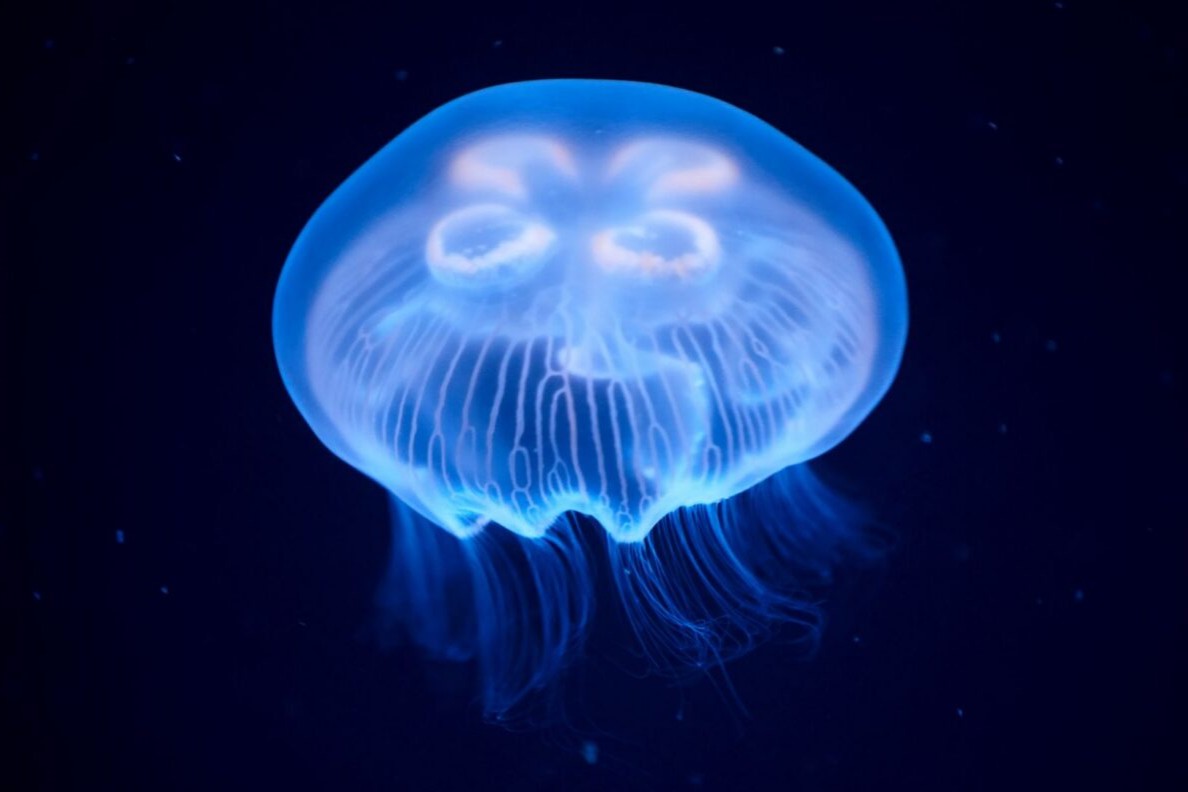
A newly identified moon jellyfish species, Aurelia profunda, was first spotted glowing near boat lights during a Gulf research expedition.
Texas A&M University
A new moon has been discovered in the Gulf near Texas. Moon jellyfish, that is.

It started with a single, glowing pulse in the dark.
Article continues below this ad
While on a research expedition offshore near Louisiana, Alexandra Frolova Ruthenbeck, a former Texas A&M University at Galveston doctoral student, noticed something unusual drifting near the boat lights.
“I saw something pulsing in the water column near the boat lights. We scooped it up and it was a beautiful moon jellyfish carrying many larvae,” recalled Ruthenbeck. “What was kind of amazing was that this was the only jellyfish we saw on the entire five-day cruise.”
That lone jellyfish would turn out to be something scientists hadn’t documented before.
Dr. Maria Pia Miglietta, a marine biologist at Texas A&M Galveston, helped identify and study a newly discovered moon jellyfish species from the Gulf.
Texas A&M University
Not only was it a never-before-seen specimen, but it was also carrying larvae, a state Dr. Maria Pia Miglietta, associate professor of marine biology at Texas A&M Galveston, described as the jellyfish equivalent of being pregnant. That rare find gave researchers a fleeting window to do something even rarer: follow a brand-new species through its entire life cycle.
Article continues below this ad
Back in the lab, the team reared the larvae—known as planulae—into polyps, the tiny, bottom-dwelling stage of a jellyfish’s life. From there, they watched the polyps reproduce asexually and eventually undergo strobilation, the process that releases juvenile jellyfish, or ephyrae, into the water column. Tracking every stage, from larvae to full-grown medusae, allowed scientists to confirm they weren’t looking at a variation of a known species, but something entirely new.
The species is now known as Aurelia profunda, a newly identified moon jellyfish that lives deep within the Gulf.
“In the Gulf, we used to have three species of Aurelia,” Miglietta said. “Now we have four.”
Article continues below this ad
Scientists identified Aurelia profunda after collecting a rare specimen carrying larvae in the Gulf.
Dr. Maria Pia Miglietta
The discovery, detailed in a paper published in Marine Biodiversity in fall 2025, relied on more than just appearances. Genetic testing confirmed the jellyfish was distinct from other members of the Aurelia genus, a group that has long challenged scientists because many species look nearly identical despite being genetically different.
That’s part of what makes this discovery stand out. Moon jellyfish are among the most studied jellyfish in the world, often found drifting near shorelines and frequently displayed in aquariums thanks to their translucent, moon-like bells and relatively mild sting.
“Aurelia are probably the best-studied group of jellyfish because they’re easy to keep in the lab,” Miglietta said. “They’re also everywhere around the world and look very nice, so they’re the ones that you often see in aquariums.”
Article continues below this ad
Even so, major gaps remain, especially when it comes to their earliest life stages.
All jellyfish begin as polyps, Miglietta explained, but those tiny organisms are notoriously difficult to find in the wild.
“The 28 recognized species of Aurelia are mostly known from the medusae stage,” she said. “Of those 28 species, only 13 of their polyps have been found in the wild.”
That makes documenting a full life cycle particularly valuable. For Aurelia profunda, it also revealed how different the species really is. Experiments showed its polyps are highly sensitive to temperature, thriving only in cooler, deeper waters between 10 and 27 degrees Celsius—conditions that help explain why the species had gone unnoticed. Its preference for depth is reflected in its name, profunda.
Article continues below this ad
Researchers traced the full life cycle of the newly discovered jellyfish species from a single Gulf specimen.
Dr. Maria Pia Miglietta
Physically, the species breaks the mold in subtle ways. Adults are smaller and more fragile than their coastal relatives, while their early life stages—polyps and juveniles—are among the largest recorded for the genus. The jellyfish also has unusually long oral tentacles, which may help it feed or brood larvae in the open ocean.
Only two adult specimens, including the original jellyfish carrying larvae, have been collected so far, confirming the species reproduces in the wild.
By combining genetic analysis with observations across every life stage, researchers were able to untangle a group of animals known for hiding in plain sight.
Article continues below this ad
“It gives you an idea of how much biodiversity there is that we don’t know,” Miglietta said. “It takes people being out there on the water to find it.”
Type specimens of Aurelia profunda—examples representing each stage of its life cycle—are now archived at the Florida Museum in Gainesville.