
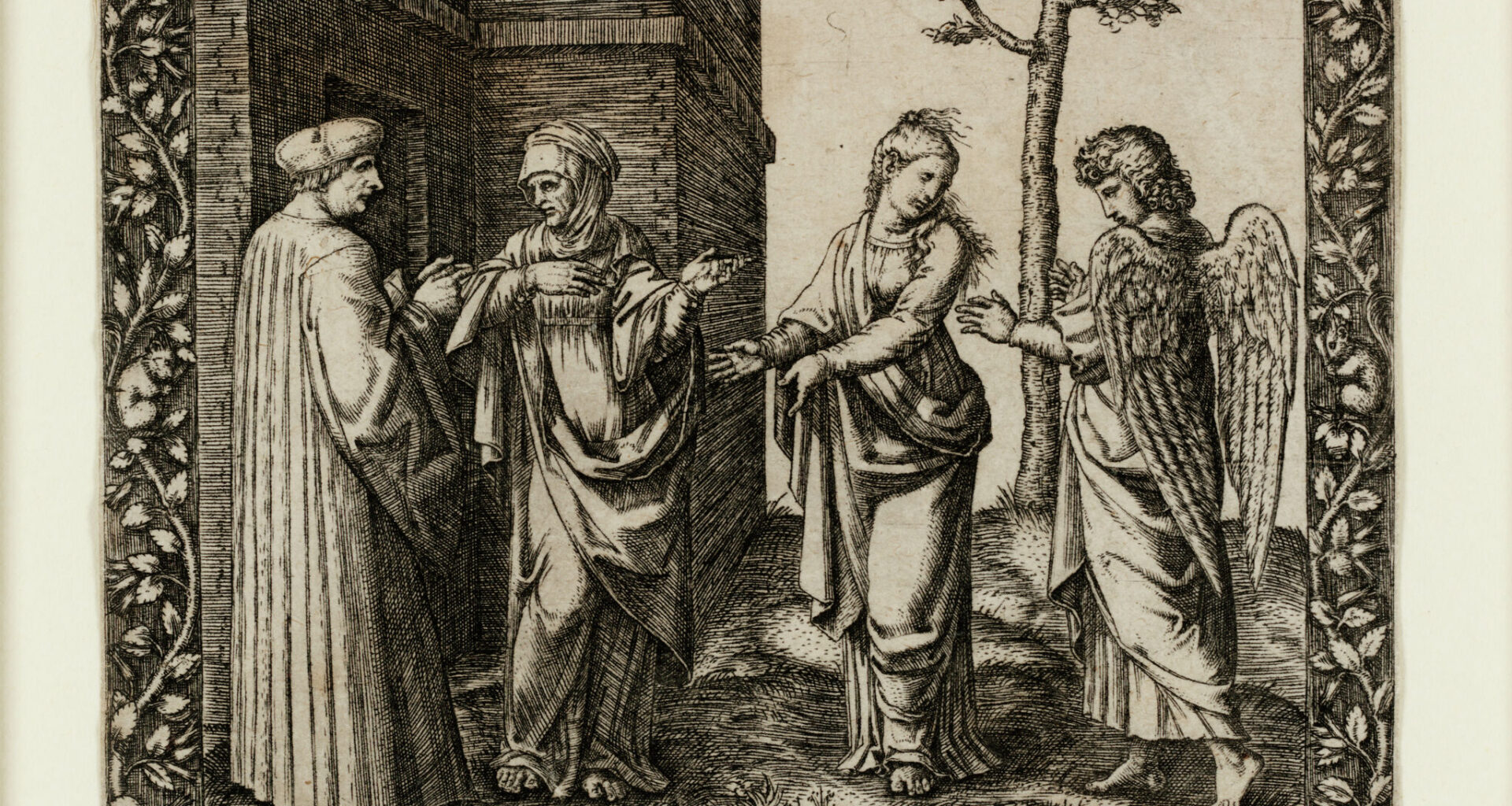
In Marcantonio Raimondi’s 1510-17 engraving, the three figures chatting in the garden with Bishop Amedeo Berruti are Austerity, Love and Friendship.
Dallas Museum of Art
“Paper Technologies: Prints and Drawings,” another small but mighty show of works on paper at the Dallas Museum of Art, gives, in the gallery space of a medium-sized bedroom, a fascinating tour of two and a half centuries of renaissance and baroque artistic ideas. Inch for inch, there is more to see in old master prints and drawings than in almost any other art form, since each minuscule line is clearly visible and reveals something about the artist’s thinking.

Due to the small size of “Paper Technologies” (it consists of 11 works, a mix of loans and pieces from the collection), the show can’t fully follow through on all the ideas it introduces. But it does open a viewer’s mind to many possibilities for further study.
Article continues below this ad
In the art of this period, one of the standout features is the widespread use of allegory, specifically the use of human figures to represent abstract ideas. Although allegory hung on into the 19th century (think of the Statue of Liberty, or the Lady Justice fountain at the Bexar County Courthouse), its unfamiliarity today can make earlier allegorical art seem strange and even off-putting to contemporary viewers unaccustomed to the device.
Once one gets the hang of allegory, however, it can become fun and entertaining to explore whole areas of meaning that would be unavailable from within the terms of strictly realist art. For example, in Marcantonio Raimondi’s engraving, the three figures chatting in the garden with Bishop Amedeo Berruti are Austerity, Love and Friendship. The illustration was commissioned to introduce Berruti’s book, a dialogue covering “not only true friendship, but also the wretchedness of the Roman curia,” according to historian Rebecca Boone.
In Pietro Testa’s “Triumph of the Virtuous Artist on Parnassus,” both the approving Muses and the defeated Vices react to the hero’s successful summit of the mountain of artistic success.
Rijksmuseum/Creative Commons
Another squad of allegorical figures turns up in Pietro Testa’s Triumph of the Virtuous Artist on Parnassus, as both the approving Muses and the defeated Vices react to the hero’s successful summit of the mountain of artistic success. While later, post-allegorical, realistic depictions of the artist’s studio can capture the psychology and atmosphere of art-making, the device of allegory is uniquely able to suggest the sense of a journey and spiritual struggle that accompany an artist’s vocation.
Article continues below this ad
Make Dallas News a preferred source so your search results prioritize writing by actual people, not AI.
Add Preferred Source
The show also has no shortage of putti — the enigmatic pudgy, nude boy figures who became prominent in the renaissance and were often put to allegorical use (but just as often used for purely decorative purposes). These are found in two fine drawings on loan from the Tom Gillett Collection, as well as flanking the coat of arms that Agostino Carracci designed for Cardinal Filippo Sega, his fellow Bolognese.
Antonio Maria Zanetti’s chiaroscuro woodcut of Saint James, one of Jesus’ 12 apostles, dates to 1722.
Dallas Museum of Art
The works afford insight into the artists’ processes in many ways. For example, Luca Giordano’s drawing illustrates the parable of Lazarus and the rich man, told by Jesus in chapter 16 of Luke’s gospel. While the parable gives the bare bones of the story (as the rich man feasted, Lazarus would beg for his scraps), the drawing shows how much the compositional decisions are up to the artist’s judgment. Giordano arranges the figures in a single arc running from left to right across the paper, putting the two main characters in direct sight of each other — a clearer, less ambiguous confrontation than in versions of the same story by Bassano, Fetti or Millais.
Article continues below this ad
Other artistic inventions are still more adventurous. Salvatore Castiglione’s etching of the Nativity shows the infant Jesus on the lap of his mother, Mary, as expected, but omits Joseph, Jesus’ earthly father, in favor of God the Father and the Holy Spirit as a dove — an unconventional choice that gives a thoroughly spiritual interpretation to the story. Castiglione surrounds all the figures with many shades of cross-hatched gray, making them appear to be wreathed in shadowy clouds.
Ironically more brightly lit and less shadowy than the Castiglione, Tiepolo’s etching of a pointy-eared, cloven-hoofed satyr family at rest on a tombstone looks like the beginning of a ghost story. It reflects, the curators write, the 18th-century Venetian fascination with “antiquity and the supernatural.”

By signing up, you agree to our Terms Of Use and acknowledge that your information will be used as described in our Privacy Policy.
With the Tiepolo displayed next to Zanetti’s chiaroscuro woodcut of Saint James, one of Jesus’ 12 apostles, the juxtaposition suggests another signal feature of this period of art: the casual, easy intermingling of characters from classical pagan antiquity with those from the Christian canon. Like the practice of allegory, this intermingling is largely unfamiliar today (perhaps outside of C.S. Lewis’ Narnia books), but in its time, it led to a remarkably fertile tradition of artistic invention.
Article continues below this ad
Details
“Paper Technologies: Italian Prints and Drawings” continues through Sept. 20 at the Dallas Museum of Art, 1717 N. Harwood St., Dallas. Free. Open Wednesday through Sunday from 11 a.m. to 5 p.m. Call 214-922-1200 or visit dma.org.