
Join us on a journey to better understand Houston, one question at a time. Sign up to get the Houston Explained newsletter in your inbox every Tuesday and Friday.
If you were paying attention, this was quite a week to be in “Space City.”
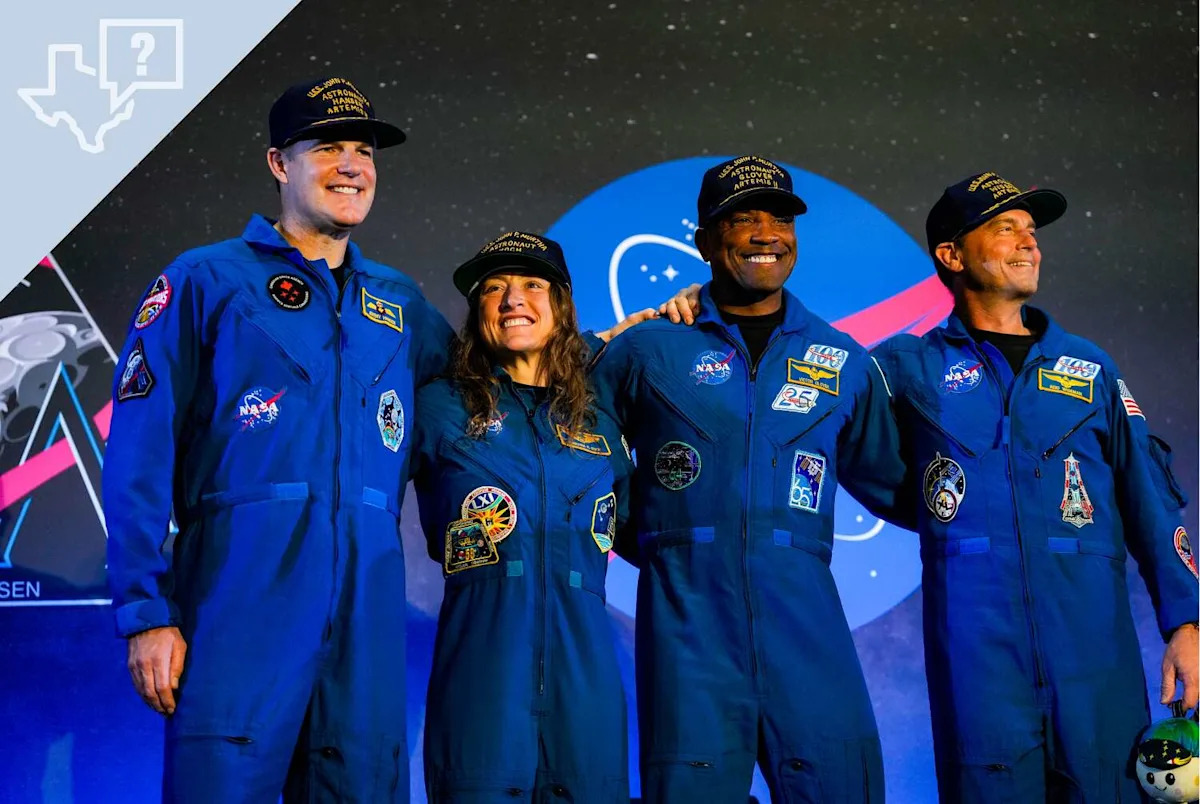
On Saturday, the Artemis II crew touched down at Ellington Field after a 10-day mission that took them farther from our home planet than any humans ever have been. And they returned not to Cape Canaveral, where they launched, but to Houston, where they live and train and are known by name to the people who spend years preparing them for this.
(Yesterday also marked the 56th anniversary of Apollo 13’s Jim Lovell radioing to the space wizards in Clear Lake that, uh, Houston, they’d had a problem. Have any of you newbies ever seen the movie?)
I say all of this as someone who finds space exploration genuinely fascinating and has spent too many working hours diving through the Houston Chronicle archives, reading about the days when astronauts were Houston’s greatest heroes, when the city threw them parades and a disgraced developer even built a whole neighborhood hoping they would move in. That’s right; Houston’s astronauts were once so woven into local life that they even got tangled up in one of the city’s favorite pastimes, a good real estate swindle!
Houston and the space program had a real romance once. But I’m not sure whether it’s survived, or whether the “Space City” identity has become something most Houstonians relate to the way San Antonians relate to the Alamo. Is our moniker an iconic source of pride to be defended against any outsider who dares talk smack (let the record show that despite his eagerness to claim this city, this writer is, in fact, not a Houston native), or is it a reference to a far-flung place that school-age children are hauled to on boring, sweaty field trips and then mostly forgotten about until a relative comes to town?
TELL US: What are your thoughts on the Artemis II mission?
Consider what Houston actually did to mark the most significant crewed space mission in half a century. In January, NASA got a segment during a Texans game. Space Center Houston did its job by throwing a watch party in Clear Lake. The Rockets played a video on their scoreboard.
That support from our biggest institutions isn’t nothing, but it’s also not the city that once lined the streets of downtown to honor its astronauts and collectively held its breath as its neighbors were launched toward the moon.
To understand how we got here, it helps to go back to how we got the name in the first place.
How Houston became ‘Space City’
The first thing you must understand is that Houston has never been in the rocket business, a fact that apparently escaped at least one New York Times writer during the latest Artemis mission. The rockets launch from Florida.
What Houston has been since the federal government chose it as the home of NASA’s Manned Spacecraft Center (now the Lyndon B. Johnson Space Center) is the brains, the place where decisions get made, whesre astronauts are trained for years before they ever launch into space and where Mission Control has guided every American human spaceflight since Gemini 4 in 1965.
But while the Manned Spacecraft Center is technically within city limits, thanks to some creative annexation, it was always built near Houston more than in it.
Humble Oil donated a thousand acres of land near Clear Lake, about 25 miles southeast of downtown, to Rice University, which then passed it along to NASA. The engineers and flight controllers and astronauts who flocked to Southeast Texas settled around Clear Lake, an area that offered them new subdivisions, new schools, new lives far from the hustle and bustle of urban Houston.
Just like that, the center of American human spaceflight was permanently installed far from where most Houstonians actually lived, just close enough to claim but far enough away that many of us could go years without giving it much thought.
Why we have to keep earning ‘Space City’
If you don’t tend to an identity, civic or otherwise, you either lose it altogether or someone else will define it for you. (As a Hispanic person living in America right now, I have some feelings about that.)
When the New York Times called Houston “Rocket City” (a moniker that actually belongs to Huntsville, Alabama) during its Artemis II coverage, it was certainly a careless slip. But isn’t that exactly how a city begins to lose its grip on its own story?
Part of what happened is that both Houston and the rest of humanity were kind of spoiled, if we’re being honest. After three decades and more than 130 missions, the shuttle program became so routine, so bureaucratic that we stopped being amazed by space travel.
The case for Houston’s claim to this identity can’t just be based on nostalgia or routine anymore. The Artemis II crew came home here on Saturday, just a few days ago. Mission Control, as annoying as it might be to make the trek down Interstate 45, is still down there in Clear Lake. And if you have never driven out there and tried to absorb what actually happens inside those buildings, you are leaving something extraordinary completely unclaimed.
We have to have actual pride in what our fellow Houstonians are accomplishing. That means at least knowing their names and celebrating what they did, the way you know who won the 2022 World Series MVP award or which retired Texans player was thrice the NFL’s defensive player of the year. (By the way, the astronauts’ names are Reid Wiseman, Victor Glover, Christina Koch and Jeremy Hansen, and they went to the damn moon.)
I mean, if not us, then who? No other city has this. No other city gets the call when something goes wrong 200,000 miles from Earth or gets to claim as neighbors the four people who just traveled farther from home than any humans in history.
So maybe the romance didn’t die so much as settle, the way it does in any long relationship, into something comfortable, forgettable even, that we only think to mention when someone asks how the Astros got their name.
For the sake of humanity and our own neighbors, it’s time for us to rekindle it.

What is your Houston question?
This article originally published at Is Houston still Space City? What Artemis II’s homecoming reveals about civic pride, nostalgia.