
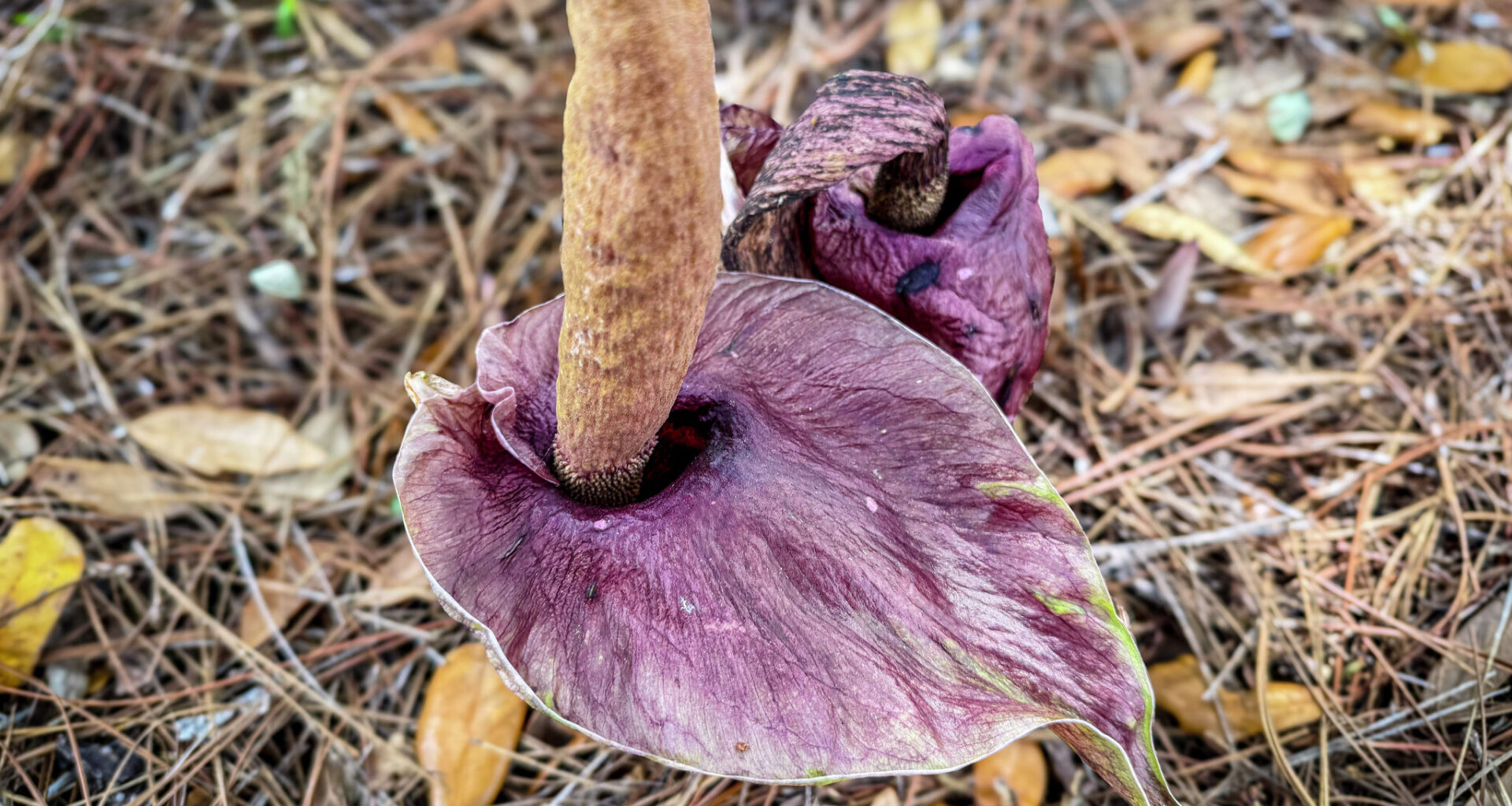
For a brief moment, one of the plant world’s strangest blooms opened quietly at the Houston Botanic Garden.

The corpse flower, Amorphophallus henryi—sometimes called a voodoo lily—emerged during the Garden’s Flower Power festival over the weekend, not towering or immediately obvious but unmistakable once you get close enough. At its peak, the bloom shows off bright red and white coloring that stands out against the shaded garden.
“The corpse flower gets its name because it smells really bad,” said TJ Oliver, the Garden’s director of horticulture. “Sometimes people will say that it smells like rotting flesh… It’s evolved and adapted to be pollinated by flies and stuff like that, so they’re attracted to that smell.”
Article continues below this ad
A corpse flower, also known as a voodoo lily, reaches peak bloom at the Houston Botanic Garden, releasing a scent meant to mimic rotting flesh.
Ariana Garcia
For a short window after blooming, that odor is the main attraction.
“It does smell pretty bad,” Oliver said. “To me, it’s definitely got a dead animal that’s been lying there for a while type of smell.”
That scent serves a purpose. Instead of attracting bees or butterflies, corpse flowers rely on flies and beetles—insects that typically search for decaying material. The plant’s deep red interior and structure help mimic that environment, pulling pollinators in close.
Article continues below this ad
A close-up highlights the corpse flower’s textured interior during its short-lived bloom.
Ariana Garcia
Unlike most plants, the bloom appears before any leaves, with foliage coming later.
It’s not a rare plant, but catching it in bloom is.
A corpse flower shows off its deep red interior during peak bloom at the Houston Botanic Garden.
Houston Botanic Garden
Like others in the Amorphophallus genus, the plant grows from an underground tuber, storing energy for years before sending up a bloom. In some cases, that process can take up to a decade.
Article continues below this ad
“It can take 7 to 10 years to actually flower from when the tuber splits off from a mother plant,” Oliver said.
This one is far smaller than the tower titan arum—the giant corpse flower species that has drawn crowds during past blooms at the Houston Museum of Natural Science—but it follows the same unusual playbook.
Even then, the bloom doesn’t last long.
The short-lived bloom of a corpse flower draws in flies and beetles with its rotting odor.
Houston Botanic Garden
Each flower typically lasts 48 to 72 hours, with the strongest smell fading after about a day. Miss it, and it’s gone.
Article continues below this ad
“You have to check it all the time,” Oliver said. “It could come and go in 48 hours.”
At the Botanic Garden, this one is planted beneath a live oak in near-constant shade, mimicking the dappled light conditions of Southeast Asian forests where these plants originate. The humid environment and steady presence of insects make it a natural fit.
“We call this area the ‘Corner of Curiosity’ because it’s kind of the first thing people experience,” said Justin Lacey, the Garden’s director of communications and community engagement. “Some of these plants are selected and put here because they’re curious and draw people in.”
Article continues below this ad
Another corpse flower is getting ready to bloom at the Houston Botanic Garden.
Ariana Garcia
After the bloom fades, the plant’s central spike remains, eventually producing clusters of berries that will drop and grow new plants.
This particular bloom peaked during Sunday’s festival and has already begun to fade, but another corpse flower nearby is expected to open soon.