
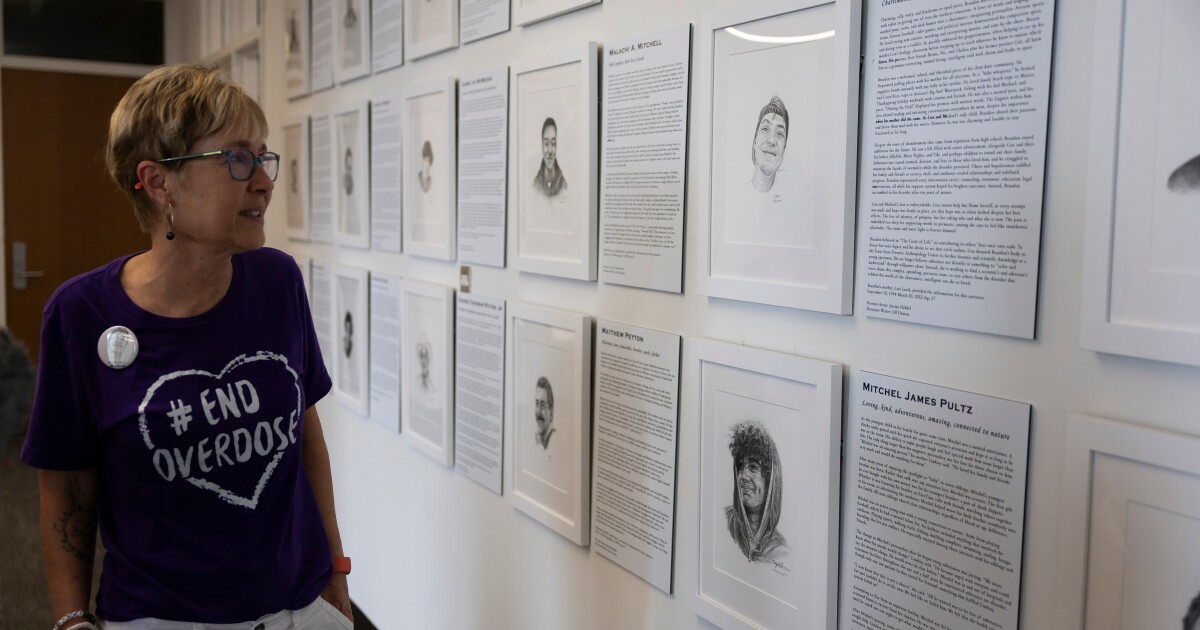
Pencil-drawn portraits of nearly three dozen people line the walls on the second floor of Walter Webb Hall on UT Austin’s campus. Their faces are shaded light and dark, just as their lives were: Each portrait is of a person in Central Texas who lost their lives to addiction.
Among them are Josh Bell, a 33-year-old with soulful eyes, and Brandon Lasch, a 27-year-old with a broad smile.
Josh and Brandon never knew each other. But on a Friday in early April, the boys’ mothers visited their portraits side by side. Annie Hernandez and Lisa Lasch met through an overdose loss group at the Christi Center, an organization that provides grief support to Central Texans.
“It’s a different loss than ‘my child died to cancer,’” Hernandez said in her lilting Irish accent. “People are more afraid to talk to us than they would be of another mother that maybe lost her child to a different disease.”
“There’s some kind of comfort in knowing you’re not the only one,” Lasch added.
That’s part of why Hernandez and Lasch submitted their sons’ stories to the Into Light project, a traveling exhibition that puts faces to the disease of addiction and the opioid crisis. Since losing Josh and Brandon to overdoses, the mothers have been working to raise awareness about what opioid addiction looks like, and to show that addiction can happen to anyone — sons, daughters, parents, friends.
‘That child had my heart’
Into Light is preparing to visit its 21st state, each time partnering with a local museum or university to show portraits of overdose victims from the area. Austin’s exhibit is hosted by the UT School of Social Work.
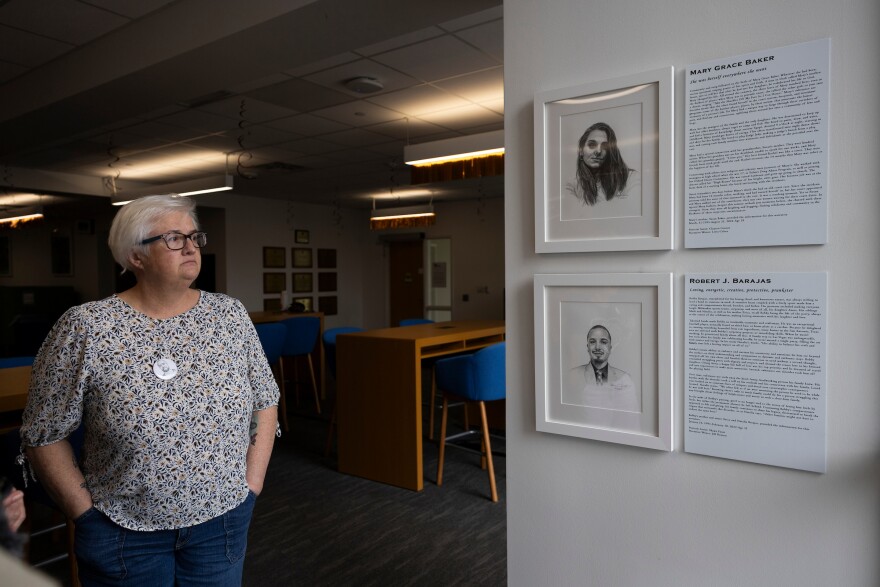
Next to each portrait is a narrative about the person’s personality and life. Hernandez and Lasch submitted a detailed application that a writer used to paint a picture of their sons with words.
“It was very intense,” Lasch said. “I had to step away from it for a couple weeks. I’m like, ‘I’m not sure I can do this.’ But … I did get through it.”
The narrative next to Brandon’s portrait describes a sensitive and charismatic young man, an animal lover who could always be counted on to correct his friends’ spelling and grammar. He believed in “the circle of life,” the idea that a person’s death could somehow bring something good and useful to someone else.
Lasch found a way to honor that belief: She donated Brandon’s body to the Forensic Anthropology Center at Texas State so his body could be studied for scientific research.
Much like Lasch describes Brandon, Hernandez remembers her son, Josh, as a bright and charismatic person who “never met a stranger.” He loved sports and cheered especially hard for the New England Patriots. He was dedicated to his family.
“That child had my heart the minute he was born,” Hernandez said. “I have four children, but this one knows exactly how to get whatever he wants.”
Lorianne Willett
/
KUT News
Annie Hernandez looks at two of the stories included in the Into Light exhibit. Her son, Josh, died of an overdose in 2019.
While Josh continued to show up for family events and appeared well, he was struggling with an addiction behind the scenes. It started out with opioids prescribed by a pain management specialist after he was in a car accident. From there, things snowballed. He started taking more than he was prescribed, buying extra pills on the street. And when that got too expensive, he ventured into heroin.
Like Brandon, he underwent treatment for his addiction, but died of an overdose in 2019. Hernandez believes a pill laced with fentanyl was responsible.
Today, Hernandez is an outspoken advocate for addiction treatment, harm reduction and education. But at first, she struggled to know how to talk about losing Josh. There was just so much stigma about addiction.
“People might have an idea in their mind what a drug addict is, right? And I was no different,” she said. “A million, million reasons I would think my son would die, would never be of drugs.”
A mother’s mission
Reducing stigma and spreading awareness about addiction was a key goal of the founder of the Into Light project, artist Theresa Clower.
Clower’s own son, Devin, died of an overdose in 2018. Her daughter suggested she try drawing a portrait of him as a way to process her grief. For three days, Clower put pencil to paper, studying each tiny detail of his face.
“We’re all made up of light and dark. No one should be defined by their darkest moments.”
Theresa Clower, founder of the ‘Into Light’ project
“I was working from a reference of Devin just about five hours before he died, so I was visiting with him,” Clower said. “It was unbelievably intense and beautiful.”
Clower took some time to gather herself before taking the last step of signing the portrait. It felt final — a goodbye.
Afterward, Clower was surprised by a desire to draw portraits of everyone she met, from her grandchildren to people on the street. She had the idea to give her passion a purpose: What if she could use portraits to connect with other people who had lost a loved one to drug overdose?
The first exhibit was held in Maryland — Devin’s home state — in 2019. In the early days, Clower drew many portraits herself, but she began hiring other artists to complete the drawings as the project grew. Artists bring their own style, but each portrait is rendered as a simple, black-and-white graphite drawing.
“We’re all made up of light and dark,” Clower said. “No one should be defined by their darkest moments. We focus on the whole person very intentionally, because we all are made up of lots of different parts. My own son, Devin — he had a tremendous personality, and he was addicted to drugs.”
The next frontier to fight addiction
The 34 individuals memorialized at the Texas Into Light exhibit represent a small fraction of addiction-related deaths in recent years. As fentanyl proliferated, drug-poisoning deaths skyrocketed by 68% statewide between 2019 and 2024.
But signs of improvement have begun to emerge. In spring 2025, local officials announced drug-related deaths in Travis County decreased by 22% between 2023 and 2024, roughly mirroring national trends.
Kasey Claborn, the director of UT’s Addiction Research Institute, credits this to widespread distribution of the overdose-reversing treatment naloxone, from local law enforcement to bar owners to regular folks.
“Three years ago, the public had no idea how dangerous the drug supply is,” Claborn said. “However, we have trained everyday citizens across Central Texas to actually be first responders.”
She credits strong coordination by local agencies with some of this effort, but says awareness campaigns like Into Light have also played an important role.
“Research has shown that stigma proliferates in spaces where we don’t have connections, where we don’t have direct understanding of human experience,” she said.
The nation is still in a “dangerous phase” of the opioid crisis, Claborn said, with only around 20% of the 48.7 million Americans with a substance abuse disorder getting treatment as of 2024. She wants to see silos in the addiction research and treatment space broken down to prevent more instances of relapse and get people into treatment sooner.
Families and loved ones
Claborn also wants to see more support for the families and loved ones of people who struggle with addiction, including those who lose their lives to the disease.
“Overdose impacts the entire family system,” she said.
That’s where grief groups like the one Lasch and Hernandez joined through the Christi Center come in. The women have found vital support through the group — and have provided it, shepherding other members through the Into Light exhibit on campus.
Their shared tragedies have led to a real bond.
“We’ve become very good friends,” Lasch said.
When Brandon died, he left behind a French bulldog-pug mix named Jellyfish. Sometimes, Hernandez helps Lasch out by dog-sitting. Other times, they get together, and Jellyfish weaves between the legs of Hernandez’s large dogs. It’s not always easy to laugh, but it’s easier with a hapless mutt named Jellyfish around.
Into Light is open through May 23 at UT’s Walter Webb Hall.