
Harris County leaders are gearing up for a sweeping effort to expand affordable access to child care and early learning—a burdensome expense for many local workers and families across Texas.
Commissioners Court on April 16 is set to discuss the county’s 2027 legislative priorities and take action on proposed local policies that could ease burdens on child care providers and families in need of subsidized care.
The overview
Precinct 2 Commissioner Adrian Garcia and Precinct 4 Commissioner Lesley Briones are spearheading the initiative to tackle local concerns about the affordability and availability of education for children under age 5.
In January, their offices quietly launched the Harris County Coalition on Early Childhood Education and Care, composed of regional stakeholders and advocates in the public, private, academic and nonprofit sectors.
In addition to shaping local policy, officials said the coalition will work ahead of and throughout Texas’ 90th legislative session, which begins in January 2027, to help direct state-level reform of subsidized early education.
In an April 13 joint interview with Community Impact, Briones and Garcia said the issue extends beyond Harris County’s boundaries, and effective change requires bipartisan participation from state leaders as well as cross-sector collaboration in the Greater Houston region.
“This is what I see the value of this deep coalition being—how can we capitalize on our respective strengths and capabilities,” Briones said.
The need
Harris County has approximately 166,000 children under age 5 who qualify for subsidized prekindergarten, according to data from county officials.
Eligible kids must come from households earning below 85% of the state median income—or about $87,000 for a family of four—which is the maximum threshold to qualify for subsidized care, according to the Texas Workforce Commission.
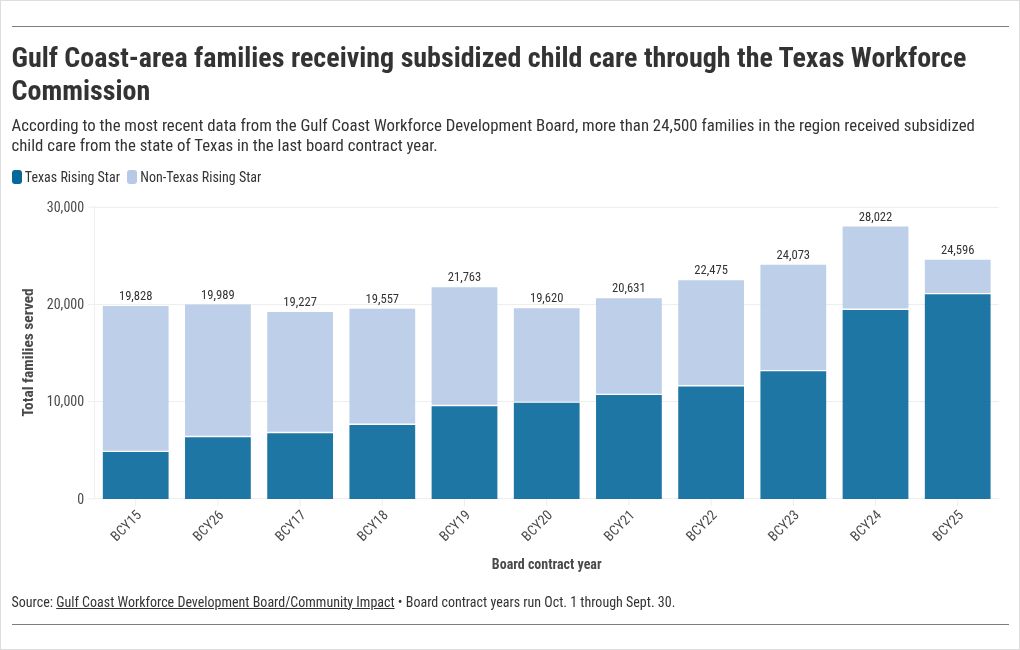
The state of Texas receives money from the federal government to fully or partially subsidize child care for low-income residents below the 85% SMI threshold. Regionally, the Gulf Coast Workforce Development Board then connects eligible families to early education scholarships.
However, the funding only goes so far, as an estimated 30,000 eligible children in Harris County are on a waitlist to access scholarships from the TWC, the data shows. Texas funnels approximately $240.5 million in federal funding to qualifying Harris County families annually, or about $10,000 per child.
Garcia also said there aren’t enough centers to address the “inordinate number of wait lists” in Harris County. He said by working with the state to streamline processes, as well as implementing more local support, Harris County can reduce administrative obstacles to opening centers.
“I learned myself the things that our current providers are dealing with—cumbersome regulatory processes and an immense amount of regulations and standards to achieve,” Garcia said.
County officials are also exploring ways to help more centers earn a Texas Rising Star certification, the TWC’s quality rating system. While the number of TRS-certified centers has grown regionally over the past several years, some providers chose not to go through the process of obtaining the certification, as it is not required to operate a child care center.
 Diving in deeper
On top of expanding the number of certified centers—and improving provider retention—officials said proposed policy solutions will focus on reducing cost barriers for more residents.
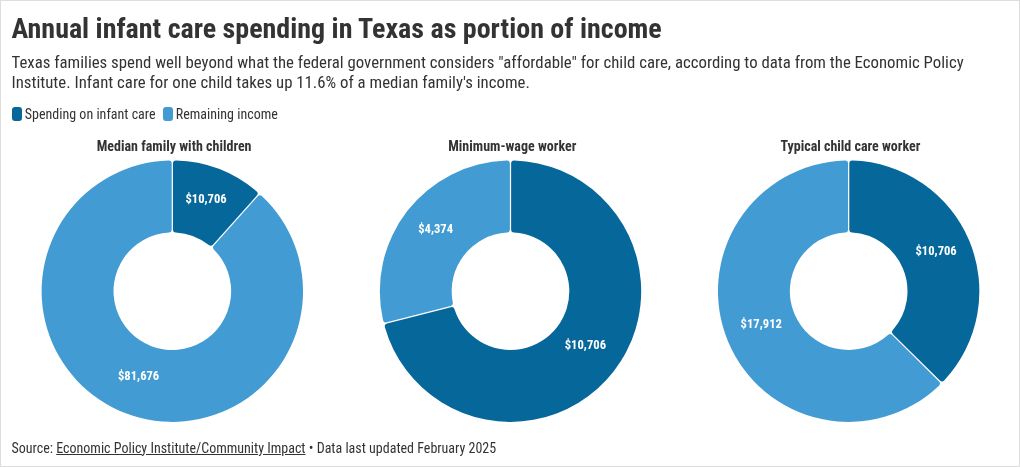
The average annual cost of infant care in Texas is $10,706, or almost $900 per month, according to 2025 data from the Economic Policy Institute. Care for a 4-year-old costs $9,664 per year for Texas families, or $805 per month, the Institute found.
According to the U.S. Department of Health and Human Services, child care is considered affordable if it does not exceed 7% of a family’s income. The Institute’s analysis found that only 26.5% of Texas families can afford infant care based on the HHS standard.
“From an affordability standpoint, average child care costs about 28% more than a state college tuition—that’s just not sustainable,” Briones said. “When you have folks struggling to pay for rent and groceries, it is very difficult.”
 Zooming out
Both commissioners said the timing of Harris County’s effort aligns with recent attention on early childhood education from state officials, creating a window of opportunity for policy change.
Gov. Greg Abbott launched a Task Force on Early Childhood Education on Jan. 20, composed of different representatives from the child care space to address the governance and operational challenges of the Texas early education system, according to a news release from his office.
State lawmakers passed House Bill 117 in 2025, granting Abbott authority to form the task force under the Texas Education Code. The governor’s task force will review existing early childhood education and care programs within state agencies—including the Texas Education Agency and Texas Workforce Commission—and consider methods for a “large-scale redesign” of administrative procedures, according to the legislation.
The Texas Legislature also established the Quad Agency Child Care Initiative in 2025 to improve affordability and access to child care. The initiative includes a commission of representatives from four state agencies:
Texas Workforce CommissionTexas Education AgencyHealth and Human Services CommissionDepartment of Family and Protective ServicesWhen asked about adding to the lengthy list of policy priorities already identified for the 2027 session, Garcia and Briones said they’re hopeful about garnering direction from the governor and bipartisan support.
“We’re very optimistic, and jurisdictions across the state of Texas are working on it,” Briones said. “Because this moment is ripe with the governor’s focus on it, we want to do everything possible to come together from across the state and get something meaningful done as Texans.”
Looking back
In 2022, Commissioners Court established the Harris County Early Childhood Initiatives division and identified early education as a funding priority for the county’s American Rescue Plan Act, or ARPA, allocations.
The county’s fiscal year 2025-26 budget included more than $125 million of ARPA funds for early childhood education, including the Early REACH program, Early Childhood Impact fund and SHINE Childhood Facilities fund, according to previous Community Impact reporting.
Commissioners have also since approved a 100% property tax exemption for qualified child care centers that are Texas Rising Star-certified and provide subsidized services.
The one-time ARPA funding is set to expire at the end of 2026. In August, County Judge Lina Hidalgo tried to seek voter approval of a 1-cent property tax increase to continue funding early childhood education programs, but commissioners did not support what they described as a rushed attempt to put the proposal on the ballot, Community Impact previously reported.
Garcia told Community Impact on April 13 that Harris County can’t solve the issue independently and instead must collaborate with other advocates in the Gulf Coast region and across Texas.
“You just can’t announce something that has no study, no plan to it,” he said. “You’ve got to bring people together to understand what it is that you’re trying to achieve, what it’s going to cost, and the best possible way to get there sooner rather than later.”
Next steps
As a first step in Commissioners Court on April 16, Garcia and Briones plan to propose a countywide Business Accelerator Program for local child care providers to teach best practices for bookkeeping, insurance requirements and other regulatory aspects of operating a center.
Both commissioners said they’ve seen success with similar programs in their respective precincts for small business owners. Briones said they’re working closely with the Gulf Coast Workforce Development Board and the University of Houston to develop a curriculum for providers.
“They want to grow their facilities, but they don’t want to stretch themselves to the point that they put themselves in an inordinate amount of debt,” Garcia said.
One more thing
Harris County is also partnering with the policy team at the Greater Houston Partnership to drive early education reform in the 90th Texas legislative session.
Taylor Landin, executive vice president and chief policy officer for the Greater Houston Partnership, said regional economic success depends on kindergarten readiness and workforce participation, both of which are directly linked to early childhood education access.
“We see some workers will leave the workforce, [and] they’ll make that decision on the cost-benefit analysis of being in the workforce versus being home with their kids,” Landin said April 13. “What we need is the front end of the pipeline and the back end of the workforce pipeline to work in harmony.”
He said early education governance is too “fragmented” across different state agencies, and improving regulatory systems could open the door for state funding opportunities.
“I’m not going to go so far to say that if we get the governance right, then state investment will follow,” Landin said. “But I think I can be fairly confident in saying that state investment won’t materialize until the governance structure is more consolidated and aligned.”
Briones said the Coalition on Early Childhood Education and Care will meet again shortly after the April 16 Commissioners Court meeting to establish clear deadlines for what Harris County will accomplish before lawmakers begin regular session in January.
“This is a collective effort between the private sector, Gulf Coast workforce, providers, the experts in education and academia, [and] nonprofits,” Briones said. “It’s this entire ecosystem, and so we see the county’s main role as a convener and as a local actor and partner.”