
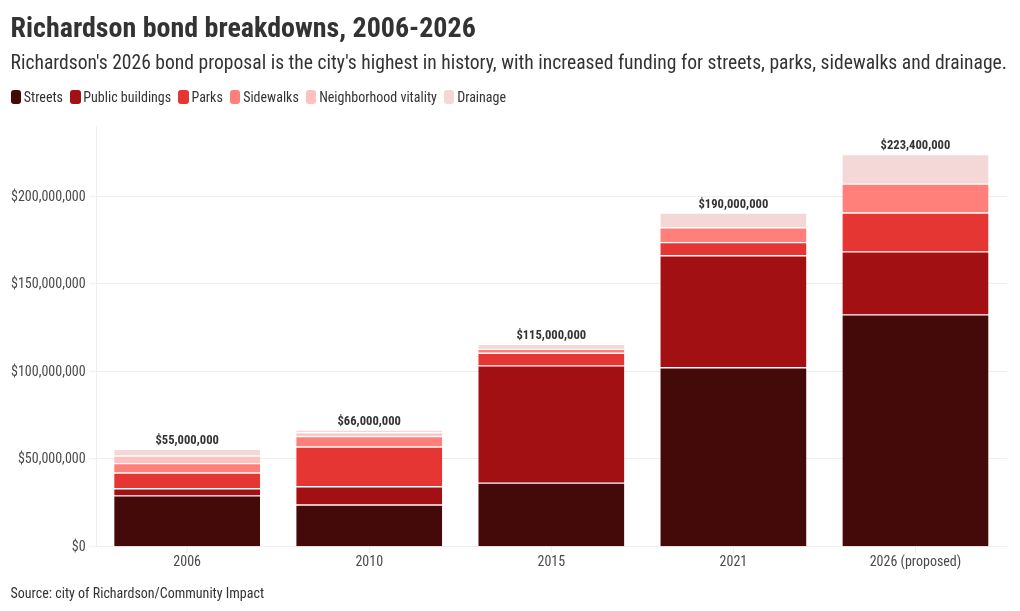
Richardson’s $223.4 million bond proposal, the city’s largest ever, is heading to the ballot in May.
The big picture
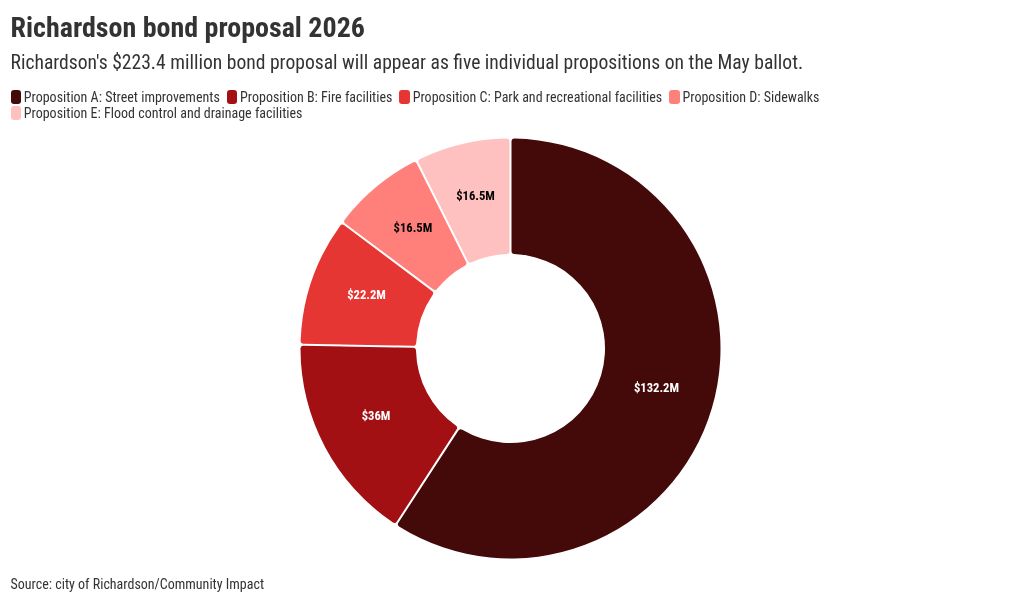
The proposed bond features five propositions funding street repair, fire facility renovations, park improvements, sidewalk construction and drainage work. The majority of the money, $132.2 million, will go toward streets and alleys, as Assistant City Manager Charles Goff said in an email that infrastructure maintenance “is an ongoing need” in Richardson.
About $12.5 million would support the proposed expansion of the city’s fire facilities, including the design for a new Fire Station No. 7, and $23.5 million in a future payment would be authorized in the bond for its construction in north central Richardson.
The proposed parks funding would support renovations at Breckinridge Park, pool projects and playground renovations.
Zooming in
The bond program is “hyper-focused on our core infrastructure,” City Manager Don Magner said, including traffic signals, school zone flashers, street and alley repair, and sidewalk construction.
“Roadway systems require periodic repair, rehabilitation or replacement as they age and experience continued use,” Goff said.
Most street repair is not typically covered through general city funds, Goff said, so cities rely on bonds to pay for larger repair projects. The proposed bond includes 13 alley repair projects and 15 street reconstruction projects, which will include full-depth pavement replacement of the entire road segment, as well as waterline and sewer replacement, Magner said.
Magner said Richardson has seen a “disproportionate amount of need” for road projects over the last decade because the city did not prioritize repairs when streets began aging. A citywide pavement condition assessment in 2019 identified the roads most in need of repair, some of which were reconstructed over the last several years under the 2021 bond, Goff said.
Richardson has fewer major facility needs in the 2026 bond program, Goff said, so the proposal was able to set aside more funding for road repairs.
“Seeing this level of focus on especially streets and alleys will really help us move the needle,” Mayor Amir Omar said at a Dec. 15 council meeting.
Also of note
In 2021, Richardson established a $400 million, five-year capital improvement plan aimed at upgrading citywide infrastructure, including utilities, streets and alleys. Magner said the plan is the largest capital investment in city history.
Richardson may face a budget shortfall in the next few years due to a statewide cap on property tax increases, so Magner said the city will rely on the larger bond program to continue with the planned projects.
The bond could also free up limited general city funds for other uses. The 2026 bond would fund localized street repair for the first time, projects typically paid for by city funds to replace smaller concrete panels that are in poor condition.
Other infrastructure funding on the ballot includes $16.5 million for multiple erosion control projects and improvements to the Lois Branch channel to reduce flood risk in the nearby Highland Terrace area.
What’s next
While the ballot is required to state that the proposed bond “is a tax increase,” Magner said the program would not require a tax rate increase and is “net-neutral to residents.”
“This is about continuing what’s been several years of strong investment in our core infrastructure,” Magner said.
Magner said the bond will allow Richardson to continue its five-year capital construction plan that exceeds $400 million, also a first in city history.
If a proposition does not pass, Magner said the city will consider alternative funding sources and projects could be deferred or canceled. More information on the propositions can be found at www.cor.net/our-city/bond-projects/2026-bond.