

I never imagined I’d wind up in a guided sound meditation with famed criminal-defense attorney Dick DeGuerin. There we were, though, among a few dozen people sitting in straight-backed chairs in a room at a high-end Houston hotel on a gray Sunday morning in February, about to close our eyes and chant “om.” DeGuerin, who was wearing a leather jacket and a Stetson Open Road, has represented Waco cult leader David Koresh and real estate heir slash murderer Robert Durst, so he’s obviously a man unafraid of a challenge.
Our polka-dot bow tie–clad spiritual guide for this meditation, neurosurgeon and best-selling author Eben Alexander, encouraged everyone to relax. As the lights went out, a recording of soothing binaural beats and soft tones meant to connect us to a spiritual realm began playing. Alexander told us to close our eyes. Before I did, I peeked at an older gentleman who already had his eyes shut. He was either really into meditation or asleep.
The fifteen-minute-long meditation was the final event of the weekend at the 188th annual gathering of the Philosophical Society of Texas (PSOT). Billed as the oldest learned society in the state, it’s actually older than the state itself. It was formed in 1837 by charter members including then–Texas President Sam Houston, as well as illustrious men with names many of us recognize as local streets, towns, schools, or landmarks: Lamar, Burnet, Bonnell. The society was created to support the intellectual and cultural growth of Texas through the “collection and diffusion of knowledge.” Philanthropist and mental health advocate Ima Hogg became its first female president in 1948. Today the organization is made up of brilliant, well-read, curious, and accomplished folks in medicine, business, media, law, politics, and the arts. Among its 387 current members are former President George W. Bush and Laura Bush; H-E-B chairman Charles Butt; former U.S. Senator Kay Bailey Hutchison; Senator John Cornyn; former Secretary of Education Margaret Spellings; Landman and Yellowstone creator Taylor Sheridan; renowned neurogeneticist Dr. Huda Zoghbi; and Pulitzer Prize–winning author Lawrence Wright.
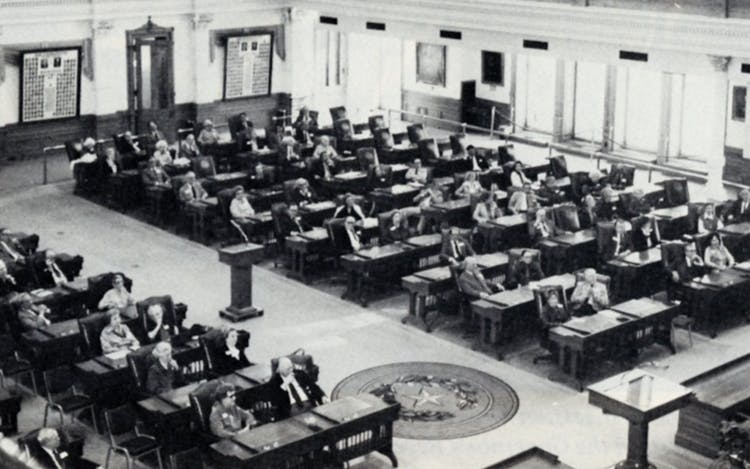 The 1979 annual meeting of the Philosophical Society of Texas included a session held in the chamber of the Texas House of Representatives, in Austin. Courtesy of the Philosophical Society of Texas
 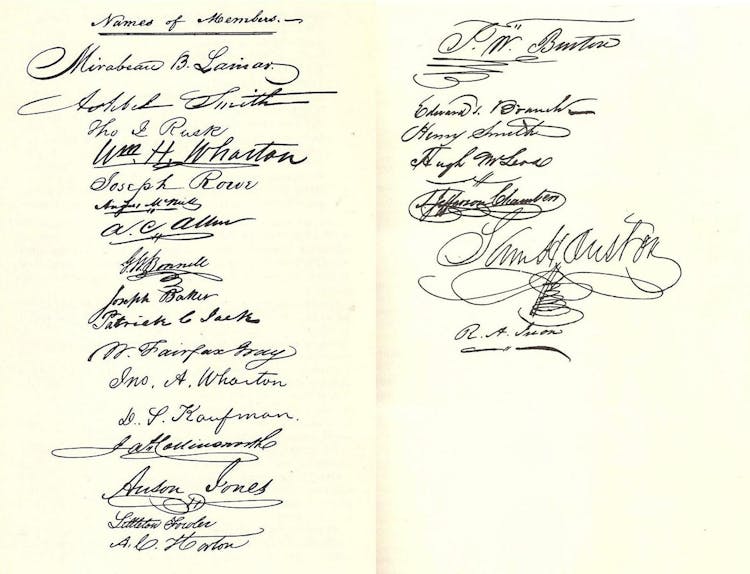 The original signatures on the society’s charter from 1837, including those of Mirabeau Lamar, Sam Houston, and Anson Jones. Courtesy of the Philosophical Society of Texas
Despite its high-profile members (which also include past Texas Monthly editors in chief William Broyles and Dan Goodgame), the society itself isn’t well-known. I discovered PSOT in early 2025 while doing some internet research on Texas philosophers. When I clicked on the website, with its old-timey calligraphic font and suspiciously simple emblem of a ship’s anchor, I wondered if I’d stumbled upon an elite secret society like Yale’s Skull and Bones or the Freemasons, with their rites and symbols. Did PSOT members sacrifice small animals or swear a blood oath of secrecy during initiations? Was there a handshake? I needed to find out.
I reached out to the organization’s director, and after a ten-month wait that required board discussion and approval, I was told I could attend the 2026 meeting. I’d be the first journalist allowed to cover the event. I don’t think this is because I am, like the official members, very illustrious. I’m just the first person to ever ask.
The well-heeled crowd of about 180 members and 200 guests and speakers that I encountered when I arrived at the Thompson Houston, next to Buffalo Bayou Park, on Friday evening did not seem to be the blood-oath type. Many men wore suits, and many of the women were enshrouded in luxurious, elegantly draped scarves. I saw many such scarves over the course of the weekend—the sartorial aesthetic of the learned. There were also more-casual guests in jeans, jumpsuits, cowboy hats, fedoras, and jackets with Frida Kahlo prints. Every single person wore a large, laminated name tag. I scanned these for names I might recognize. A few days earlier, I’d received a rundown of the attendees, and I studied that list with the zeal of Anne Hathaway memorizing the names and backgrounds of fancy party guests in The Devil Wears Prada.
Karl Rove, former deputy chief of staff and senior adviser to Bush, was in attendance, though his former boss was not. Kathryn Childers, one of the country’s first female Secret Service agents, was milling about, as was renowned Houston infectious disease expert Dr. Peter Hotez. I didn’t need his name tag to know who he was. The man cocreated an affordable COVID vaccine, and he’s been, in his words, “public enemy number one” for vaccine skeptics like Joe Rogan, Elon Musk, and Robert F. Kennedy Jr.
“Do you want to hear about my new book?” Hotez asked almost as soon as I introduced myself.
Of course I did. He told me he plans to rewrite Texas history through the lens of epidemics. As he talked about Cabeza de Vaca and Austin once being a malaria colony, I found myself feeling a little out of my element. This was the first of many conversations throughout the weekend that would make me feel, if not dumb, maybe slightly less scholarly than those around me. I related to the member’s wife who told me, “I leave here every year with an inferiority complex.”
Potential members must be nominated, and it can take up to three years to get voted in. There have been 1,209 members throughout PSOT’s history, including this year’s inductees, like DeGuerin. Although it’s possible to be kicked out if you don’t pay your dues, attend at least one of your first annual meetings, or engage in “improper conduct,” so far, that hasn’t happened.
One of the things that initially intrigued me about the group was its diversity, especially at a time in this country when people with differing beliefs can barely lock eyes without melting down and hurling insults. Democrats and Republicans, men and women of many ethnicities, poets and professors, physicians and oil magnates get together for one weekend a year to listen to lectures about a specific topic. Previous meetings have discussed the North American Free Trade Agreement, the Superconducting Super Collider, the criminal justice system, immigration, cybersecurity, writers, and space. Speakers have been as disparate as legendary Pulitzer Prize–winning astronomer Carl Sagan and television hitmaker Sheridan. “It’s people from the right and the left,” Hotez said. “It’s a lesson in civic behavior and a good model for the country. It’s meaningful intellectual stimulation.”
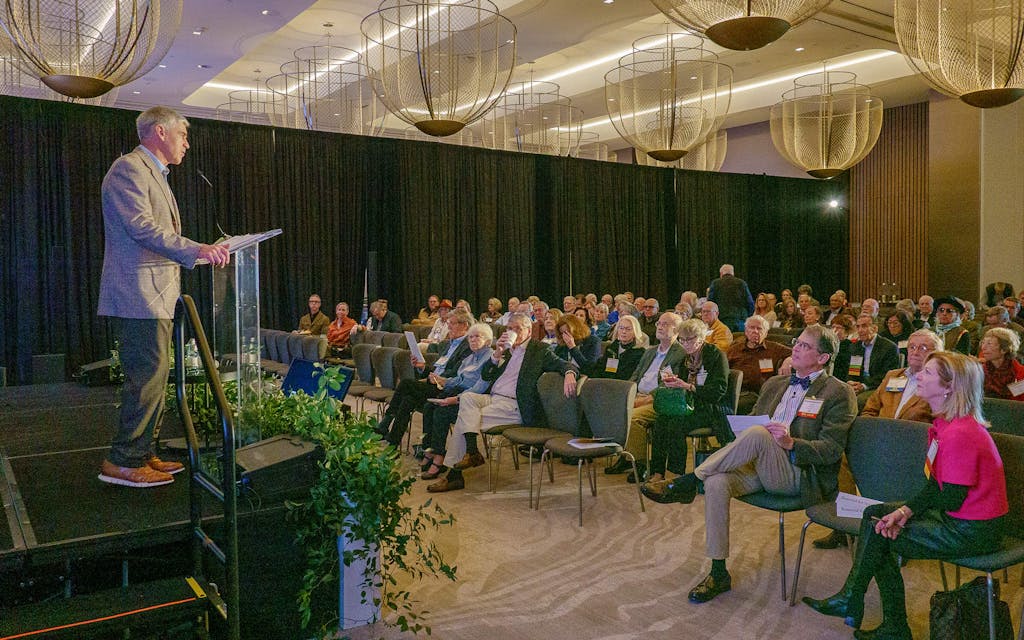 Last year’s PSOT president, Paul Hobby, during the society’s annual business meeting on February 8, 2026. At the end of the meeting, Hobby “passed the gavel” to the current president, Bryan A. Garner, with an actual gavel that is symbolically passed from president to president.John Gullett/Courtesy of the Philosophical Society of Texas
This year, the theme was “Exploring the Mysteries of the Brain.”
We were called into a large chandeliered ballroom for dinner and the opening night program. There are no assigned seats at any of the events, which is intentional. I found a spot next to Monte Monroe, a former Texas state historian, from Lubbock, and his wife, Laura, who sweetly offered me, a total stranger, a sip of her wine and asked to see a picture of my son. Soon, board member and last year’s PSOT president, Paul Hobby, took the podium for the opening remarks. Hobby, whose grandfather and father served as governor and lieutenant governor of Texas, respectively, is a former owner of Texas Monthly. “Are you a materialist or a panpsychist?” he began. I had no clue what he was talking about, which would become a theme of many of the presentations I would listen to throughout the weekend. Hobby’s continual pronunciation of the PSOT acronym (“pee-sot”) would inspire a few bemused grumbles in the coming days. “We never used to say ‘pee-sot,’ ” I overheard one attendee scoff.
Hobby called up new members like DeGuerin (who can be found “zipping around Marfa on a red motorcycle”), the Honorable Eva Guzman (the first Latina to serve on the Supreme Court of Texas), University of Texas Provost William Inboden III, Kind founder Daniel Lubetzky; and Carrin Patman, former ambassador to Iceland. Since this was taking place during the apex of Trump’s obsession with taking over Greenland, Hobby made sure to add, “Iceland, not Greenland.” The night closed out with a talk about psychedelics and mental health, delivered by Broyles, the Oscar-nominated screenwriter and founding Texas Monthly editor. This was the man who gave a stranded Tom Hanks a companion in the form of a volleyball named Wilson in Cast Away. “We are meant to connect and not be alone,” said Broyles toward the end of his speech.
His speech would come up again the next morning during a PSOT history session led by Hutchison, clad in a lovely, prim matching set. “Not many of us are familiar with psychedelics,” she said.
You can’t really leave out psychedelics when you’re “Exploring the Mysteries of the Brain,” but it wasn’t the only topic of discussion. Other panels had titles such as “Computer Interfaces Impacting Mental Health” and “Genetics, Dementia, and Brain Health.” In a session called “Brain Economy and Public Policy,” my own noggin spun into a funnel cloud of utter confusion. A panel that included Rice University provost Amy Dittmar; Dr. Jochen Reiser, president of the University of Texas Medical Branch; and David Gow, CEO of the Center for Houston’s Future, discussed something called Project Metis, the Global Brain Capital Index, brain-lens investing, and neurodesign for real estate. One of the panelists referenced an article in the current issue of The Economist, and in a moment that I now recognize as peak PSOT, a gentleman at my table reached down and pulled that very issue of The Economist out of his briefcase.
As the conference went on, my brain buzzed like it did back in college, when knowledge and learning were wildly stimulating to me, before work and parenting took center stage. Being surrounded by so much intelligence, and by people who want to have deep, meaningful talks, even if they disagree, is so rare today. I wasn’t sure what I’d be walking into when I set foot in the Thompson on Friday, but I didn’t expect so much discussion about diversity and inclusion, since the world outside those hotel walls was stomping out those concepts like a modern-day Godzilla. I started to settle into PSOT’s cozy cocoon of calm, productive discourse. Some of these people were saving the damn world, right here in Texas.
At a creativity session Saturday afternoon, acclaimed Houston-based pianist Chelsea de Souza appeared, wearing an exoskeleton MoBI brain cap. The experiment was conducted by Anthony Brandt, professor of composition and theory at Rice’s Shepherd School of Music, and Jose L. Contreras-Vidal, director of the Houston-based BRAIN Center. Large screens displayed images reflecting four regions of de Souza’s brain, and the crowd watched in silence as colorful patterns pulsed and moved while she played different pieces. It was all very awe-inspiring and serious until the end, when the audience was asked to yell out a random word so that de Souza could perform an improvised piece based on it. One man, clearly not understanding the assignment, raised his hand with great enthusiasm and yelled, “Dave Brubeck ‘Take 5!’ ” The rules were explained again, and a woman called out “Banana!” We had our word.
Saturday night, we gathered at the Hobby Center for the Performing Arts for dinner and a presentation by award-winning landscape architect Thomas Woltz, whom Hobby introduced as “about as renaissance as you can get.” Woltz talked about the meanings behind his firm’s designs for Memorial Park and the Ismaili Center in Houston, as well as the Rothko Chapel. He waxed poetic about outdoor spaces being communal and sacred. “We’re missing the opportunity to love people we don’t know,” he said. I teared up a little, which was another thing I had not expected to happen when I’d first laid eyes on the Philosophical Society of Texas website and wondered whether the members sacrificed small animals or just talked about Plato.
Sunday morning’s meditation was a special elective, so less than a quarter of the members attended. We were supposed to be deep into our zen. Someone’s cellphone started ringing, and we all pretended to ignore it. A few seconds later, I heard a glass of iced tea crash to the floor right in front of me, and my eyes popped open. I tried to get back into the zone, any zone, but it was impossible. They say to let the thoughts come and then float away, but I mentally started writing this very piece you are reading, and I couldn’t stop. I was dying to grab my notebook and scribble things down. Why was this so hard?! I thought about DeGuerin, sitting across the room. How was his meditation going?
Alexander, in his bow tie, eventually instructed us to come back into the room, which was easy for me because I’d never left. As soon as I opened my eyes, I grabbed my notebook. There was a brief recap, during which people told Alexander about their experiences. I wasn’t the only one who had found it stressful. A woman a row ahead of me said she’d struggled to let go of her thoughts, and another had been reminded of a nun who was her teacher years ago. One participant had floated through some sort of tunnel. On the way out, I passed DeGuerin. “Wasn’t that amazing?” he asked me. Even though my meditation had been a bust, I replied, “It was.”
Read Next