
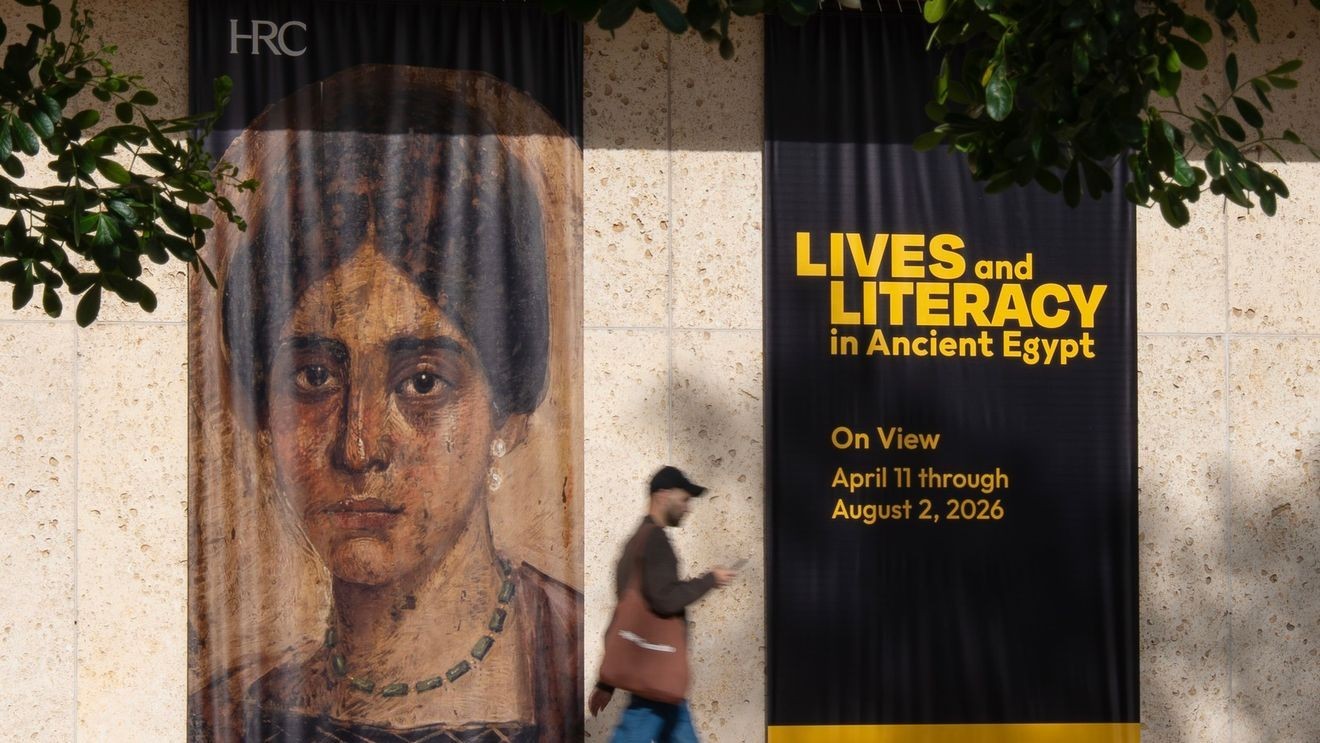
AUSTIN, Texas — In a quiet gallery on the University of Texas campus, the past does not feel distant. It feels legible.
Not in the way of grand monuments or museum-scale spectacle, but in fragments, a torn corner of papyrus, a line of ink on broken pottery, a face painted onto a wooden panel nearly two thousand years ago.
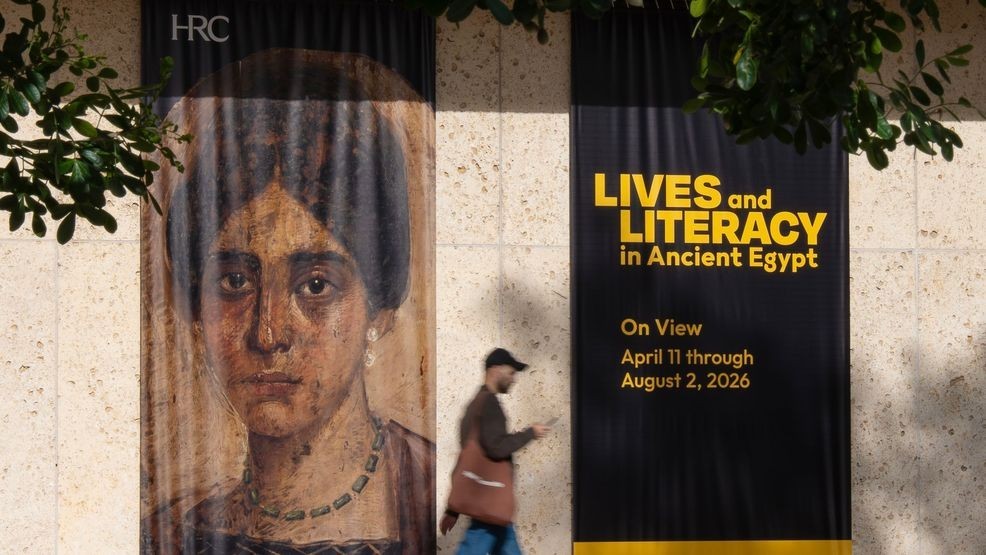
UK-US collaboration brings rare ancient Egyptian texts to UT’s Harry Ransom Center (Credit:{ }Harry Ransom Center)
Together, they form something closer to a whisper than a declaration. And yet, what they say is unmistakably human.
“It’s very cool,” said Aaron Pratt, curator of early books and manuscripts at the Harry Ransom Center, standing among the cases that hold more than 70 ancient objects, many of which have traveled farther than they were ever meant to.
When you have an exhibition that takes this long, and requires such a complicated logistical endeavor, it’s really thrilling to have this stuff coming to fruition.
The exhibition, Lives and Literacy in Ancient Egypt, is the product of a yearslong collaboration between the Ransom Center and the John Rylands Library in Manchester, England.
#TBT: UK-US collaboration brings rare ancient Egyptian texts to UT’s Harry Ransom Center
For the first time, many of these papyri and manuscripts, some of the most significant survivals of the ancient world, have left the United Kingdom and are now on display in North America.
“Any time institutions can get together,” said Jeremy Penner, a senior curator at the Rylands Library, “I think everyone benefits.”
But the real beneficiaries, it turns out, are not just the institutions or even the visitors.
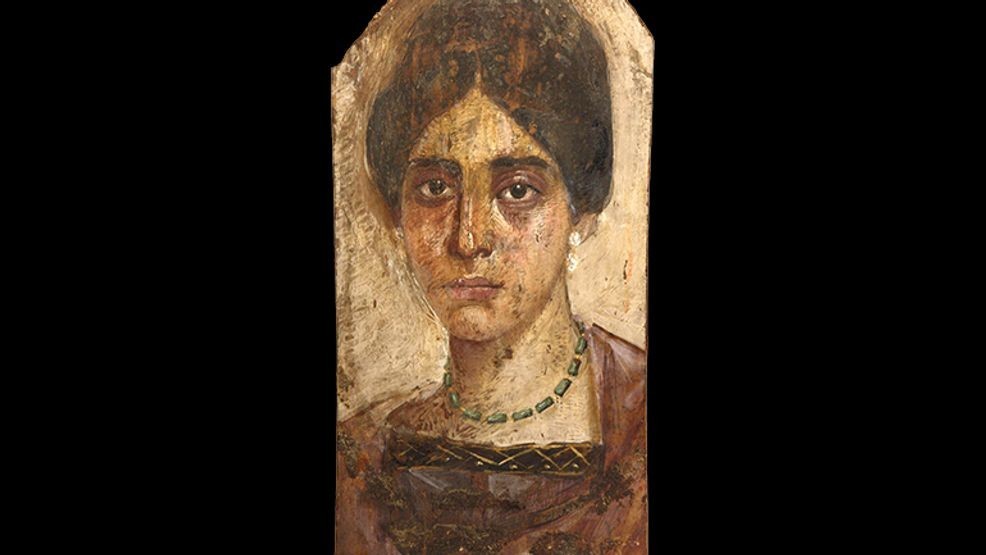
Panel painting (Classmark 2266). Encaustic portrait of a Roman woman painted on a thin wooden panel, originally attached to her.
It is the past itself, or rather, the version of the past that emerges when attention shifts away from emperors and monuments toward something quieter and more revealing.
Most of the objects in this exhibition were never meant to endure. Many were discarded in what Penner describes as ancient rubbish heaps.
MORE | #TBT: Oscar-winner Olivia de Havilland’s papers find a new home at UT’s Ransom Center
Their survival is accidental. Their significance is not.
“They weren’t meant to be preserved,” he said.
And so, we get a glimpse into people’s lives.
That glimpse is, in many ways, the point.
Ancient Egypt, as it is typically understood, is a civilization of spectacle, pyramids, pharaohs, and the afterlife rendered in gold and stone.
But here, the emphasis is different. The grandeur recedes. In its place: receipts, contracts, letters, complaints.
WEB EXCLUSIVE: This striking portrait was painted nearly 2,000 years ago and placed on a mummified woman in Egypt. Its lifelike detail offers a rare, personal glimpse at a real person behind the ancient texts—bringing history face-to-face.
“If you sell some sheep, there’s a document,” Pratt said. “If you’re paying your taxes on salt, there’s a document.”
What emerges is a portrait of a society built not just on monuments, but on paperwork, a deeply bureaucratic world in which writing, though limited to a relatively small literate class, shaped nearly every aspect of daily life.
Literacy, in this sense, was less an individual skill than a social system: scribes, officials, and intermediaries translating spoken needs into written form.
The result is a record not only of power, but of participation.
Among the fragments is a petition written on behalf of an enslaved woman, appealing to a magistrate over a disputed claim of ownership.
There is no resolution attached. But the act itself, the decision to write, to appeal, to assert, endures.
There are also texts that carry a different kind of weight.
One small fragment, no larger than a credit card, has drawn particular attention: a piece of papyrus known as P52, containing a few verses from the Gospel of John.
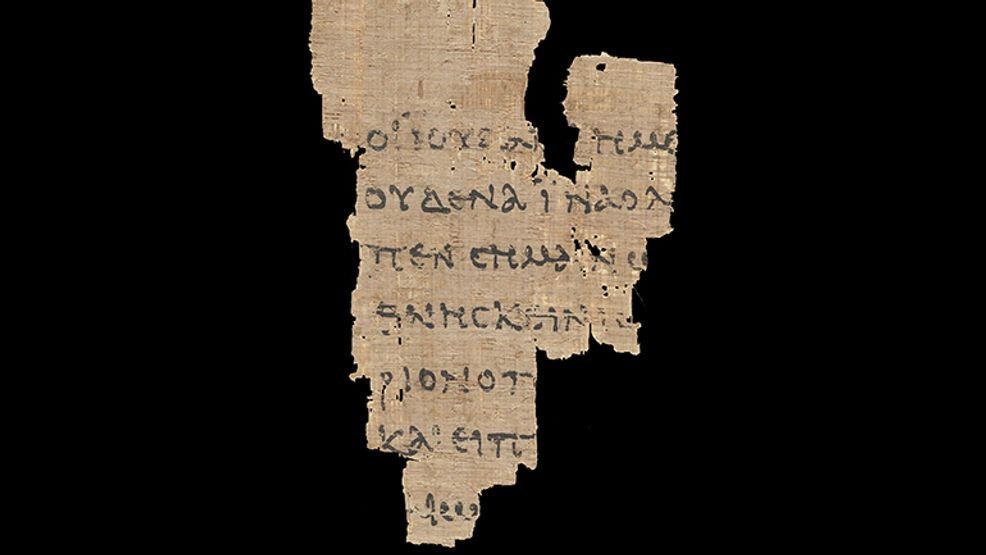
St. John Fragment (P. Ryl. 457). Papyrus fragment of the Gospel of John 1831–33, dated to the 2nd century CE. John Rylands Libra.
It is widely considered one of the earliest surviving copies of the New Testament, likely dating to the second century, within a generation or two of the original composition.
“It’s quite close,” Penner said. “Not that much time.”
The fragment’s significance is theological, historical, and even emotional.
ALSO | #TBT: Huston-Tillotson’s jazz orchestra brings big band legacy back to East Austin
But in the gallery, it is also something else, disarmingly small. Easy to overlook, if not for the surrounding context.
Elsewhere, the exhibition turns from the sacred to the intimate.
WEB EXCLUSIVE: This ancient papyrus blends science and magic—filled with mysterious, made-up words meant to hold power. It’s a glimpse at how people once tried to shape their world using language alone.
A painted funerary portrait, once wrapped in the linen of a mummy, captures the face of a woman from Roman Egypt with striking immediacy.
Her gaze is direct, her features individualized, her presence difficult to dismiss.
“This exhibition has a lot of writing,” Pratt said.
But to see a human face like this, I think, was really special.
It changes the terms of engagement. The texts are no longer abstractions.
They belong to people, people who argued, worshipped, recorded transactions, and occasionally, joked.
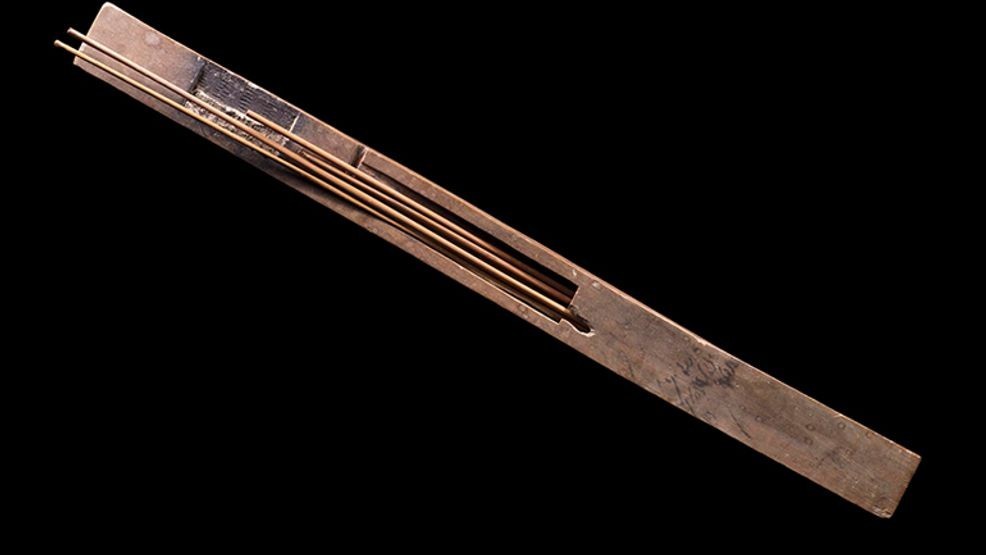
Writing palette and pen-case (Classmark 11500). Wooden palette and pen-case for a scribe, containing reed pens and a dried cake.
One such joke survives on a shard of pottery, known as an ostracon.
Written in a woman’s voice, it laments, or perhaps mocks, a lover’s preference for younger women.
The tone is ambiguous, somewhere between complaint and performance.
“This is probably the oldest joke at the Ransom Center,” Pratt said, with a hint of amusement.
It is tempting to treat such moments as curiosities, evidence of continuity across millennia.
WEB EXCLUSIVE: This ancient pottery shard, or ostracon, dates back to around 100 BCE—and features a surprisingly modern, humorous complaint about a lover. Now, UT researchers are studying it, shedding new light on everyday life in the ancient world.
People have always been people. But the exhibition resists easy conclusions.
Even the most familiar sentiments are embedded in systems, linguistic, cultural, and technological, that feel at once distant and strangely recognizable.
MORE | #TBT: From SNL to Mean Girls – UT Austin opens Lorne Michaels exhibition
Consider the languages alone: hieroglyphics evolving into more fluid scripts, Greek introduced through conquest, Coptic emerging later, Latin appearing at the margins.
Documents shift from scroll to codex, from papyrus to parchment. Communication adapts. So do the institutions that preserve it.
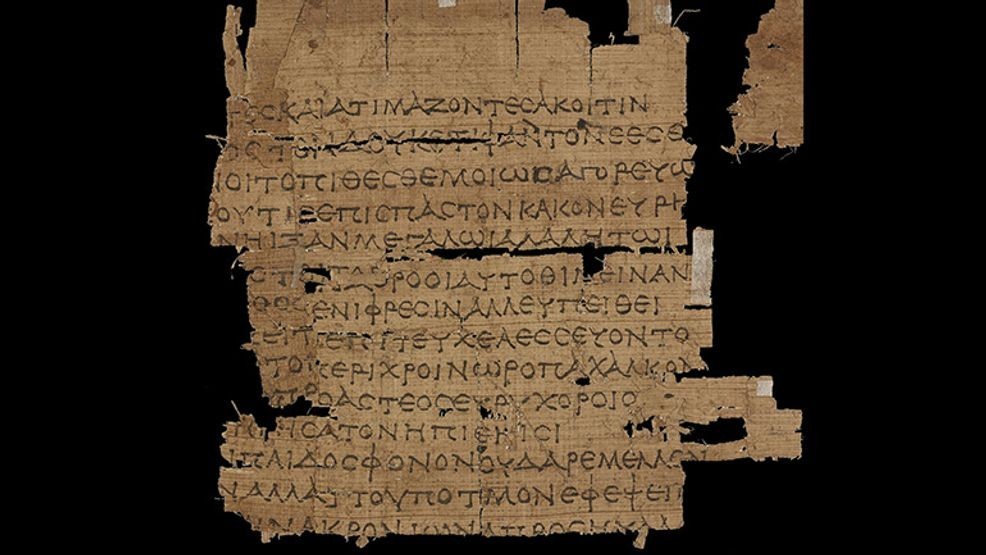
Fragment of Homer’s Odyssey (P. Ryl. Gr. 3 546). Papyrus fragment containing lines from Homer’s Odyssey, written in Greek.
Standing in the gallery, it is difficult not to think about the present, about emails and text messages, about the fragility of digital archives, about what, if anything, will remain.
“We collect emails, computer files,” Pratt said.
The forms of communication change, but the impulse doesn’t.
The exhibition does not insist on a direct line between then and now. Instead, it offers something subtler: a sense of continuity in the act of recording a life, however ordinary, however fleeting.
“If you’re interested in how we communicate and relate to one another,” Pratt said, “this is going to show you a version of that from thousands of years ago.”
WEB EXCLUSIVE: This rare page from Homer’s Odyssey was carefully written by a professional scribe nearly 2,000 years ago. Once part of a massive, costly book, it shows just how valuable—and fragile—stories were in the ancient world.
In the end, the power of Lives and Literature in Ancient Egypt lies not in any single object, but in the accumulation of voices, faint, fragmentary, and unexpectedly familiar.
They do not ask to be marveled at. They ask, simply, to be read.
The Lives and Literacy in Ancient Egypt exhibition is on view through August 2, 2026, and admission is free.
EDITOR NOTE: #TBT or Turning Back Time is an award-winning series of stories by CBS Austin This Morning Anchor John-Carlos Estrada. The series focuses on the history of Central Texas and its impact on the community. If you want to share a story idea with him, email him (jcestrada@cbsaustin.com) or message him on social media via Facebook, Twitter, TikTok, BlueSky, or Instagram.