
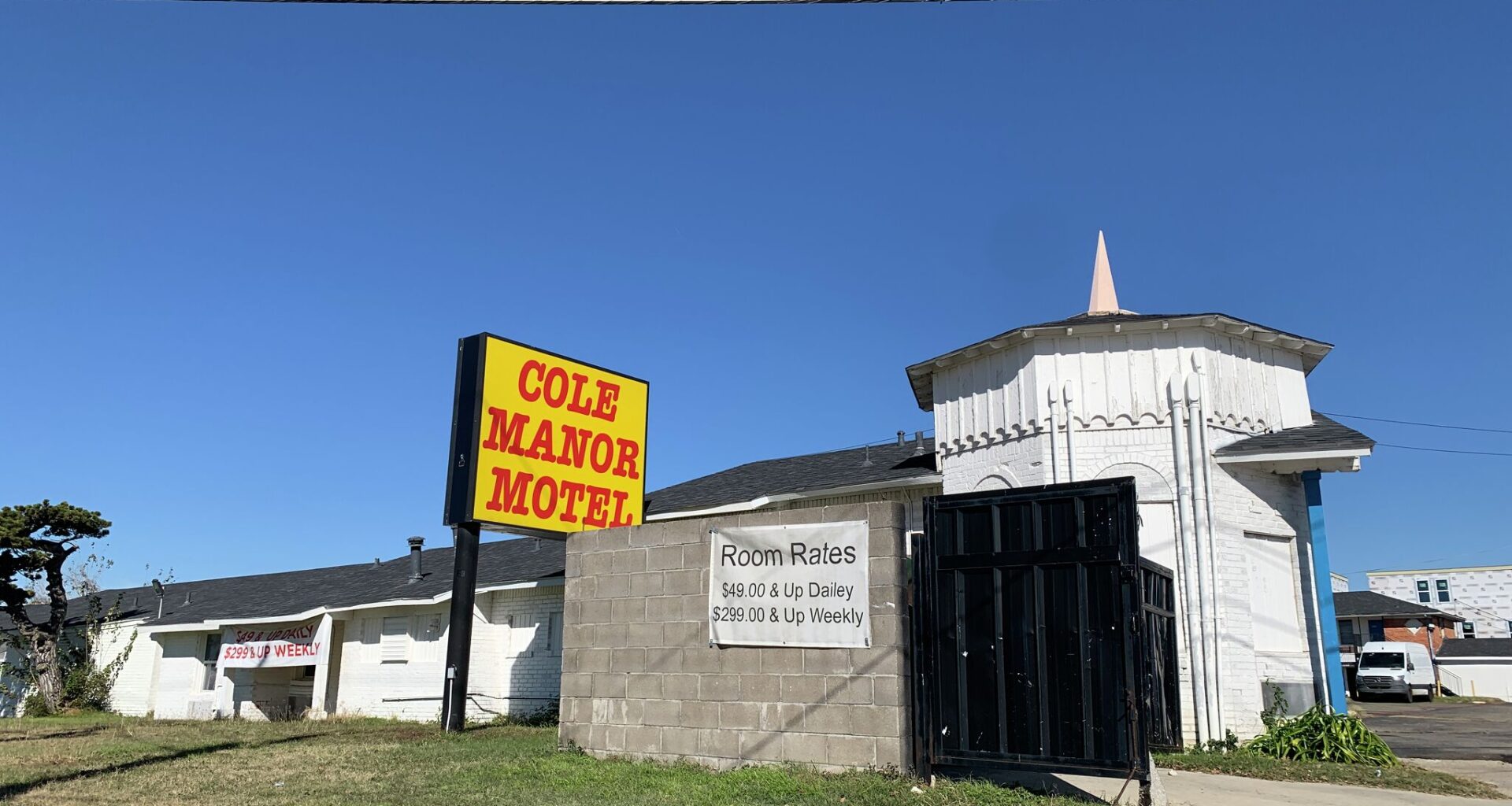
For a year, attorneys representing the city and Cole Manor Motel have been fighting over the fate of the crime-ridden, code-violating Harry Hines Boulevard motel.
Robert Wilonsky/Staff writer
A security guard, ever-present during past visits, wasn’t around Wednesday morning; the “OPEN” sign, occasionally illuminated, had been snapped off; the office, its doors unlocked, was nonetheless dark. For the first time in my four months of visiting, it was easy to walk freely around the confines of the Cole Manor Motel, built 80 years ago along Harry Hines Boulevard for tourists who long, long ago abandoned the beleaguered motor court to the locals.
A handful of cars — one, its driver’s-side window replaced with tattered plastic — and a white van were parked in front of rooms whose doors are painted blue. A woman walked a small white dog with legs the color of rust. The woman stopped to speak for a moment, but asked that I put away the notepad and not use her name because she didn’t want trouble. The 65-year-old said she has lived at the motel for four months, paying $375 each week.
Article continues below this ad
She said she grew up around the corner, on Thurston Drive just off Empire Central Drive, and came back here when she lost her job and everything else. Her son had told her Cole Manor was a dangerous place, but she said it’s just fine now, quiet enough, clean enough. The right place, for now, at the right price. She thanked God that the owners let her pay rent a little late whenever she can’t scrape it together on time.
Before we parted, I asked if she knew the owners of Cole Manor had agreed to sell the place within the next four months — a revelation in court documents filed at the end of last week. No, she said. I asked if she knew they’d agreed to tear it down if they could find no buyers. No, she said. I asked if she even knew the city had sued the owners in April of last year, alleging Cole Manor has long been used for the sale of drugs, weapons and sex. No, she said before we shook hands and said good-bye.
Police and prosecutors say very bad things have happened behind the blue doors at the Cole Manor Motel in recent years.
Daniel Carde/Staff Photographer
‘A beacon of hopelessness’
Article continues below this ad
This was my third visit to Cole Manor since December, made only because a trip to the courthouse for a trial had been canceled at the end of last week. An owner whose attorney had denied the motel was a dangerous place agreed, unexpectedly, to part ways with it, one way or another. Cole Manor may well celebrate its 80th anniversary by disappearing altogether; and with it, the people who’ve come to make a home in this motel on the margins.
Make Dallas News a preferred source so your search results prioritize writing by actual people, not AI.
Add Preferred Source
It’s easy to drive past or live near or walk around Cole Manor, and other tumbledown motels just like it along Harry Hines and scattered across town, and think only about the high crime and miserable conditions. Bad things happened here. In February 2025, local and federal officers made five arrests and seized six guns, fentanyl, crack and $20,000 in cash. Police say a 69-year-old woman was shot to death at Cole Manor. And in January, a 39-year-old man with a long history of felony charges sexually assaulted a child under 15.
Article continues below this ad
About a decade ago, a Dallas Observer writer described Cole Manor as “a beacon of hopelessness … the kind of place you’d sooner forget to pack your blow dryer than your gun.” But these places are also stuffed with men, women and children for whom cheap, dilapidated motor courts serve as the last stop before the street.
At some point, the original Cole Manor Motel sign was replaced by the smaller yellow version now planted along Harry Hines Boulevard.
Daniel Carde/Staff Photographer
“I’m scandalized when I drive past these places,” said Joe Dingman, co-founder of the Catholic Housing Initiative, which has converted several old motels into housing for the formerly homeless. “It makes me feel terrible. I wouldn’t wish anyone had to live at Cole Manor.”
The city usually encounters residents at these motels when the cops or coroner pay a visit. It took kids from Coppell overdosing at the Han Gil Motel in northwest Dallas before the feds raided the nightmare factory and it was shut down (and, eventually, torn down).
Article continues below this ad
Sometimes, too, the city buys these hostile hostels and sends their residents back to the streets. That happened in 2008, when the City Council spent $5 million to acquire the Delux Inn on Stemmons Freeway to build the Trinity toll road before that project was eventually put out of its misery (and ours). And in February 2022, when the council OK’d another $5 million for the TownHouse Suites on Independence Drive that staffers have been trying to offload ever since.
These motels-turned-low-rent apartments aren’t subject to the same code regulations and inspections, debated endlessly and approved in 2016, that demand accountability of apartment owners who let their properties fall into disrepute and disrepair. They’re treated like any other business: After they get a certificate of occupancy, they’re on their own. So the city only gets involved when it’s too late – and in the case of Cole Manor, after neighbors spent decades complaining of drug-dealing, prostitution and shootings.
Attorneys representing the city and the motel were scheduled to meet in court last week for a long-scheduled trial. But on April 9, a mediator sent a note to Judge Aiesha Richmond informing her “the matter has now been resolved.”
Yet there’s no real resolution. Not yet.
Article continues below this ad
Preservation Dallas has long worried that the Charles Dilbeck-designed Cole Manor Motel on Harry Hines Boulevard would be razed due to its proximity to the Medical District. If the current owners don’t find a taker for the motel, it may well end up in the landfill.
Daniel Carde/Staff Photographer
A troubled present (and past)
Mike Patel, president of Manor Hospitality Corp., has owned the motel for 25 years, but not for much longer; whatever comes next, whether that’s a sale or a bulldozer, Manor Hospitality will have its certificate of occupancy revoked within 120 days. The woman I met Wednesday knew none of this, because the agreement with the city says only that Patel has to give her notice “at least 10 days prior to closing the property.” New residents, however, have to be notified upon check-in.
When reached Wednesday, Jill Haning, deputy chief of the Litigation Division in the City Attorney’s Office, said only, “We have entered into an agreement with the property owner that we expect will resolve the longstanding issues at the property. We will be closely monitoring the owner’s compliance with the terms of the agreement.” Because Patel still has a laundry list of code violations to address.
Article continues below this ad
I never heard back from Patel’s attorney, Luke Beshara, who in December dismissed the city’s allegations as “unsubstantiated offenses that supposedly occurred and were somehow related to my client’s property.” Beshara’s also tussling with the city over two other southern Dallas motels with different owners – a Motel 6 on South R.L. Thornton Freeway and the Super 7 Inn on Independence Drive mere steps from the TownHouse Suites. Those have both been deemed habitual criminal properties by city attorneys.
Local preservationists have also long been concerned about the fate of Cole Manor, as it was designed by the architect, Charles Dilbeck, also responsible for the still-shuttered Belmont Hotel in Oak Cliff and numerous cherished and celebrated homes around town. It opened in 1946 for tourists as the El Sombrero Motor Courts; then shot well past its expiration date sometime in the 1970s, after its name was changed to the Cole Manor Motel.
The Cole Manor Motel opened 80 years ago on Harry Hines Boulevard as the El Sombrero Motor Courts. Like the beloved Belmont Hotel in Oak Cliff, the northwest Dallas motor court was designed by Charles Dilbeck.
Courtesy Willis Winters
Truth is, Cole Manor has always been a crime scene, dating back to 1950, when a 28-year-old pointed a gun at a clerk and demanded $300 from the cash register. Stories like that popped up in the papers every few years. By 1976, a front-page Dallas Times Herald story counted Cole Manor among the victims of a suspected serial arsonist terrorizing Oak Lawn. A year later, a guest murdered one man and injured another over what this paper called “a dispute over the amount of room rent.”
Article continues below this ad
By signing up, you agree to our Terms Of Use and acknowledge that your information will be used as described in our Privacy Policy.
Violence has been as much a part of Cole Manor’s history as its octagonal windows and the cupolas adorning the roofline.
But soon enough, Cole Manor will soon be under new ownership. Or buried in the landfill.