
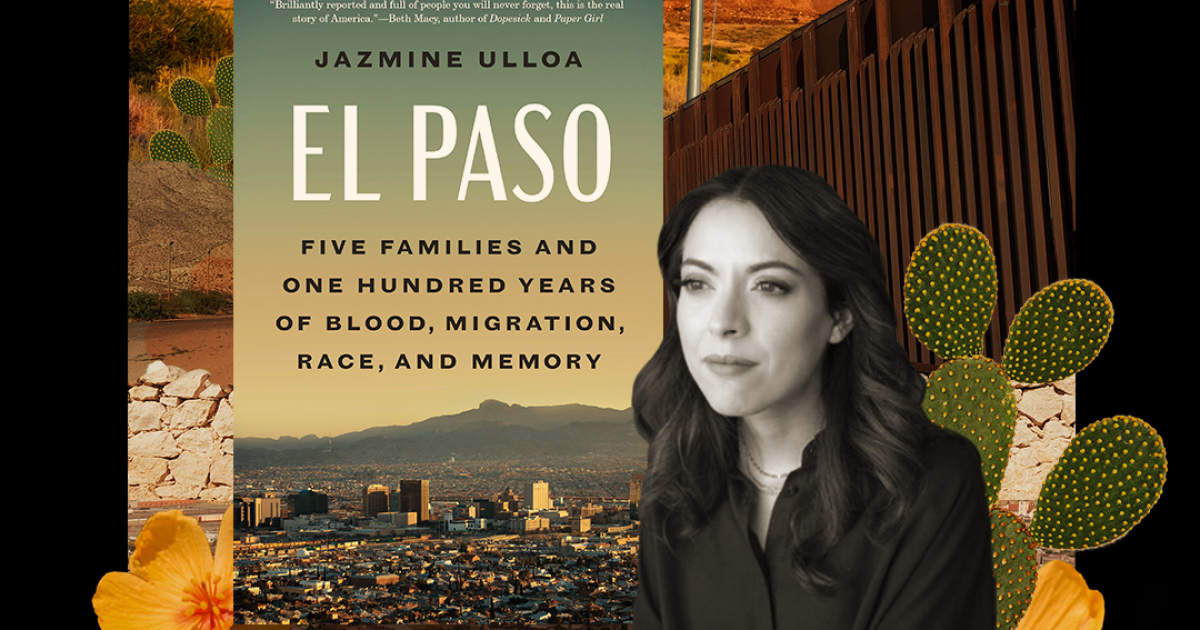
In 2019, journalist Jazmine Ulloa traveled to her hometown of El Paso to cover the aftermath of a deadly shooting in the border city. A gunman, who admitted to authorities that the attack was racially motivated against Latinx people, drove over nine hours from North Texas to an El Paso Walmart and killed 23 people, while injuring 22 others.
Ulloa, a Mexican American with roots in neighboring Ciudad Juarez, went to school three minutes away from where the mass murder occurred. When she arrived to El Paso, she found herself more emotionally distraught than she had anticipated.
“I thought I had a thick shell from my years of covering crime and courts as a young reporter,” Ulloa told The Times. “It was very difficult to hold it together.”
It was after attending a hillside memorial at the site of the incident — which offered sweeping vistas of El Paso and its sister city Juarez just across the border — that something clicked for Ulloa.
You’re reading Latinx Files
Fidel Martinez delves into the latest stories that capture the multitudes within the American Latinx community.
By continuing, you agree to our Terms of Service, which include arbitration and a class action waiver. You agree that we and our third-party vendors may collect and use your information, including through cookies, pixels and similar technologies, for the purposes set forth in our Privacy Policy such as personalizing your experience and ads.
“I did a lot of thinking there about wanting to return someday and really look at this massacre, not as this rupture in history, but part of this much larger legacy,” she said.
Nearly seven years later, Ulloa — now a reporter for the New York Times — published her book “El Paso: Five Families and One Hundred Years of Blood, Migration, Race, and Memory” about the fraught and instructive history of her hometown on March 3.
After spending more than a decade covering immigration, Ulloa used her connections and research skills to chronicle how the last 100 years in El Paso and Ciudad Juarez have been marked by all the maladies and movements that have come to shape the current state of American and Mexican society. Ulloa bounces between a linear, historical telling of the political, economic and racial shifts in the area and the personal accounts of five families from the region, including her own.
Part of her mission for the project was to reposition the sister cities from “forgotten places” in the American consciousness to “the center of not only American history, but Mexican history.”
Ahead of her appearance on the De Los stage at the Los Angeles Times Festival of Books this weekend, Ulloa spoke to The Times about her research process, the challenges she faced while writing the book, how she landed on which family histories she wanted to chronicle and the many ways that the ever-evolving dynamics of a border city can help explain the current state of the U.S.
This interview has been edited and shortened for clarity.
How many years of research did you have to do for the book?
I was working on telling this story through three national election cycles, so it was done over the course of about four years. As I was doing the research, I was traveling the nation for work. I was working out of hotels, coffee shops and airport lobbies. I’d spend the whole day trailing candidates and talking to voters in different states and then at night I’d do reading and research for the book. It was a really interesting process because immigration was becoming more and more of a salient issue with each election cycle. Candidates were sounding angrier on the issue of immigration and American voters were more divided, even if they did not always fit into these neat ideological boxes on the issue. To me, the echoes of history and of my hometown were never too far away.
How did you end up landing on these five families to view the history of El Paso through?
Some of the families I had met through the course of reporting daily news stories. The Rubio sisters — California state Sen. Susan Rubio and Calfornia state Assemblywoman Blanca Rubio (D-Baldwin Park) — I had actually met as a statehouse reporter when I was working at the Los Angeles Times in the Sacramento bureau. They were Democratic state leaders and were positioning the state as a bastion of resistance against the first Trump administration.
Part of the challenge was making sure I could corroborate as much as I could about all these families’ stories. So I had to find families who had kept documents or who were very open and who would would allow me into their lives. That’s a hard ask because many immigrants bring so little when they come into this country or when they’re deported during nativist periods. A lot of families don’t have heirlooms or don’t keep records of deportations.
One of the families was actually the family of a historian who had already been tracking some of that information. The Chews actually weren’t part of the original five. I was doing research and I kept coming across this photo of a woman who was dressed as a Mexican female combatant of the Mexican Revolution wearing a bandolier. Growing up, I had seen that photo and always thought she was a Yaqui Indigenous woman because she’s identified as such in some archives. Once I started digging into her backstory, I found out she was a Chinese Mexican woman and that many of her descendants were still alive. They had become prominent lawyers and judges in the border city and were very much shaped by the story of their grandmother. So that’s when I started trying to track them down.
With the Ixil Mayan family of Kaxh Mura’l from Guatemala, he was one of the many immigrants who had been stranded in Ciudad Juarez while I was covering the “Remain in Mexico” policy under the first Trump administration and then under the Biden administration.
What was the biggest challenge in writing this book?
I wanted it to feel different from a daily news story. I wanted it to sound like your grandfather or your grandmother telling you a story. I wanted it to sound how my mother would tell me stories about Mexican history or her upbringing in Juarez when I was younger.
I wanted it to feel really Mexican — like the Mexican-ness of that region. But I also wanted to capture the diversity within that Mexican-ness, within that Latinx identity. I was trying to come back to that at every turn and make sure that I included the perspectives of not only eminent scholars from Texas, but also from Ciudad Juarez and Chihuahua in Mexico, and Chinese Mexican scholars who had worked on both sides of the border. I also interviewed indigenous scholars who had been digging up their own history on both sides of the border. I tried to make sure I included as many perspectives as possible. History depends on who’s telling it and it can change depending on your perspective.
The story of the Chinese Mexican Chew family delved into the complexities of identity. They faced discrimination in the early 1900s through anti-Mexican and anti-Chinese legislation in the U.S. and in Mexico through anti-miscegenation policies and deadly assaults. Was that something you felt strongly you needed to include to show that one side of the border is not necessarily more just or moral than the other and that you being from there doesn’t make you blind to some of the injustices that were going on?
I tried to lean into that complexity of identity, of the violence and division at every turn. [The Chews’] story stood out to me because it was so emblematic of the migration through there. I was trying to show how El Paso is the American city that most tells us about our nation’s immigration battles today and that knowing its story lets us see that our southern borderlands have always been these rich, multiracial, multi-ethnic stomping grounds where the forces of conservatism, liberalism, white supremacy and resistencia have long been at odds.
I felt like the Chews really captured that. In Herlinda Wong Chew’s letters you can really see how there’s always been these grand debates about race in America. All those debates were already happening in her time period, but how she lived her identity was much more complex. Identities can collide and collapse into each other and people can forge these new forms of culture and connection, despite the many waves of hate and division that have swept the country through the eras.
What kind of reception have you gotten from people from Juarez and El Paso?
The reception has been incredible. It’s kind of blown me away because I knew that El Paso was a critical gateway into the United States — that’s what I set out to show. I’ve heard from so many families whose grandparents or parents crossed through these two border cities. So many people have also been coming forth to tell me their own stories of crossings.
I was amazed by how many people who came to the first reading in New York were from El Paso and Juarez, and we were comparing notes on who we knew. It feels like El Paso’s a city that’s really true to its name.
Do you feel that as things change, the more they’ve stayed the same, not only in terms of El Paso, but also how the country has moved through periods of ideological and legislative turnover?
I feel that El Paso is the city that’s key to understanding the nation’s immigration battles and how they’ve shaped, not only Latino identity, but American identity itself. The story of El Paso and Ciudad Juarez matters because without it, we don’t see that there is no Latino invasion of the United States; we don’t see that Mexican American culture and history have always been part of who we are as Americans.
As I was crisscrossing the country for work, I was passing through so many cities and towns that had seen these big demographic changes in recent decades and we’re now starting to have a lot of the same debates and fears of the “other” that had been so present in El Paso’s history for many generations. I feel the United States as a whole can learn a lot from where I’m from.

(Jackie Rivera / For The Times; Martina Ibáñez-Baldor / Los Angeles Times)
Join De Los at the L.A. Times Festival of Books this weekend 
This Saturday and Sunday on the USC campus, the L.A. Times is hosting its annual Festival of Books — the largest book festival in the country.
For the third year in a row, De Los and L.A. Times en Español are joining forces to present programming that highlights Latinx voices in the literary world.
People of all ages can enjoy children’s book readings on both days and music from Mariachi Corazon Hispano on Saturday morning.
My colleague Andrea Flores wrote about some of the can’t-miss panels that will take place on the De Los stage this weekend.
On Saturday at 1:05 p.m. Noticias Telemundo anchor Julio Vaqueiro will discuss his book “Río Bravo: Mexico, Estados Unidos y el Regreso de Trump” with Times journalist Soudi Jimenez.
Emmy-winning writer Gloria Calderón Kellett will head a conversation about the portrayal of Latina motherhood in works of fiction at 2:55 p.m on Saturday. Pulitzer Prize-winning playwright Quiara Alegría Hudes, New York author Alejandro Heredia and Cuban American writer Alisha Fernandez Miranda will join in on the discussion.
At 3:50 p.m. on Saturday, writers Alex Crespo, Carolina Ixta, René Peña-Govea will talk about dealing with “big feelings” in a conversation moderated by Locatora Radio host Ariana “Diosa Femme” Rodriguez.
Los Angeles poet Yesika Salgado will lead a poetry panel about identity and power that will feature poets Matthew “Cuban” Hernandez, Karla Cordero and Sonia Guiñansaca on Sunday beginning at 12:50 p.m. There will be a poetry reading following the conversation.
De Los’ resident Bad Bunny-ologist Suzy Exposito is moderating a discussion with fellow Benito experts Vanessa Díaz and Petra Rivera-Rideau about their book “P FKN R: How Bad Bunny Became the Global Voice of Puerto Rican Resistance.” The chat starts Sunday at 2 p.m.
Stories we read this week that we think you should read
Unless otherwise noted, stories below were published by the Los Angeles Times.
Politics and immigrationArts & EntertainmentSouthern California