
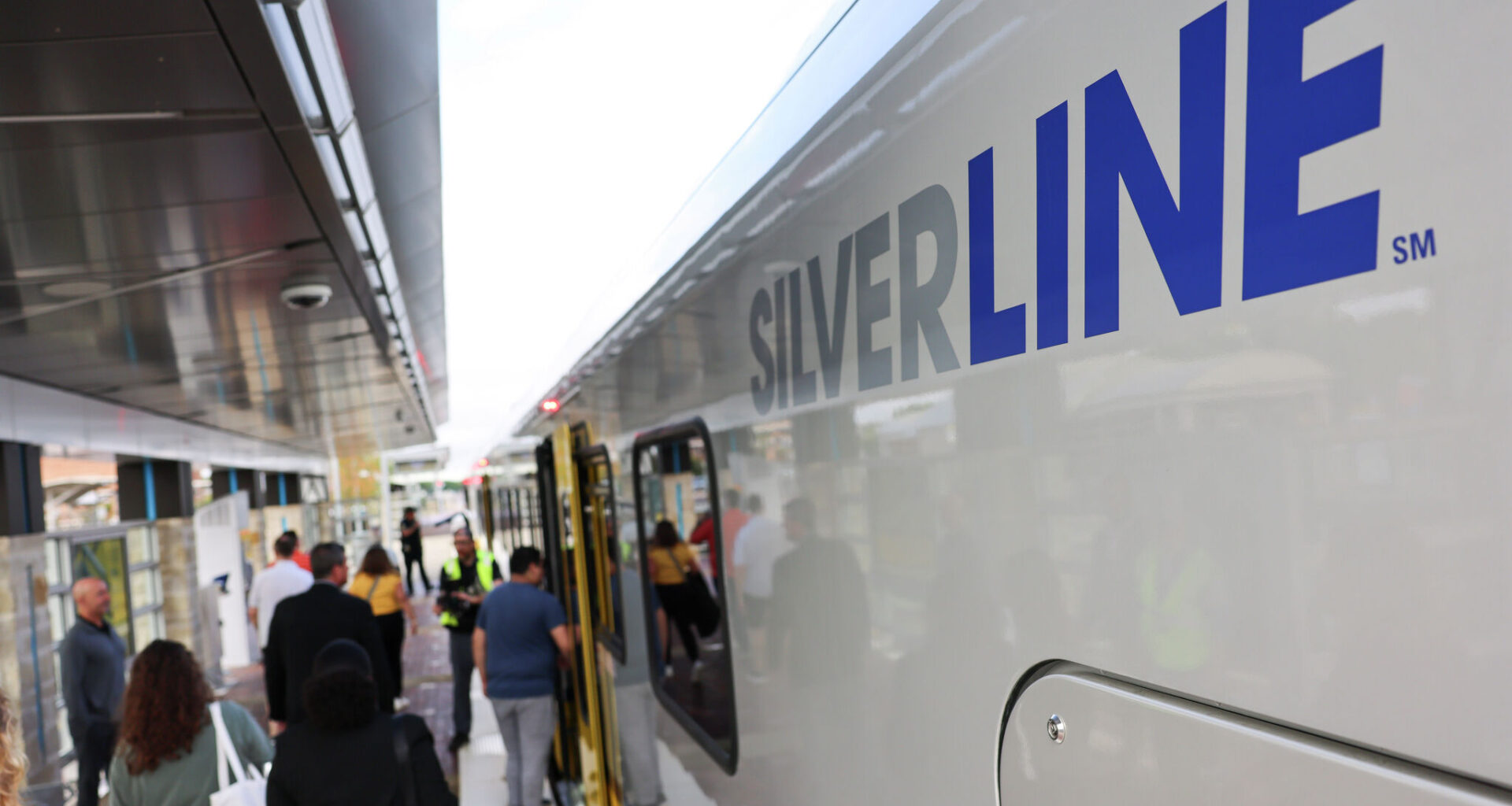
People board the newly inaugurated DART Silver Line as it prepares to depart for the next station following a ribbon-cutting to mark its opening, on Saturday, Oct. 25, 2025, in Addison.
Shafkat Anowar/Staff Photographer
Last fall, Addison was celebrating the newly opened Silver Line, hosting a ribbon-cutting at the Addison station and breathing a sigh of satisfied relief after years of advocating to bring more rail service north of Dallas.

Months later, the same City Council who posed by the tracks for a celebratory photo opted narrowly to put membership in Dallas Area Rapid Transit to a vote, just weeks after the council originally voted against calling the election.
Article continues below this ad
“It is kind of baffling,” said Addison resident and transit advocate Tyler Wright. “It seems, in the context of Addison’s history, quite a fast turnaround.”
Though proposed reforms and financial agreements convinced three other cities to cancel their withdrawal elections, Addison voters will decide May 2 whether DART service continues in the city or if trains and buses will move through without stopping.
Addison Mayor Bruce Arfsten has seen animosity bubble between residents as competing groups campaign for and against DART. It has brought the city’s regional role and future with microtransit into question, a multimillion-dollar inflection point that has riled a community still finding its place and defining its values.
Addison resident Valerie Collins said DART is not worth the money — it’s not truly a regional service and there are adequate alternatives.
Article continues below this ad
Make Dallas News a preferred source so your search results prioritize writing by actual people, not AI.
Add Preferred Source
“We need a system, there’s no doubt about it,” she said. “We totally believe in public transportation. We just don’t believe in DART.”
Here’s what’s at stake in Addison as voters consider leaving the public transportation system.
A history betting on DART
Over a decade ago, Arfsten remembers residents donning bright yellow T-shirts advocating for rail service in Addison, traveling in groups to DART’s headquarters to make their pitch.
Article continues below this ad
The city has bet big on transit. Addison’s City Council recently approved a $240 million mixed-use district with plans for an office building, hotel and entertainment space anchored around the Silver Line train station.
“How effective will the development be without the transit adjacent to it?” asked Arfsten, who voted against calling an election to leave DART. “I don’t think it’s going to be as effective.”
Addison Mayor Bruce Arfsten, (center right), Gary A. Slagel, (third from right) Board Chair of DART Board of Directors, and other officials cheer as they take part during the progressive ribbon cutting to mark the opening of the Silver Line, on Saturday, Oct. 25, 2025, in Addison.
Shafkat Anowar/Staff Photographer
DART reported about 225,000 rides on its services in Addison from October to December, including 16,000 rides on the Silver Line, nearly 205,800 on buses and nearly 400 rides on paratransit services in the city, which sits about 15 miles north of downtown Dallas and is home to more than 17,000 residents.
Article continues below this ad
For a relatively small population, Addison’s DART station stays busy because the city “is a powerful economic engine,” Wright said, with a buzzing restaurant scene and popular annual events.
“This historical understanding of the value of transit doesn’t seem to be recognized by the current council,” said Wright, founding vice president of transit advocacy group Dallas Area Transit Alliance.
Over two dozen former Addison mayors and council members endorsed a “Yes DART Addison” campaign letter asking residents to “continue to be part of the transportation solution” in the region and vote to stay in the system.
Madison McNair, an advocate for the disabled community and a DART rider, pictured at Addison Transit Center, Thursday, April 9, 2026, in Addison.
Elías Valverde II/The Dallas Morning News
Jim Duffy, a former Addison council member and treasurer of the Addison Way Forward political action committee, signed on to the letter.
Article continues below this ad
“Literally decades of leadership was in support of staying in DART,” Duffy said. “Decades of investment in DART shouldn’t be walked away from.”
A ‘troubling’ financial commitment
Tom Donohue, treasurer of the Addison Deserves Better political action committee, said it’s time to cut ties with DART.
As an Addison resident and a fiscal conservative, he said it was “quite troubling” to learn how much his city pays into the system, considering what an EY study found in 2023.
Article continues below this ad
The firm reported DART spent $9.5 million on services in Addison while taxpayers contributed $16.3 million in sales tax to the agency in the 2023 fiscal year. The study didn’t consider the economic impact of the Silver Line and its methodology has been criticized. But leaders in smaller, suburban cities have criticized DART for the imbalance.
“The suburbs were picking up the tab,” said Collins, who plans to vote to leave DART. “We need the tax dollars in Addison.”
If Addison leaves DART, the city will continue paying a one-cent sales tax to the agency to cover debt and obligations associated with the city’s contributions. Addison leaders estimate it will take around three years to pay off.
Article continues below this ad
The city could then hold an election to decide to spend its penny sales tax on things like public safety projects, lowering property taxes or economic development initiatives.
“It’s one of the reasons the Friscos and the Allens and the Prospers … exploded,” said Addison council member Randy Smith. “They have twice as much sales tax revenue for economic development as the rest of us do. So it’s time for us to start catching up.”
For those skeptical of remaining in DART, the 13-member system is hardly a regional entity — growth is creeping north, where many cities are not in DART’s service area.
And the Silver Line, Smith said, “is not going anywhere.” Its Knoll Trail Station, situated in Dallas but less than one mile from the Addison Transit Center, would not shutter if Addison voters chose to leave the system.
Article continues below this ad
Addison Mayor Bruce Arfsten, (center right), Gary A. Slagel, (third from right) Board Chair of DART Board of Directors, and other officials take part during the progressive ribbon cutting to mark the opening of the Silver Line, on Saturday, Oct. 25, 2025, in Addison.
Shafkat Anowar/Staff Photographer
Some residents also hope the federal dollars tied to the Silver Line project might protect the Addison station from shuttering if voters choose to leave DART.
In a statement, DART officials said “except under specific circumstances, DART cannot operate services outside of its service area,” and the agency intends to comply with the rules requiring it to stop operating the Silver Line in cities that leave.
Microtransit alternative
Addison City Council approved a six-month contract with Via, the same transportation company Arlington uses to provide on-demand, rideshare-style service. Plano has also contracted with the company to supplement DART service.
Article continues below this ad
Called Addison Orbit, the service is slated to begin April 24. The contract, which will cost the city no more than roughly $872,000, could be ended if voters choose to stay in DART. The proposed fare structure includes free travel to and from “rally points” that connect to DART service.
Donohue said Via could be a “good alternative for a suburban, small town like us.” Duffy is concerned the service isn’t the “door-to-door” solution leaders claim it will be.
“It’s really door-to-DART service, picking up people and taking them to the edge of Addison and dropping them off at a DART location,” Duffy said. “We’re proposing to discontinue paying for DART but continue to use it.”
Article continues below this ad
Arfsten worries about the loss to regional connectivity and efficiency in replacing DART services with microtransit.
“It’s just an additional stop for the rider,” he said. “How much of an inconvenience is that going to cause?”
Madison McNair, 29, lives in Oak Cliff and relies on DART paratransit services because of her disabilities. Several times a month, she uses DART to go to Addison to visit her sister or go to medical appointments. She has concerns about Via — commutes traversing different systems get more complicated, costly and lengthy, she said.
“DART is our freedom,” she said. “Losing a member city of DART could be detrimental to a lot of people.”
Article continues below this ad
Madison McNair, an advocate for the disabled community and a DART rider, poses for a photo as A DART Silver line train arrives at Addison Transit Center, Thursday, April 9, 2026, in Addison.
Elías Valverde II/The Dallas Morning News
Council member Howard Freed said the Via service can be renegotiated, unlike DART membership, which can only be voted on every six years.
“The beauty of Via is it’s expandable or shrinkable with our needs,” Smith said. “It’s a much more breathable, much more living system than the mammoth that DART has become.”
On either side of Addison’s DART debate, voters want the opportunity to decide for themselves.
Article continues below this ad

By signing up, you agree to our Terms Of Use and acknowledge that your information will be used as described in our Privacy Policy.
“It should be a decision the voters choose,” Freed said. “We pay more for this than we pay for police or fire or any other government service in Addison.”
Key dates
Early voting
Monday, April 20, 8 a.m. — 5 p.m.
Tuesday, April 21, No voting will take place for San Jacinto Day
Wednesday, April 22 to Friday, April 24, 8 a.m. — 5 p.m.
Saturday, April 25, 7 a.m. — 7 p.m.
Sunday, April 26, noon — 6 p.m.
Monday, April 27 and Tuesday, April 28, 7 a.m. — 7 p.m.
Election day: Saturday, May 2, 7 a.m. — 7 p.m.
First day to canvass: Tuesday, May 5
Last day to canvass: Wednesday, May 13
In any city that withdraws from DART, service ends the day after votes are canvassed