

EL PASO, Texas (KTSM) — An El Paso advocacy group is demanding accountability surrounding DWI cases and underage drinking.
The group, called the Sober Street Movement, is petitioning for stricter enforcement of existing DUI laws, harsher penalties for offenders and greater support for the families affected by these senseless tragedies, according to the group in a news release.
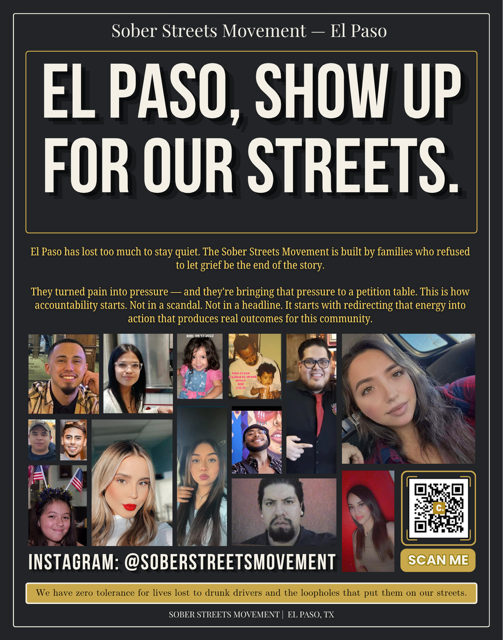
“By imposing mandatory minimum sentences, increasing fines and ensuring that repeat offenders face serious consequences, we can deter potential violators from getting behind the wheel while intoxicated,” read part of the news release.
Hope and Anchor bar hosted the petition event on Thursday, April 16. This comes after a 19-year-old DWI suspect was involved in a deadly crash in West El Paso, and claimed that prior to the crash, she was drinking at Hope and Anchor with her “Sugar Daddy.”
DOCS: Drinks with ‘Sugar Daddy’ lead to fatal crash
The Texas Alcoholic Beverage Commission has opened an investigation into the bar, but noted that the establishment has no complaints or violations on record.
The business released a statement following the investigation, saying that they are cooperating with the TABC and they take their responsibility as a licensed bar very seriously.
“Our hearts go out to the Andrade family. Jaime Andrade was a member of this community and his loss is a tragedy. Hope and Anchor has been part of the El Paso community for over 16 years. We are a neighborhood bar and we take our responsibilities as a licensed establishment very seriously. It’s how we have operated since our inception.
“We are cooperating fully with TABC and stand by our staff’s training, our ID verification protocols, and our legally vetted handbooks. Fake IDs are a persistent challenge facing every licensed establishment in El Paso and across Texas, and we card every guest who appears to be under the age of 30.”
TABC investigating Hope and Anchor after fatal crash
Araceli Rascon, the supervisor program coordinator for Sober Streets, says the drunk driving is a “overall community effort.”
‘We are fighting to change our laws and to have leaders hold people accountable when they do offend and more so when there’s a fatality involved. But the community has to do their part. And this location, allowing us to host an event to spread the word is so, so important and we’re very grateful for that,” she said.
Rascon has been personally affected by drunk driving, with the death of her 20-year-old daughter. According to Rascon, in 2023, her daughter and three other friends were out driving when they were hit by a drunk driver. Rascon’s daughter and a friend died as a result, and one friend has lifelong injuries.
“I think that, you know, all of the mothers in our group, you know, we truly hope that nobody is ever standing in our shoes. You know, this is a lifelong sentence that we live, waking up, and with a reminder that our kids, they didn’t have the fighting chance. And no other parent, no other family member, no other sibling deserves to live with that on a daily. And we hope that when they see our message, when they see what we’re trying to put together, we truly, truly hope that they say, ‘hey, you know what? I would hate to be in their shoes. And I would hate to be accountable for putting another family through this more than anything,’” she said.
Veronica Diaz, a representative with Sober Streets, is hoping to get city leaders together to start changing DUI and DWI laws.
“And we’re trying to push for changing the laws and marrying laws from one of the stricter states in the United States,” she said. “We also want to lower the BAC limit from 0.08 down to 0.05. As well as the bonds. The bonds in a DWI case, those need to be higher. DWI cases that involve fatalities, we’re trying to push no bond until you go to criminal court. That’s what we’re trying to push.”
She expresses the same sympathy as Rascon, as many members of the Sober Streets Movement have lost someone to a drunk driver. Diaz said these types of incidents are just everyday stories and people are not being punished enough, with the low bonds that they’re given.
“El Paso, we’re getting these stories every day. Every single day, you know, we talked to law enforcement and their hands are tied as well. I mean, they’re doing what they’re supposed to do. They’re getting those blood draws to prove that these people are intoxicated. But unfortunately, there’s a little run around where they go to jail and they come right back out because of the low bonds. Extremely low,” Diaz said.