
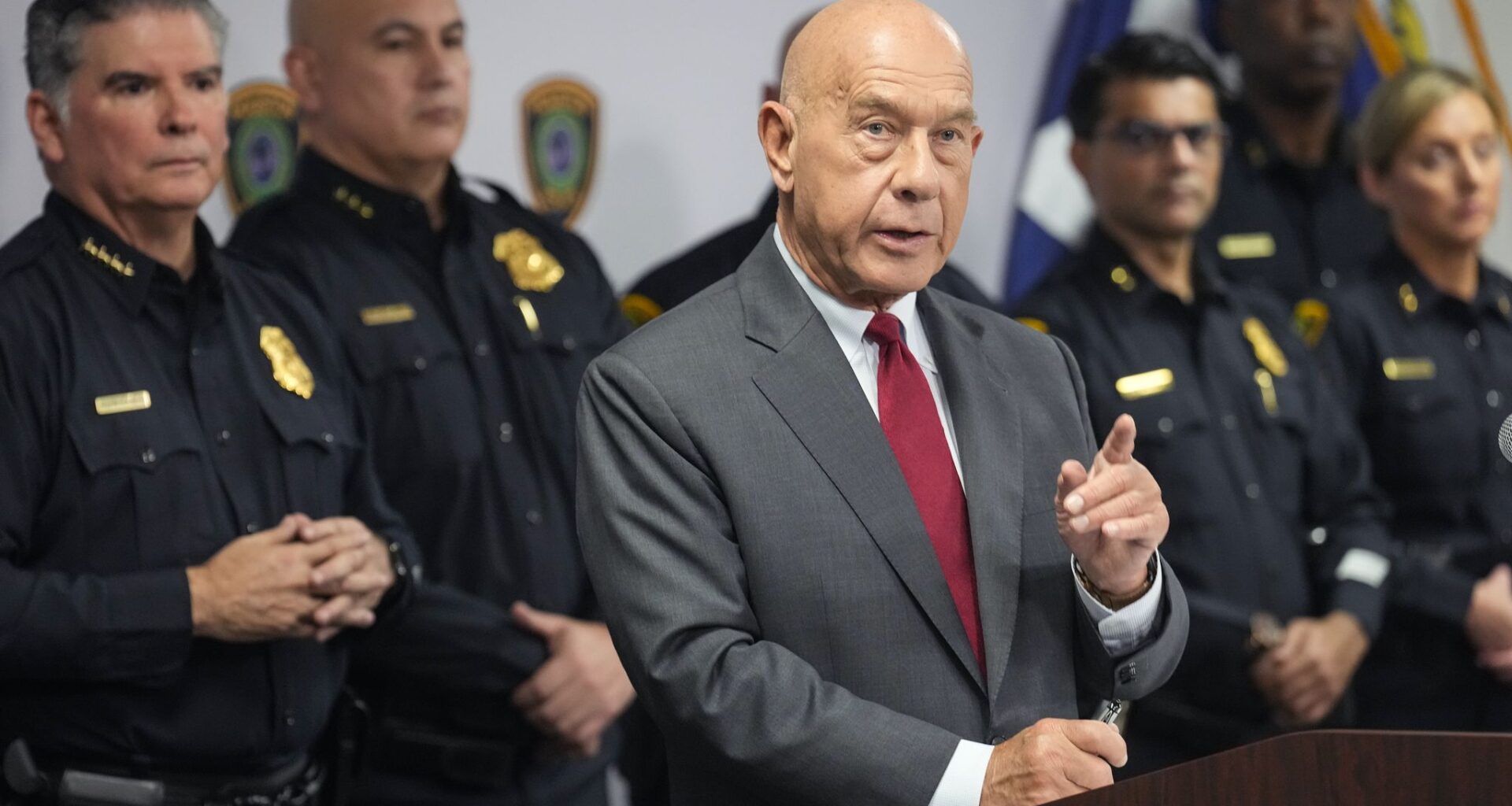
Mayor John Whitmire speaks to the media about the city’s immigration policies, after reports that at least two officers violated policies by transporting people to ICE, during a news conference at HPD headquarters in Houston, Wednesday, March 11, 2026.
Brett Coomer/Houston Chronicle
Mayor John Whitmire says the city must walk back its new policy limiting Houston police officers’ cooperation with federal immigration agents after Gov. Greg Abbott threatened to pull $114 million in grants over the measure, saying fighting back would be “a waste of time.”
But some council members are calling on the mayor to challenge state leaders – particularly since Attorney General Ken Paxton has sued the city over its policy. Legal experts say Houston could have a good case, and that a judge could block Abbott from following through on his threat.
Houston’s new policy eliminates a requirement that officers wait 30 minutes for U.S. Immigration and Customs Enforcement agents to arrive when they encounter someone with an immigration warrant. These are civil documents that do not on their own give officers the authority to make arrests.
Article continues below this ad
Legal experts and the authors of the ordinance argue Houston’s new policy brings the city in line with the Fourth Amendment of the U.S. Constitution, which prohibits officers from detaining people excessively. For instance, once the original reason for a traffic stop is addressed, a driver with an immigration warrant must be released even if federal agents have not reached the scene.
But the measure – and similar policies in the cities of Austin and Dallas – has come under attack from Republicans.
Paxton’s lawsuit alleges Houston’s policy violates a 2017 state law prohibiting cities and counties from “materially restricting” cooperation with ICE. And Abbott says the ordinance falls afoul of the terms of Houston’s agreements to receive federal public safety grants that are passed through the state.
The U.S. Fifth Circuit Court of Appeals largely upheld that 2017 law, called Senate Bill 4, after a lawsuit questioned whether parts of the bill were unconstitutional. But that case did not set a clear precedent, said Marc Levin, the Houston-based chief policy counsel for the Council on Criminal Justice.
Article continues below this ad
“A court hasn’t ruled on whether or not SB 4 is in conflict with the U.S. Constitution,” Levin said. “There hasn’t been a ruling on the points at issue here.”
Levin added that there might even be an argument that SB 4 doesn’t apply to Houston’s ordinance.
As for the paperwork Houston signed to receive public safety grants, one legal expert who reviewed the documents described in the letter Abbott’s office sent Houston questioned whether the conditions apply to the city’s ICE policy.
The grant document requires cities to report information about immigrants in “custody” to federal authorities and prohibits cities from restricting cooperation with ICE agents.
But Krystal Gómez, an attorney with the Texas Immigration Law Council, said Houston’s ordinance does not deal with people in “custody,” only those briefly detained, such as during traffic stops. These are legally different situations, she said.
Article continues below this ad
Council Member Alejandra Salinas, one of three council members who put forward the new ICE policy, has urged Whitmire to seek a court order temporarily blocking Abbott from taking the city’s grant funding while the case works its way to a trial on the merits.
“As legal experts have made clear, the state’s position is unlawful,” Salinas said to Whitmire during a Tuesday council session. “This ordinance, which we both voted for, is fully compliant with Senate Bill 4. It does not restrict communication with federal authorities or prevent enforcement of criminal law. It ensures officers remain focused on solving crime.”
In response, Whitmire said the city shouldn’t “play chicken” with the governor, and that any effort to push back was ultimately doomed in Texas’ GOP-run courts.
Whitmire’s office did not respond to a request for comment for this story. The mayor and his office have not responded to questions from the Houston Chronicle since August.
‘Political theater’
Friction between state leaders and Texas’ big cities is not new.
Article continues below this ad
Cities and counties have faced significant pushback in recent years from a state government looking to crack down on local control, Levin said. And in many of those cases, local leaders have turned to the courts to mediate.
Dustin Rynders, legal director of the Texas Civil Rights Project, spoke before council on Tuesday and gave the example of Harris County, which has battled the state on several items.
An appeals court, for instance, just a month ago struck down Paxton’s effort to halt the county’s immigrant legal services fund after Harris County filed a lawsuit against the state.
“When you fight, you often win,” Rynders said.
Both Abbott and Paxton have said they’re eyeing other cities’ policies. Late Thursday Abbott’s office sent letters to Dallas and Austin threatening them with a loss of grant funds over their ICE policies.
Article continues below this ad
In response, Austin Mayor Kirk Watson said he “will not play into this political theater.” Watson said city leaders were confident their rules did not conflict with Senate Bill 4, and that the governor’s threats would actually put public safety at risk. In the state’s letter to Austin, the money at risk was about $2.5 million.
Calls to Dallas, which has stricter rules on police cooperation with ICE, about their plans went unreturned as of Thursday afternoon.
A spokesperson for San Antonio said that city’s rules are fundamentally different from those of Houston. He said San Antonio does not plan to take legal action against the state and “continues to operate within federal and state law.”