
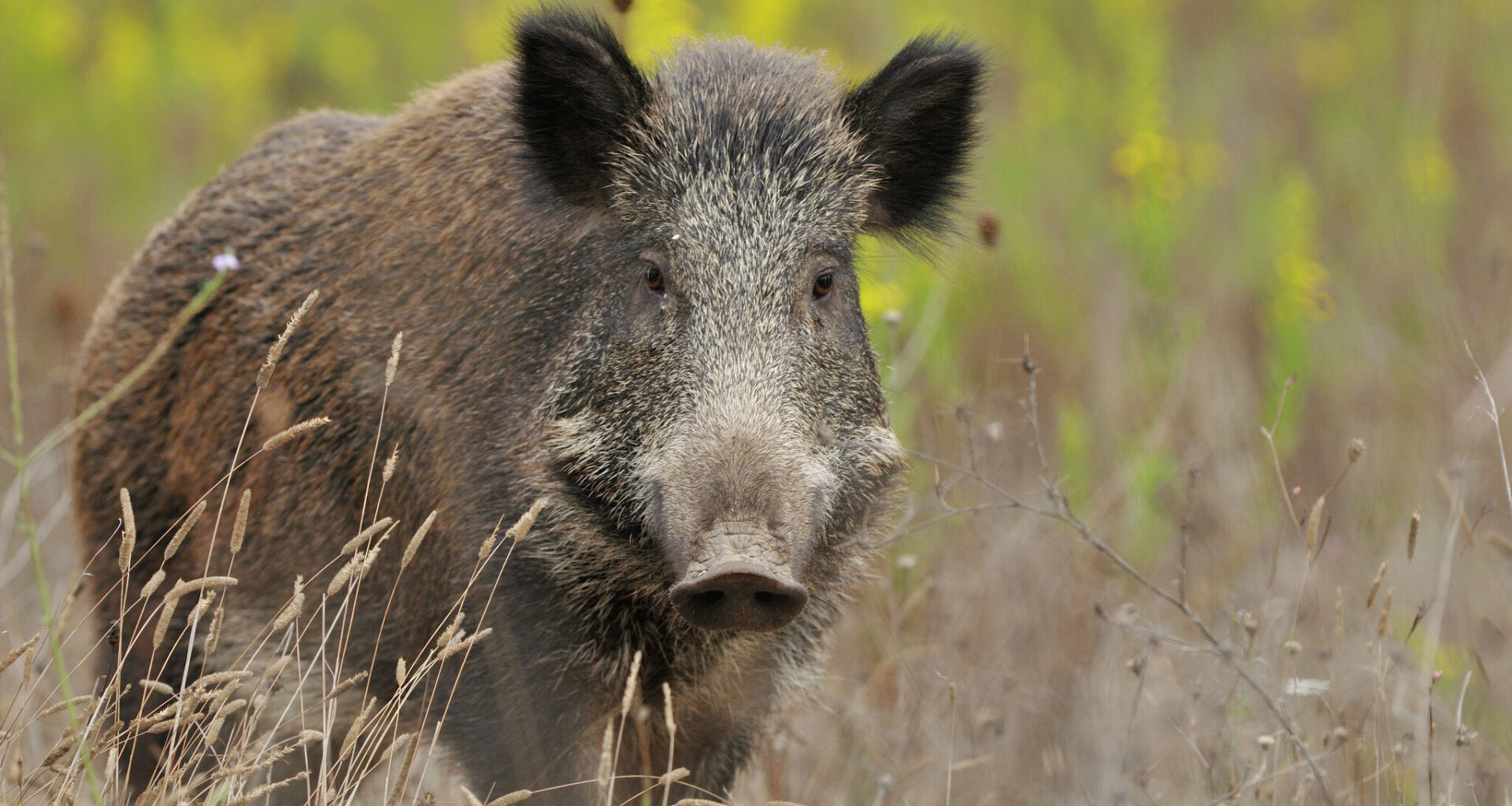
Known for their rapid spread, feral hogs have established populations across most of Texas.
mauribo/Getty Images/iStockphoto
Feral hogs have torn through crops, neighborhoods and natural areas across nearly all of Texas. But there’s one place where they haven’t managed to take hold.

In a state with an estimated 3 to 4 million wild pigs spread across 253 counties, El Paso County stands apart as the lone holdout—at least for now.
Article continues below this ad
“I don’t know that I want to say it’s completely free, because someone could always send a picture with a perfect geolocation and prove otherwise,” said Marcus Blum, an assistant professor and AgriLife Extension wildlife specialist who focuses on large mammal ecology and management. “But it’s definitely free of an established population to our knowledge. I wouldn’t be surprised if there’s an occasional hog out there, but there’s no confirmed population.”
What’s working against them
That distinction matters in Texas, where feral hogs are one of the most destructive invasive species on the landscape. According to the Texas A&M Natural Resources Institute, the animals cause an estimated $670 million in agricultural damage each year, plus another $200 million in control and mitigation costs. They root up crops and hay fields, damage rangeland and can spread disease to livestock and wildlife.
Article continues below this ad
Despite thriving in much of Texas, feral hogs have not established a population in El Paso County, experts say.
Texas Parks and Wildlife Department
Blum says there’s no single, clear answer, but the environment plays a major role.
“It’s very arid, which typically doesn’t support hogs well,” he said. “The area itself isn’t great hog habitat—it’s very dry, and they rely on water—but for whatever reason, they just haven’t established there.”
Article continues below this ad
That lack of water is key. While feral hogs are famously adaptable—capable of eating almost anything and surviving in a wide range of environments—they still have limits.
“As long as they have water, they can take advantage of the habitat for the most part,” Blum said. “But they’re not desert-adapted animals like mule deer or sheep.”
Water scarcity can make it difficult for feral hogs to establish in some parts of Texas.
GizmoPhoto/Getty Images/iStockphoto
West Texas as a whole tends to have fewer hogs than the rest of the state, but even that region isn’t entirely spared. Populations pop up in pockets where conditions allow, especially near water sources or agricultural areas.
Article continues below this ad
“When we’re talking about densities, West Texas is going to be lower,” Blum said. “There are pockets here and there, but if you compare West and East Texas, it’s not really a comparison. West Texas will have way fewer hogs.”
A problem across the rest of Texas
In East Texas, the opposite is true. The wetter climate, dense vegetation and abundant forage create ideal conditions for hogs to thrive and multiply.
And multiply they do. Female hogs can begin breeding as early as six months old, with a gestation period of about 115 days, helping fuel rapid population growth across the state.
Article continues below this ad
That growth is part of why hogs now occupy nearly every corner of Texas. Originally introduced by Spanish explorers in the 1500s, escaped domestic pigs established wild populations that have since spread across much of North America and eventually the globe.
Even so, El Paso County remains an outlier.
What could change
Blum doesn’t rule out the possibility of hogs passing through from time to time, but establishing a permanent population would take significant changes.
Article continues below this ad
“They’d need suitable habitat, food and especially water,” he said. “Water is always a big limiter in arid environments.”
Development could theoretically help bridge that gap by creating green space and water access, but even then, it would take what Blum described as a “perfect storm,” including connections to nearby established populations.
If hogs were to gain a foothold, the first signs would likely show up in the places that provide those missing resources.
“You’d start seeing damage anywhere with water or agriculture—green spaces, developments, riparian corridors,” Blum said. “Anywhere that attracts them, you’d start seeing rooting and other signs.”
Article continues below this ad
Feral hogs have spread across nearly all of Texas, but experts say El Paso County still lacks an established population.
taviphoto/Getty Images/iStockphoto
For now, though, El Paso County represents something rare in Texas: a place where one of the state’s most persistent invasive species still hasn’t taken hold.
“Every species has its limits,” Blum said. “Even though invasive species are very adaptable, there’s always something that holds them back. Hopefully, in this case, El Paso is one of those limits.”
Article continues below this ad
Managing feral hogs elsewhere in Texas remains an ongoing challenge. Efforts typically rely on coordination between state and federal agencies, along with private landowners, and often involve lethal control methods tailored to specific properties.
“If neighbors aren’t working together, it’s going to continue to be an issue,” Blum said. “We’re probably not at a point where we can remove them entirely, but we can try to manage their growth.”