
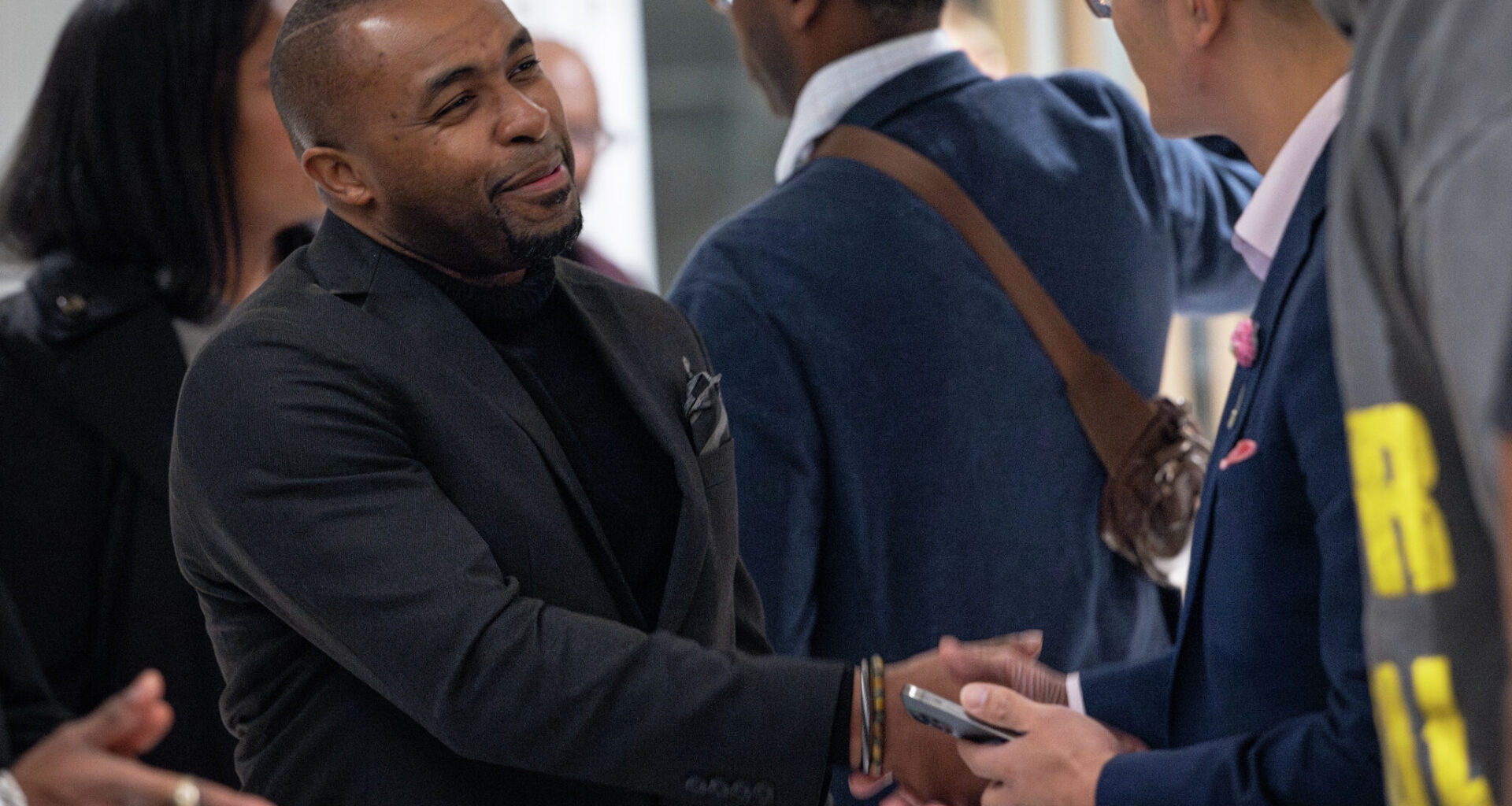
Entrepreneur Deric Durden speaks with other guests at a networking event hosted by Longhorn International Motorsports on Jan. 14, 2026, in Frisco. Durden is a motivational speaker and transition coach.
Angela Piazza/Staff Photographer
Deric Durden remembers when a letter with his name on it landed on the desk of a corporate CEO he had never met, written by people at the South Dallas Employment Project who had only recently met him.

The letter transformed his life after he served 17 years of a 25-year prison sentence for murder.
Article continues below this ad
Durden says he is not proud of what happened all those years ago — he fatally shot a man near a fast food restaurant following an argument outside a Dallas nightclub — nor does he shy away from owning his actions.
The cycle of jail and reincarceration costs counties millions of dollars from criminal justice systems costs to lost tax revenue. Breaking that cycle and helping people successfully reenter the workforce can help stabilize Dallas communities and provide area employers with a skilled workforce.
“What happened all those years ago was a young man searching for meaning, acceptance and purpose,” he said. “How I went about getting those things was wrong and I am truly remorseful for my decision.”
The South Dallas Employment Project has played a pivotal role in providing Durden an opportunity to channel that remorse into something positive.
The project’s navigators, directors, and co-founder Wes Jurey meet to discuss clients like Durden. If they are convinced a client is ready – after vetting their needs, qualifications, and character – Jurey reaches out to employers to advocate for them.
Article continues below this ad
Annette Underwood, with Vistra Corp, presents the Employer of the Year award to Ken Kuwamura, with Union Pacific, during a South Dallas Employment Project meeting and awards luncheon on Jan. 12, 2026, in Dallas.
Angela Piazza/Staff Photographer
That’s how Durden’s letter happened. Jurey talked to Annette Underwood, chief diversity officer at Vistra, to confirm the Irving-based Fortune 500 electricity and power generation company’s openness to hiring people with serious criminal records. On the strong recommendation of SDEP’s job navigator and director of operations, Jurey reached out to ask Underwood and Vistra to consider giving Durden a corporate job.
Make Dallas News a preferred source so your search results prioritize writing by actual people, not AI.
Add Preferred Source
Vistra did. Durden obtained a role that came with health insurance, retirement benefits and college tuition assistance, opening a door he struggled to push open alone after grinding out six‑day work weeks selling cars without benefits.
Article continues below this ad
The new job did more than change his paycheck. Durden was 19 when he went to prison. His daughter was just two weeks old. When he came home in 2022, she was six months from graduating high school and wanted nothing to do with him. The stability from his Vistra job, he said, gave him a foundation to keep showing up anyway.
“Because I had the bag and the stability that was presented to me, I was able to continue to fight for my relationship with my daughter, and today, my daughter is 21 years old,” Durden said. “The relationship we have is so beautiful now, but it was built on somebody taking a chance.”
“The bag” refers to the steady income, benefits and support he never had before.
Durden’s redemption is what the South Dallas Employment Project strives to replicate for thousands more Dallasites. The nonprofit coalition focuses on people who are unemployed, underemployed or considered unemployable. It connects them to short-training programs that lead to industry-recognized credentials and rides to job sites and classes when bus routes fall short. It helps them obtain IDs and driver’s licenses, and housing and health services through county and nonprofit partners such as Metrocare.
Article continues below this ad
The nonprofit now operates through 10 service centers embedded in apartments and nonprofit facilities and has grown from 14 founding organizations to more than 250 partner groups across the region. Since launching services in 2022, SDEP has invested about $2.2 million in this network, helping roughly 3,000 youth and adults last year alone.
It is funded through a mix of government grants, private donations, and support from philanthropic foundations, including early backing from United Way of Metropolitan Dallas, the Communities Foundation of Texas, and others. Additional support comes from contracts with local employers and agencies to provide transportation and wraparound services. (United Way and The Communities Foundation are supporters of the Future of North Texas initiative at The Dallas Morning News.)
SDEP’s leaders want its combination of hands-on screening, personal advocacy, and steady follow-up to become the norm citywide, rather than a lucky exception for Durden and others. To that end, the nonprofit continues to add more employer partners to expand its work.
Jim Burke, president and chief executive officer of Vistra Corp., speaks during the official countdown to United Way’s centennial celebration at AT&T Discovery District in Dallas, TX on Oct. 24, 2024.
Nathan Hunsinger/Special Contributor
Programs such as SDEP demonstrate real success reducing recidivism and meeting workforce needs, said Vistra CEO Jim Burke. He said SDEP clients display “eagerness, a hunger, [and] a gratitude for the work and opportunity.”
Article continues below this ad
Lauren Driscoll, a senior project manager at Vistra, said SDEP helps with transportation vendors to get people to job sites and offices, and is doing novel things like character-based lending rather than just focusing on credit scoring.
“Even though SDEP is currently doing really great work in this space, one organization can’t solve it,” she said. “If we want to scale the livable wage for many people in North Texas, everyone has to come to the table.”
Leaders from Dallas County’s justice system, including jail administrators and probation authorities, have now asked SDEP to help connect roughly 10,000 more people and their families to services each year, reflecting the volume of residents coming back into the community from the county jail, Hutchins State Jail and the juvenile system.
SDEP’s founders and partners argue that if more of those residents can move into stable, living-wage work instead of cycling in and out of lockups, it will strengthen South Dallas’ and North Texas’ entire labor force and tax base.
Article continues below this ad
The 6‑year‑old nonprofit network was created by Jurey, CEO of Redemption Bridge and former chair of the Texas Workforce Investment Council, and Froswa’ Booker‑Drew, then-vice president of the State Fair of Texas and a longtime South Dallas community leader. Jurey said the organization has connected more than 8,000 people and their families to jobs, training and essential services.
“If it takes a village to raise a child, it’s going to take a community to transform some of the most challenged areas of that city.”
Holistic support
Michael Hinojosa, South Dallas Employment Project chairman, delivers a speech after accepting the Founders Award during a South Dallas Employment Project meeting and awards luncheon on Jan. 12, 2026, in Dallas.
Angela Piazza/Staff Photographer
A significant share of Texans in the criminal justice system are there for nonviolent offenses, said Michael Hinojosa, chair of the SDEP Leadership Council and a former Dallas ISD superintendent. Nearly one in three Texans has a criminal record, according to the Texas Appleseed advocacy group.
Article continues below this ad
Statewide, about 47.2% of prison inmates are rearrested within three years, with 16.9% reincarcerated, according to the state’s Legislative Budget Board. Recidivism rates are worse among state jails, where 61.5% of state jail inmates will be rearrested within three years, with 24.3% reincarcerated.
Those cycles cost counties millions of dollars in arrests, jail time and court proceedings alone, Jurey said. They also represent lost tax revenue and economic activity, because people who are cycling in and out of jail are not working or contributing to the region’s growth while taxpayers cover the cost of incarceration.
Nationally, only about 12.5% of employers readily hire people with criminal records, Jurey noted, which makes it even harder for those residents to return to steady work unless someone helps them clear barriers and build job skills.
People with records make up about half of the roughly 3,000 youth and adults SDEP served last year, he said. The other half includes veterans, youth at risk, people fighting addiction, those who are homeless, the working poor trying to get by on minimal wages and unemployed residents who need help building a sustainable life.
Article continues below this ad
Jurey said North Texas will not be able to meet the demand for skilled workers in critical industries unless employers are willing to integrate all of those groups into the workforce.
Dallas County releases about 150 people from its jail each week, roughly 8,000 people a year, Jurey said. Many of them return to South Dallas communities already strained by low wages, limited transit and few paths to the kinds of practical skills local employers need.
In some South Dallas neighborhoods, such as ZIP Code 75210, typical annual incomes hover around $14,000 to $15,000, and roughly 70% of households are headed by a single adult, Jurey said. About a third of adults in these communities lack a high school diploma, creating a pool of workers who are locked out of higher-paying jobs, he said.
Homeless people and people in addiction treatment face many of the same obstacles, such as unstable housing, gaps in education and spotty work histories that make it hard to find and keep steady, better paying jobs.
Article continues below this ad
These issues undercut Dallas County’s ability to build the skilled workforce North Texas’ economy needs, and leave taxpayers paying repeatedly for short-term fixes instead of long-term stability.
Ken Kuwamura delivers a speech after accepting the Employer of the Year award presented to Union Pacific during a South Dallas Employment Project meeting and awards luncheon on Jan. 12, 2026, in Dallas.
Angela Piazza/Staff Photographer
At any given time, Texas has more than 20,000 open jobs in manufacturing, logistics, construction and related fields, Jurey said. Many of those positions churn constantly because employers hire people who lack industry level skills and then let them go within weeks.
Basic administrative barriers can also stall reentry into the workforce. State agencies regularly tell people it will take two to three months to secure a driver’s license or other state ID, Jurey said.
Article continues below this ad
But through an agreement with the Texas Department of Motor Vehicles, SDEP can secure driver’s‑license appointments for its clients at locations across the state within about 10 days. A partnership with the national group VoteRiders helps people navigate the documents they need to bring.
The South Dallas Employment Project now accepts clients referred from a range of agencies, including city community courts and county specialty courts, Dallas police, city marshals, the Texas Department of Criminal Justice, the Texas Juvenile Justice Department and Dallas County’s juvenile system.
Those referrals help, but the group’s leaders say without a coordinated system to connect those residents to support, North Texas will continue to bear the financial and human cost of churn instead of building a stable workforce.
“We wanted to make sure that we were bringing resources to holistically support a community that often isn’t recognized and doesn’t always get the attention that they need,” Booker‑Drew said.
Article continues below this ad
What comes next
Michael Hinojosa (from back left), South Dallas Employment Project chairman, and Wes Jurey, South Dallas Employment Project co-founder and managing partner, introduce members of their leadership council during a meeting and awards luncheon on Jan. 12, 2026, in Dallas.
Angela Piazza/Staff Photographer
SDEP is designing a model for pre- and post-release support in the Dallas County jail to help people before their release and after they return home.
The group also started weekly briefings at Hutchins State Jail and is working to expand its work inside Dallas County’s juvenile detention facilities to reach more young people who are no longer locked up but are still under supervision.
Article continues below this ad
Transportation is another priority. SDEP launched a small bus system last year with Clean Up USA and Goodwill to shuttle residents to jobs and training and plans to expand that pilot so more Dallasites can reach work and services consistently.
For housing, the project will place people directly into Housing Forward’s network of shelters and housing programs in Dallas and Collin counties and is partnering with Van Parker, the Dallas-Fort Worth managing director for the national Housing Connector nonprofit, to better match families in need with available units.
On the employment side, SDEP is partnering with GreenLight, an education technology company that has donated a yearlong license to its digital tools to help people store their credentials, search for jobs and map out career paths, and with First Step Staffing, a nonprofit employment agency that has opened in Dallas.
SDEP also partnered with 37 training providers, including historically Black colleges and universities, Dallas College and the city of Dallas, to provide training for industry certifications.
Article continues below this ad
Health and social services also matter. SDEP has brought in Dallas County Health and Human Services to expand the county’s services across SDEP’s 10 service centers.
On the ground, SDEP operates through service centers embedded in apartments serving 40,000 units, nonprofit facilities, and places like the Inspired Vision Compassion Center, a former Kroger that now serves more than 1,200 families a day. The centers help people apply for jobs, obtain identification and housing referrals.
SDEP is also laying the groundwork for a bioeconomy in South Dallas to convert organic waste into clean energy and local jobs. Jurey said seven companies are speaking with them about that work, which is developed with federal and state agencies. The work could help remediate brownfields in Dallas by planting specialized crops that remove contaminants from the soil.
The Dallas ISD Career Institute North facility.
Shafkat Anowar/Staff Photographer
Education remains central. Working with Dallas ISD, SDEP hopes to connect school dropouts, homeless people and other Dallasites to training at the district’s Career Institutes.
Article continues below this ad
“Why don’t we take those four, $30 million facilities that are vacant at night, and have Dallas College use the equipment in there to teach the parents of our kids and get them industry-grade certifications?” Hinojosa said.
Changing the cycle of incarceration
Jurey stressed these actions will expand the networks’ ability to serve more people at no cost to the organizations or their clients. Community leaders agree.
“The reality is to address the challenges and problems we have in this community, it’s not going to be a single organization,” said former Dallas Mayor Tom Leppert, who recently joined SDEP’s leadership council.
Article continues below this ad
Dallas police Chief Daniel Comeaux said the department’s focus is on partnering with organizations to keep people out of the criminal justice system in the first place.
“We are never going to arrest our way out of everything,” he said.
Burke said that while opening hiring to candidates with records or nontraditional backgrounds isn’t unique to Vistra, it’s making the biggest difference when managers see real success.
Entrepreneur Deric Durden grabs his crucifix necklace and tucks it under his turtleneck during a networking event hosted by Longhorn International Motorsports on Jan. 14, 2026, in Frisco. Durden is a motivational speaker and transition coach who said God has been a large part of his journey from incarceration to finding success in life. Durden was a client of South Dallas Employment Project. SDEP works with organizations to train and prepare formerly incarcerated residents for jobs.
Angela Piazza/Staff Photographer
Durden’s journey shows what that stability can look like in a single household. Today, he runs his own speaking and consulting company, leads a board, and speaks with people inside and outside of the justice system about what it took for someone to take a chance on him.
Article continues below this ad
Still, Durden said he regrets the pain he caused and is determined to live differently now.

By signing up, you agree to our Terms Of Use and acknowledge that your information will be used as described in our Privacy Policy.
“A person isn’t just their worst moment,” he said. “You can own what you did and still choose to live in a way that adds something better going forward.”
The News reached out to the family of Carlos Parker, the man killed in the incident for which Durden was convicted. His daughter declined to comment.
Article continues below this ad
This reporting is part of the Future of North Texas, a community-funded journalism initiative supported by the Commit Partnership, Communities Foundation of Texas, The Dallas Foundation, the Dallas Mavericks, the Dallas Regional Chamber, Deedie Rose, Lisa and Charles Siegel, the McCune-Losinger Family Fund, The Meadows Foundation, the Perot Foundation, the United Way of Metropolitan Dallas and the University of Texas at Dallas. The News retains full editorial control of this coverage.