
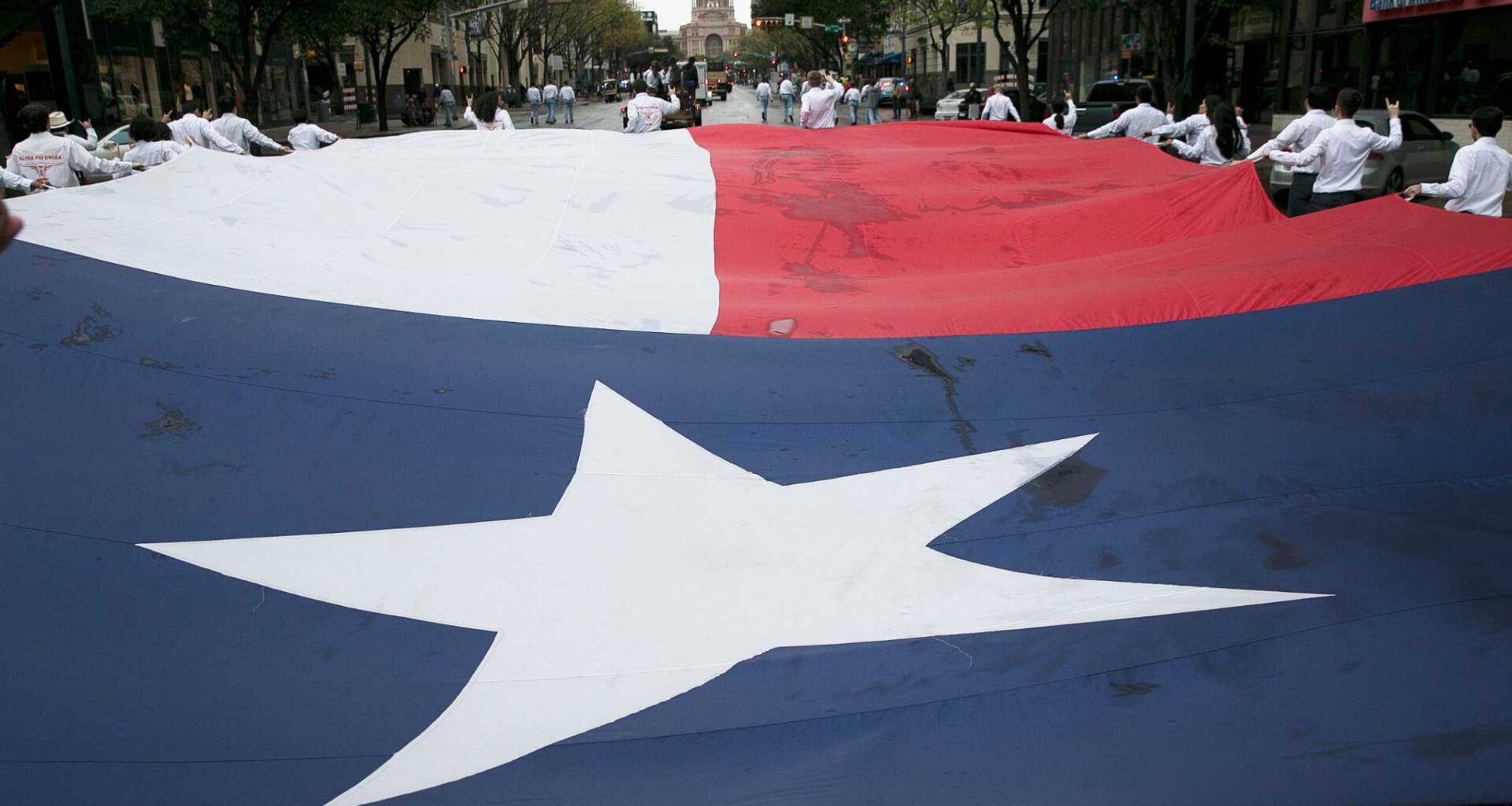
The Texas flag moves up Congress Avenue toward the Capitol carried by UT’s Alpha Phi Omega during the Texas Independence Day Parade on March 4, 2017.
Deborah Cannon
As Texans in good standing, we firmly believe that our state is the most interesting place on the planet.
Still, even we have qualms about the amount of time Texas history would consume in the state’s proposed K-12 curriculum. If state officials have their way, between grades three and eight, Texas public school students will study little else in their social studies classes.
But it may surprise some of our readers to know that in an important way, we think the revisionists are right:
Article continues below this ad
Texas history is important. Public schools should put it front and center. Not just for curriculum’s sake but to invite students into this “big wonderful thing” (to quote chronicler Stephen Harrigan and one-time Texan and artist Georgia O’Keefe).
Someday, after all, they’ll run this state. They need to understand it.
We also agree that Texas history can be the entry point to deeper understandings of this country and the world. Texas has long sat at the intersection of empires, eco-regions and eras. Our stories wrap around the globe.
“[B]ehind all the broad stereotypes about Texas,” writes historian Annette Gordon-Reed, “is a story of Indians, settler colonialists, Hispanic culture in North America, slavery, race and immigration. It is the American story, told from the most American place.”
Article continues below this ad
Historian Benjamin Herber Johnson agrees. “When Americans turn on their laptops, play video games, go to church, vote, eat Tex-Mex, go on a grocery run, listen to music, grill a steak, or watch a football game, they are, unknowingly or not, paying tribute to the influence of the Lone Star State,” he writes. “The history of the United States cannot be understood without knowing something of Texas history.”
Journalist Richard Parker said it even more boldly: “Simply put, the origin story of America, usually told as starting in the East, at Plymouth Rock, and extending to the West is wrong …The first European Thanksgiving was not in Massachusetts; it took place on the banks of the Rio Grande twenty-two years earlier.”
Who are we to argue?
We Texans love our state history and legends. “Texas history was taught in Texas schools before the study of the United States began,” wrote T.R. Fehrenbach in “Lone Star: A History of Texas and the Texans.”
Not thinking big enough
Here’s what worries us, though: Lately, the state’s official approach to Texas history has been less about curiosity and more a tool of control and censorship. Beyond just a social studies rewrite, Texas Republicans in office today have been tightening their grip on the state’s mythic narrative.
Article continues below this ad
The most high-profile effort has been the 1836 Project, an advisory committee the Texas Legislature created in 2022, to promote “patriotic education” in our state history for students and also, oddly, drivers getting their licenses at the DMV. But there has also been a coup of sorts, roiling the state historical association and college campuses, now trickling down to elementary school classrooms.
So what’s the problem with the version of Texas history that politicians are trumpeting? In an embarrassingly un-Texan fashion, they’re not thinking big enough. They focus too tightly on certain details while missing the wider view. Maybe that’s because Texas history, explored deeply and in all its complicated richness, might not tell the story they want kids to hear.
The 1836 Project and its ilk build a road through our state lore — a freeway that barrels along until it arrives at the capitalistic, low-regulation, business-friendly wonderland that plenty of Texans today celebrate — including, when appropriate, this editorial board. But that version of history is like glimpsing Houston from the car window as you speed around the Grand Parkway. What you see is real. It’s not wrong. But when the ride is over, you wouldn’t really have come to know Houston.
What we’re proposing — what historians and journalists have proposed — is to get off the freeway. Take the streets. Heck, get out of the car altogether and feel the uneven sidewalks beneath your feet.
More Texans
Texas history is Texans, and the politicians’ version too often leaves out too many of the interesting ones. They fixate on the Big Tex-sized legends that are Stephen F. Austin, William Barret Travis and Sam Houston, but underplay or ignore our state’s stubborn, outsized independent streak from many, many other people of Texas who came before us — whether it was Caddo peoples joining together to erect houses in the Piney Woods or the men and women who escaped slavery. The women who kept the Lone Star dream alive during the Runaway Scrape or aspiring Texans from across the Sabine River and Atlantic Ocean alike. Untold numbers of freedom seekers have called this land home.
Article continues below this ad
Little about life came easy here. And yet all those left-out Texans declared independence in their own ways, shaping the state we know today. These are the stories we intend to explore here in “Declaring Independence,” a series of pieces rethinking Texas history, drawing on historical scholarship and contemporary reporting to show the messy, complicated, contradictory and still wildly relevant reality of our state’s past. The series — which starts right here, today — will culminate on July 4, the day of the 250th celebration of the nation’s Independence Day.
Because we’re thinking bigger than the 1836 Project, we may not arrive at the same conclusions. But we basically share the thesis it laid out in its handy DMV-ready pamphlet:
The people that were born here or came here have made Texas. What seemed like an inhospitable zone to many has proved to be a land of promise to those with fortitude and nerve. This is their story — and yours.
We would amend that mission statement only slightly, broadening it to a size befitting Texas, a state too big, too important and too ornery to be officially squashed down into a single story, a single point of view.
Article continues below this ad
We think the sentence should be:
These are their stories — and yours.