
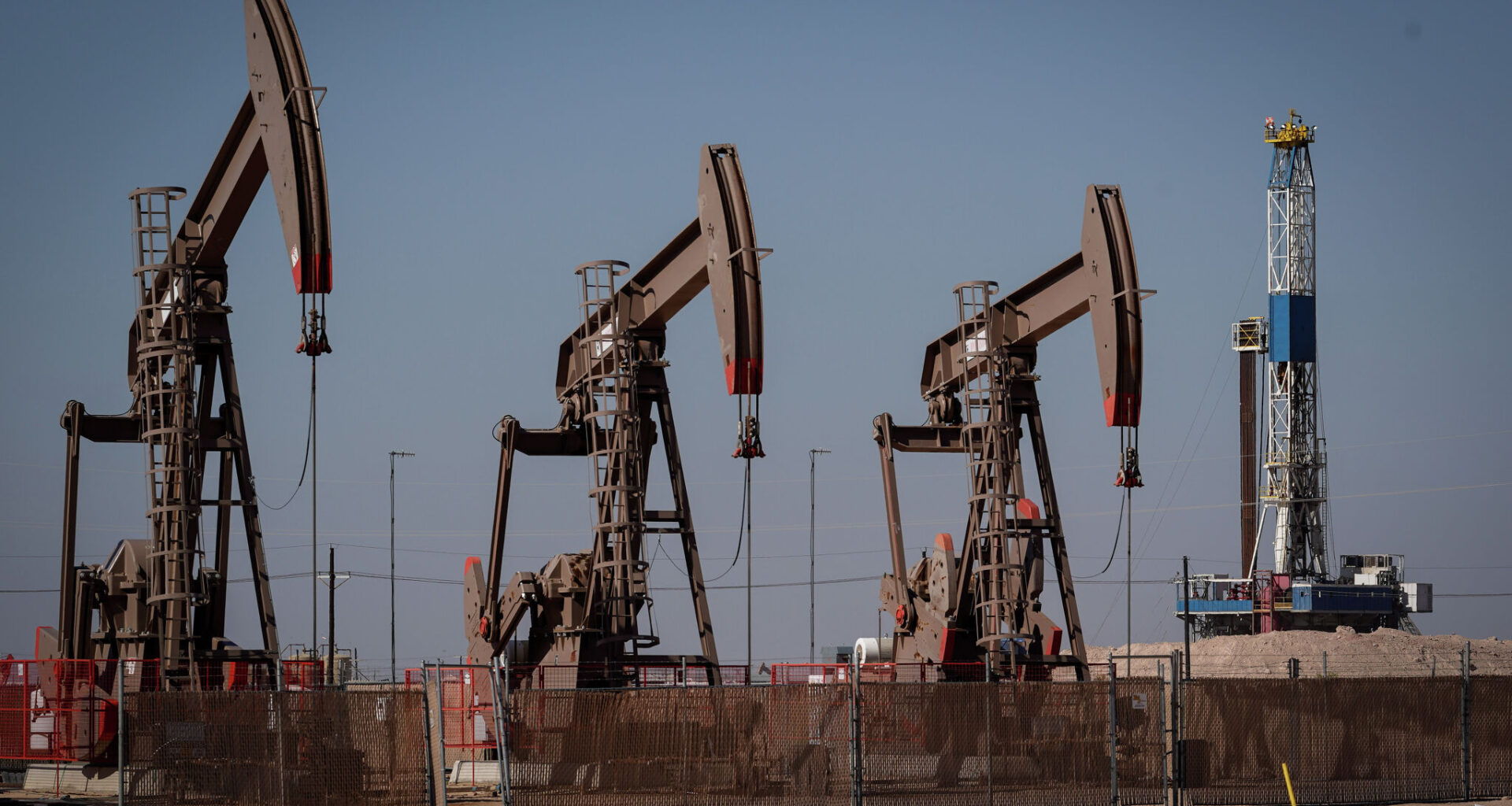
Pumpjacks operate near a drilling rig in July 2022 along Texas 191 between Midland and Odessa.
Jon Shapley/Houston Chronicle file photo
Texas is celebrating a new bragging-rights number: $2.9 trillion.

That figure, highlighted in a Friday announcement from Gov. Greg Abbott, is the state’s preliminary 2025 current-dollar gross domestic product, based on estimates from the U.S. Bureau of Economic Analysis.
Article continues below this ad
“With the Best Business Climate in America and unmatched pro-growth policies, Texas is the premier destination for job creators from across the country and world,” Abbott said. “We will keep attracting world-class investment, create jobs, and expand opportunity for Texans for generations to come.”
Gov. Greg Abbott speaks at a primary election night event hosted by the Young Conservatives of Texas and the Texas Young Republicans at Cedar Door Patio Bar & Grill in Austin on Tuesday, March 3, 2026. Abbott is seeking the Republican nomination for governor.
Jay Janner/Austin American-Statesman
So what is Texas really claiming here?
What the $2.9 trillion number means
The state produced about $2.9 trillion worth of goods and services in 2025, and its economy grew faster than the nation as a whole in real, inflation-adjusted terms, according to the governor’s office.
Article continues below this ad
GDP is the broadest scoreboard for the size of an economy. It tries to capture the value created across industries, from oilfields and chip plants to hospitals, law firms, warehouses and restaurants. When the governor’s office says Texas hit $2.9 trillion, it is pointing to the BEA’s estimate for the value of all that activity in 2025.
The “current-dollar” part means the number is not scrubbed of inflation. Prices rising can help push the total up, even when the economy is not booming in the way everyday people might imagine. Abbott’s office paired the headline with another figure meant to answer that: Texas, it said, grew 2.5% in real terms in 2025, meaning after adjusting for inflation, compared with 2.1% for the U.S. overall.
How did Texas get here
Part of this story is time and scale. Abbott’s office says the Texas economy stood at about $1.59 trillion when he took office in January 2015 and had grown to $2.9 trillion by the end of 2025.
Article continues below this ad
Texas is not running on one engine. It has a massive energy complex, one of the country’s biggest trade corridors, a large and growing manufacturing base, a huge real estate and construction footprint, and a service economy that now includes everything from finance and logistics to legal work, engineering and corporate management.
Oil and gas still matter
Energy is still one of the clearest answers to how Texas got this big.
The map indicates that the U.S. will not halt oil product imports but will instead see changes or disruptions in the refined product markets, and will continue to experience higher prices for consumers.
Jeff R Clow/Getty Images
The U.S. Energy Information Administration says Texas has the most petroleum refineries and the most refining capacity in the nation. It also leads the country in crude oil and natural gas production.
Article continues below this ad
Energy supports petrochemicals, pipeline networks, exports, port traffic, power generation, industrial construction and all the professional and financial services that spring up around those businesses. It is one reason Texas can post huge GDP numbers even when the state economy feels very different in Houston, Midland, Dallas and Austin.
Trade is a huge strength
Texas is also a trade giant.
The Texas comptroller says the state’s ports of entry accounted for more than $1 trillion in international trade in 2024. Port Laredo alone handled $339.5 billion in trade that year, underscoring just how central the Texas-Mexico corridor has become to the state economy.
Article continues below this ad
Trucks cross the World Trade Bridge into the United States from Mexico in 2019.
Danny Zaragoza/Laredo Morning Times file photo
The Office of the U.S. Trade Representative says Texas exported $123.5 billion in goods to Mexico in 2024, making it the state’s largest foreign market by far. That helps explain why trade policy, border infrastructure and the health of North American supply chains have such an outsized effect on Texas growth.
Manufacturing is a growing piece of the story
Texas’ growth pitch is no longer just oil, land and low taxes. It is increasingly about factories too.
Article continues below this ad
Samsung’s new plant near Taylor is seen in October, By 2028, it’s expected to encompass about 8 million square feet. Elon Musk a new Tesla/SpaceX chip fabrication plant would be 12 times that.
Aaron E. Martinez/Austin American-Statesman
One of the biggest examples is semiconductors. In late 2024, the U.S. Commerce Department announced up to $4.745 billion in CHIPS funding for Samsung and up to $1.61 billion for Texas Instruments projects, including major Texas expansions. At the state level, officials created the Texas Semiconductor Innovation Fund through House Bill 5174 and say lawmakers appropriated $698 million for it in 2023.
Texas is trying to stack a new industrial layer on top of the old one: energy, yes, but also chipmaking, advanced manufacturing, data infrastructure and the construction boom that comes with them.
The state’s service economy
A large share of the state’s output comes from less cinematic work: business services, real estate, logistics, finance, health care, legal services and corporate operations.
Article continues below this ad
Innovation is one of the reasons that the Central Texas food economy is thriving. Many of the local consumer packaged good, or CPG, products, including the sauces developed at Fischer & Wieser in Fredericksburg, are sold at retail outlets across the country.
American-Statesman file photo
State officials say Texas is home to 54 Fortune 500 headquarters and more than 3.5 million small businesses. A huge amount of Texas growth is tied to people managing property, moving freight, providing services, building things and running companies rather than just extracting raw materials.
What the number does not tell you
The $2.9 trillion figure is real, but incomplete.
Article continues below this ad
A giant GDP number tells you Texas is producing a lot. It does not tell you whether that growth is evenly shared, whether wages are keeping up with costs, or whether life feels more affordable for the average Texan.
GDP is largely a size metric. It is not a measure of fairness, comfort or financial security.