
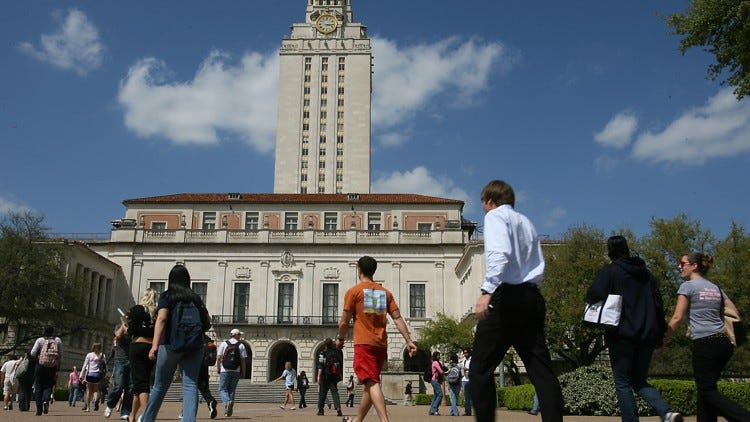
The University of Texas’ Main Mall is crowded with students in this file photo. Undergraduate and graduate students will face tuition and fee increases in the next two academic years. 2008 AMERICAN-STATESMAN
Austin American-Statesman
A new era of Ivy League schools is here, and they aren’t restricted to the Northeast like the original eight — two can be found in Texas.

The U.S. workforce is rapidly changing, thanks in large part to the mass adoption of artificial intelligence. The implications can be seen in layoffs within some of the world’s largest companies — like Amazon, Oracle and Google — as software engineers and customer service representatives are among the most AI-vulnerable jobs.
Article continues below this ad
Researchers at Stanford’s Digital Economy Lab found employment among people ages 22 to 25 in the most AI-vulnerable jobs had dropped 16% through last October, even as other age groups remained consistent. Recent data shows overall unemployment among new college graduates (5.6%) is higher than the average for all U.S. workers (4.2%), according to the Federal Reserve Bank of New York.
With these employment trends, colleges are challenged with justifying high tuition costs by preparing students for careers capable of paying off student loans. In its third annual list of “New Ivies,” Forbes set out to determine which college alumni were favored by employers.
Which Texas colleges stood out among the nation’s top institutions? Here’s what Forbes’ survey revealed about higher education trends.
Read more: Texas graduate school rankings are out. Here’s where UT Austin and Texas A&M landed
Article continues below this ad
How AI is changing hiring practices for new grads
Forbes expanded the survey beyond rating schools this year. More than 100 C-suite and hiring executives were also asked how AI was changing how they hire new grads.
Of the executives in Forbes’ survey, nearly one in four said “AI would reduce their need for entry level college graduates,” while three in five said it would influence their staffing needs.
“Artificial intelligence has entirely redefined the anatomy of the entry level role,” one C-suite executive said. “Consequently, the baseline for new hires has skyrocketed and lessened our need for traditional entry level headcount.”
Article continues below this ad
A view of the “Statement on AI Training” at the “AI, Creativity, And The Fight Around Fair Use” session durning the 2025 SXSW Conference and Festival at Hilton Austin on March 11, 2025 in Austin, Texas.
Tibrina Hobson/Getty Images
America’s top schools are adapting to meet this demand. In December, Indiana’s Purdue University became the first U.S. college to add “AI working competency” to its graduation requirements.
“The most promising talents today are beginning to emerge from institutions that prioritize intellectual rigor over inherited prestige,” another C-suite executive told Forbes, adding that the ideal graduate has received training that provides “complex emotional intelligence, radical adaptability and visionary creativity to orchestrate AI tools rather than compete with them.”
Are the Ancient Eight losing status?
Forbes first launched its annual “New Ivies” list in 2024, as employers grew skeptical about the traditional Ivy League schools truly offering the best recruits. Instead, a growing number believe the smartest and most committed grads come from “rigorous state flagship universities and some lesser known private schools,” according to Forbes.
Article continues below this ad
In the latest Forbes survey, 37% of respondents said they are less likely to hire Ivy League graduates than they were five years ago, while just 6% said they are more likely to hire Ivy League graduates. On the other hand, 42% were more likely to hire graduates of public universities and 6% were less likely to do so. Even graduates from non-Ivy or Ivy-Plus private colleges were more desirable to employers.
UT Austin named among 10 public ‘New Ivies’ — again
The University of Texas at Austin was once again declared a “New Ivy” by Forbes. Among the other public colleges on the list, it had the sixth-lowest acceptance rate and the eighth-highest median SAT score.
Undergraduate enrollment: 44,663
Acceptance rate: 27%
Median SAT score: 1390
Median ACT score: 31
Article continues below this ad
Here’s the full 2026 list, in alphabetical order:
United States Air Force Academy in Colorado Springs, Colo.
University of Florida in Gainesville
Georgia Institute of Technology in Atlanta
University of Michigan in Ann Arbor
University of North Carolina at Chapel Hill
Purdue University in West Lafayette, Ind.
University of Texas at Austin
University of Virginia in Charlottesville
William & Mary in Williamsburg, Va.
University of Wisconsin-Madison
Rice University named among 10 private ‘New Ivies’ in 2026
Visitors walk through the new, redesigned Academic Quad on the campus of Rice University on Sept. 12, 2024, in Houston.
Jason Fochtman/Houston Chronicle
Houston’s Rice University also appeared on Forbes’ list of 10 private “New Ivies,” just as it did last year.
Article continues below this ad
Carnegie Mellon University in Pittsburgh
Case Western Reserve University in Cleveland
Emory University in Atlanta
Georgetown University in Washington, D.C.
Northwestern University in Evanston, Ill.
University of Notre Dame in Indiana
Rice University in Houston
Tufts University in Medford and Somerville, Mass.
Vanderbilt University in Nashville, Tenn.
Washington University in St. Louis