
As a kid in El Paso, Leilainia Marcus struggled to get up in the mornings for school. In particular she would stress about what to wear, and the difficulty in choosing clothes would complicate the start of every day. Her father, though, who was always full of “optimism and creativity” and intent on finding solutions, devised a plan. At night, before tucking her in to sleep, they would both go through Leilainia’s clothes, make a choice, and dress a stuffed animal that Leilainia had next to her bed, by way of preparation. In that way, every morning on waking, the clothes were there and ready to go.
It was an act typical of Hal Marcus, El Paso born-and-bred artist, advocate, community leader, author, philanthropist, gallery owner and father — and it was an act which over time became a shared ritual for father and daughter; one which is a foundational memory for Leilainia. “He never saw problems, just opportunities,” she says, of him. “Nothing was ever a struggle, he chose optimism and creativity, and to always be there and be present for you.”
Before Leilainia’s birth, in the 1970s, Hal Marcus and his then-wife Judith Ann bought a dilapidated house in El Paso, built in 1903. Leilainia remembers her entire childhood featuring parties of art-making and fixing, scraping paint, sculpting wood, tiling floors, walls, bridges, and art pieces — anything and everything. “It was always about community, about building people up,” she says, and over time, as her father collected objects and local artworks dating back to 1880, the home became a living place of fascination and wonder. This was true not just for Leilainia, but also for the wide-ranging cast of artists and characters who were only ever just a door-knock away, wanting to visit with, speak to, or just be in the company of Hal Marcus.
The house remains, and it continues to be in active service as a fulcrum of community gathering. Currently, a quiet transformation is afoot, and between late 2027 and early 2028, that same house will open its doors as the privately run Hal Marcus Art Museum, celebrating his private collection of all El Paso artists — the support of whom Hal Marcus has given his life to.
****
Hal Marcus was born in 1951 in El Paso, Texas. From a young age he was fascinated with the world and accompanied his grandmother on her weekly visits to the Juárez market, across the border. He loved the borderland, its landscapes and its peoples, its colors and its textures. “It was the place,” says long-time friend, co-author, and collaborator Luke Lowenfield, “that he developed his sense of color. It was also the place he learned to be a successful merchant — by watching his grandmother buy mangos or avocados for a dime and selling them for a quarter in El Paso.” The inspiration that came from those journeys, and from being in another country, argues Lowenfield, was “very powerful” for Marcus, in particular because displacement “gives us different ways of seeing ourselves and our common humanity.”
It was in high school that Hal Marcus decided that he would become an artist. It wasn’t a desire, but a commitment. As a first-born Jewish son in an Arab-Jewish family, the expectation was that he would take over the family grocery business, but he had the necessary, difficult conversation with his father, and chose art instead. Every day since making that choice, Hal Marcus made art.
In the early years, his self-taught work was cubistic, taking shapes from the land, before evolving into a more direct reflection — and celebration — of the environment in which he lived: El Paso, in all its forms. There were folk-style paintings of people, city scenes and landscapes, and there were also smaller works, which he sold door-to-door across the city. It gave him an income, but it also gave him an opportunity to develop knowledge and experience of his community. The work began to be known and loved; people saw themselves reflected through an artistic eye that respectfully conveyed and celebrated the beauty of lives lived on the borderland. “Hal’s work is iconic in El Paso,” says Lowenfield, “it can be seen in pretty much every office and home around town.”
On one occasion in his youth, Marcus took his work to an exhibition in San Antonio, but nobody attended the opening. In a quintessential Hal Marcus way, however, he determined to resolve the problem and told the gallery that as he had family in Houston, he could provide them as an audience. His plan was to drive to Houston and bring them back to see the show, which he did. On returning, however, the work had been taken down. It made him angry, and he vowed to return to El Paso and establish the kind of respectful gallery for local artists that would make them never have to look outside the city again.
****
Little doubt that in El Paso’s art scene, Hal Marcus was a defining, foundational figure (who also happened to be highly identifiable thanks to his unflinching use of colorful shirts). Artists literally line up to speak of the influence Marcus has had on them and their work.
“For me,” says Mauricio Mora, “Hal has been a friend for 35 years, but even more than that he has been a mentor.”
Daniel Padilla agrees that Marcus is an incredible adviser, adding that he “was a father to me — just as he has been to many El Paso artists. He helped me work on a style that would later on let people recognize me through my colors and my work and my subject matter, but he also influenced me as a person.”
Francisco Romero, for his part, speaks of Marcus as “an icon; he was a promoter of arts here in El Paso when such things didn’t exist. He helped people without wanting anything in return, and gave a voice to local artists, letting them know that they didn’t have to leave to become an artist. He was a leader, and I consider him a guide.”
 Hal Marcus. Photo courtesy of Hal Marcus Gallery
Hal Marcus was true to his word and set up that gallery in April 1996, a one-of-a-kind venue of union and celebration for local artists. Since the moment it opened its doors, it has been a beating heart for culture in El Paso; a gathering point; a refuge. Emphatically and unashamedly, it is a unique place full of joy, shaped by Marcus, alongside Leilainia and his wife Patricia Medici, brimming with the work of El Paso masters from history, innumerable living local artists, and emerging talents. “I wanted to create a space that felt like home for the community’s imagination,” said Marcus. “Seeing the gallery become a place where people connect with our culture through color has been the greatest masterpiece of my life.” The gallery celebrates its 30th anniversary this month — April 2026.
****
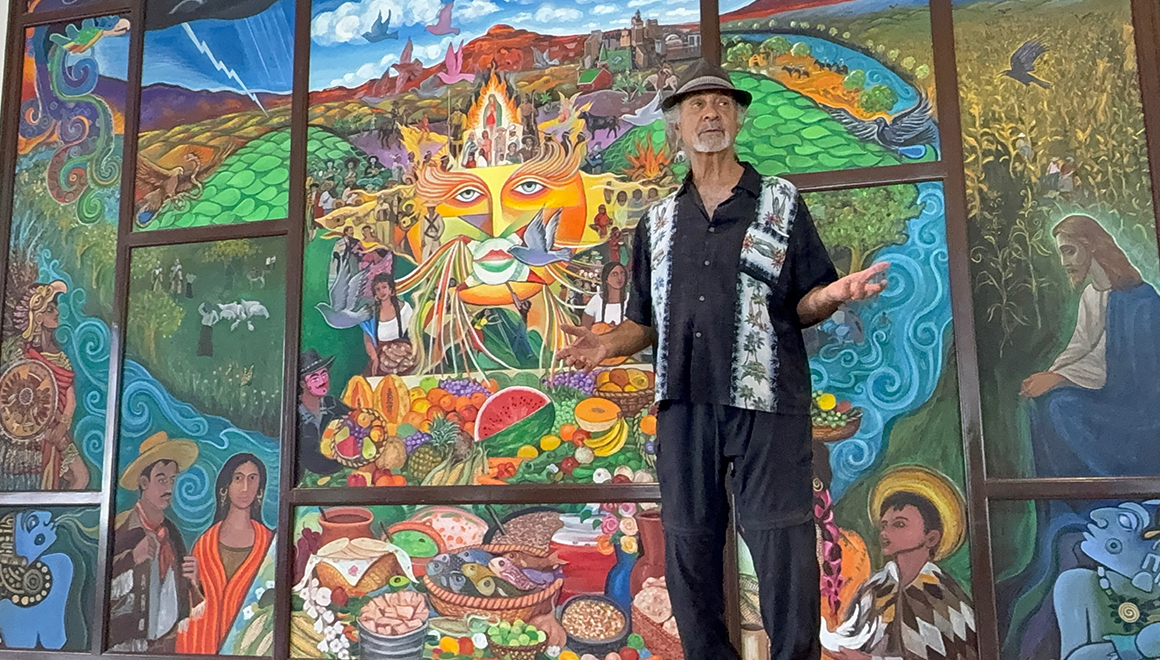
Hal Marcus has too many defining works to mention, but of all of them, perhaps the most iconic is El Paso Gracias a Dios. The work is a 9-by-11-foot, 13-panel painting marking the first record of Thanksgiving in the United States, in April 1598. “The artwork features the cultures that moved through El Paso del Norte and made the city what it is today,” says Luke Lowenfield. “With the sun at the center, the mural is filled with religious and historical figures that influence our border culture.” It is a trademark Hal Marcus piece, displaying vibrant colors, and reflecting what he saw in the borderlands, which was “harmony, beauty, and a welcoming spirit, even if it’s messy and hard”.
 Hal Marcus with “El Paso Gracias a Dios.” Photo: Luke Lowenfield
El Paso Gracias a Dios had been on display for over 30 years at the Chamizal National Memorial, but in July 2025 Marcus was contacted by a representative from Chamizal to withdraw the mural. “There was never a formal contract,” continues Lowenfield, and that was the reason given for the removal. “Hal suspected it was more than that; he sensed that the federal government’s actions to remove ‘divisive, race-centered ideology’ was being used as a reason to politicize and remove his work. It hit him very hard. He always felt artistic freedom to reflect to us, in the borderlands, what he saw. For his work to be seen as divisive or threatening was very hurtful.”
 Hal Marcus holds the children’s book “Buenas Noches, El Paso” written by Luke Lowenfield and illustrated by Hal Marcus. Photo: Luke Lowenfield
Marcus tried to find a new home for the work with the City and County, without luck. He then asked Lowenfield — by then a co-author with Marcus on a number of children’s books — if he had any ideas. Lowenfield, who also happens to be Vice President at the Casa Ford in El Paso, asked Marcus if he would consider having it at the car dealership. “He saw the open space, the large wall, and said it would be a great home for his artwork. I’ll never forget the day we went to Chamizal to pick up the mural. I followed Patricia as she whispered prayers of peace, and we were joined by the craftsman who originally built the custom frame. We laid out the pieces in the showroom at Casa Ford, just a few minutes from Chamizal, and moved on our hands and knees around the giant mural securing each panel in its place. Hal took over the showroom as a crowd gathered to hear the painter share the history of our region and his artistic representation.”
****
Hal Marcus was diagnosed with cancer the same summer. He was offered chemotherapy but told the doctors that they had the wrong guy, that there was no way that they were going to put poison in his body. “My medicine is to do whatever I need to do to make me happy,” said Marcus, “to enjoy every single moment and to spend as much time in my studio. That’s my medicine.”
Over the years, Marcus had kept his vibrant shirts, even after they were too weathered to continue wearing. He knew that somewhere down the line, a moment would emerge in which they would become relevant. The diagnosis was that moment. “He had been saving his crazy shirts forever,” says Leilainia. “He knew that one day he was going to do an art piece,” and, as is inevitable, the time came. “It was a whole new style, quilt on canvas. He was making the transition, just as he was transitioning.”
****
On a warm late afternoon on April 8, 2026, Marcus is at his gallery, surrounded by artists, friends, family, and people who have come in off the street to see artwork, as they do every Wednesday of the year. He is a little more insistent then, directing the orchestra, giving everyone jobs. “Soon I’ll be able to tell you all what to do at the same time,” he says. Marcus was undefeated. His chin still set high, he continued to look clearly ahead, no matter where the path might end, where the frontier lay.
Hal Marcus, artist of the borderlands, died in the early morning of Sunday, April 12, 2026. He was a man of conviction, and of great, inclusive humanity; a craftsman who understood that we all exist on the frontier, and that our communities are as strong as what we choose to build and who we choose to be — and that art is an essential, foundational tool in this construction.
The Hal Marcus Gallery — located at 1308 N. Oregon Street, El Paso — opens every Wednesday from Noon to 5 p.m., or by appointment.
The unveiling of El Paso Gracias a Dios will take place on Sunday, April 26, 2026, from Noon to 3 p.m., at Casa Ford (5815 Montana Avenue, El Paso, TX 79925).