
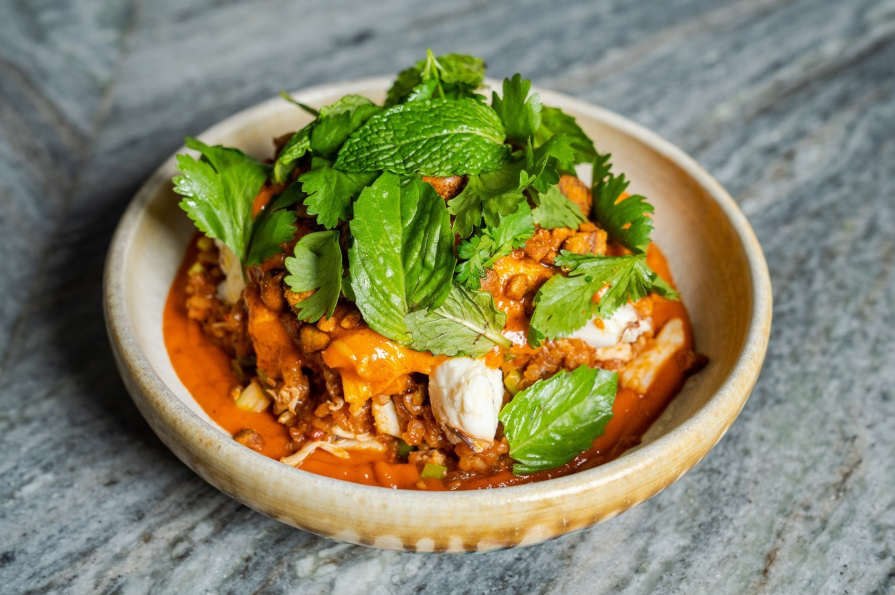
Bludorn is a lot of things, but one thing I’d never call the Houston restaurant is dead. Aaron and Victoria Pappas’ namesake restaurant at 804 Taft St. is an exercise in controlled flux. Waiters and managers scurry around the dining room with various orders, and the kitchen in the back is a busy parade of occasional flames and white hats.
But a few things never change at Bludorn, like on the menu, underneath pasta and grains: the crab rice. The medley of Carolina gold rice, crab étouffée and spiced peanuts is a distinctly Black dish that, at a glance, feels at odds with the rest of the menu. It’s not to say that the other dishes at the French-Texan-Gulf restaurant aren’t, but the crab rice is the only one that feels fully and distinctly informed by the historic foodways that have converged to make it happen.
And by happenstance, Bludorn was the only place where it could have happened.
Before Bludorn opened in 2020, Aaron worked at the Dinex Group, the hospitality company owned by legendary New York chef and restaurateur Daniel Boulud. When Aaron became the executive chef of Café Boulud in Manhattan’s Upper East Side, he joined the restaurant’s GM Cherif Mbodiji, who had moved to America from Senegal. The two eventually teamed up to open Bludorn with Mbodiji acting as both partner and director of operations.
“Cherif Mbodji and I actually came up with it together,” Aaron Bludorn told Chron. “I asked him if it made sense to do a jollof-style rice dish with crab, and he said they would never do that in Senegal. I said this was perfect because we are doing it in Houston on the Gulf Coast.”
The ingredients and methods that have gone into the dish are almost entirely derived by the history of African Americans in the American South. Carolina gold is an heirloom rice that originated along the East Coast in the 1700s and was primarily grown by enslaved West Africans. The étouffée (French for smothered) draws various influences, from the Acadians who migrated south from Canada to the various peoples of African and Caribbean descent who would settle on the Louisiana coast.
It also isn’t just a coincidence that Senegal is one of the largest peanut-producing countries in the world.
“We created the dish based on the idea that the Gulf already has so many influences of West African cuisine; it just made sense to dive deeper into those influences,” Bludorn said.
It’s one of the dishes my wife and I get every time we go to Bludorn. It’s unmistakably Creole, spicy and rich in tomato acidity. My wife says she can taste the shallots every time. It’s typically priced between $28 and $32.
Bludorn’s crab rice, according to Aaron, has remained unchanged and remains one of the more popular items on the menu. On an average night, the restaurant will sell around 20 dishes or about 140 a week.
Houston has a long history of interesting dishes that draw from the histories of the people who settled here. Much like the Viet-Cajun crawfish at Crawfish & Noodles and the fried chicken at Himalaya, Bludorn’s crab rice adds another example to that list. But it also has the spice of a fruitful friendship to go along with it.