
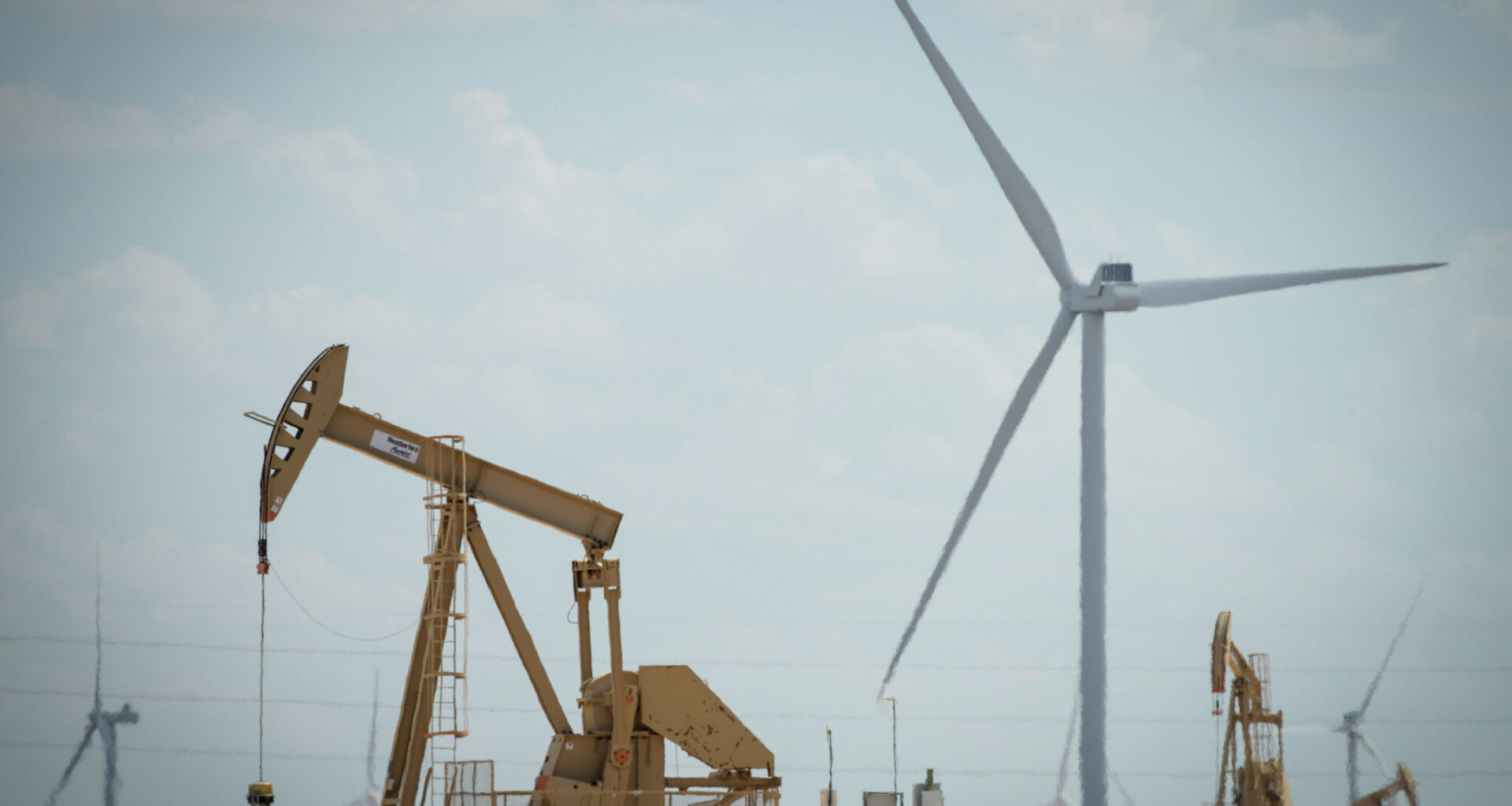
Pumpjacks operate next to large wind turbines Friday, July 8, 2022, near Midland.
Jon Shapley/Houston Chronicle
If you’re celebrating Earth Day today, make sure to thank Texas. That’s because both the holiday and the broader environmental movement were launched partially in response to the Apollo-era space program, whose orbital altitude let us see the beauty of our planet from a new perspective. And none of that would have been possible without our state’s Johnson Space Center. It’s fortuitous that the Artemis II mission timed its success in the lead-up to this year’s Earth Day, setting Texas up to repeat this feat.
Yes, there is a certain irony in claiming that an oil and gas state like Texas plays a critical role in the larger environmental movement. If Texas were a country, we would be the world’s third largest gas producer and fourth largest crude oil producer. At the same time, we’re also successful at building renewable energy — we have the world’s sixth largest installed wind capacity, and rank third for battery energy storage systems and in the top ten for utility-scale solar. Texas also led the way in new solutions such as the lithium-ion battery and carbon sequestration.
These facts are not contradictions: When it comes to energy, Texas operates at a large scale and moves quickly — and that’s what it takes to pursue environmentalist policy in the year 2026.
Article continues below this ad
ALSO: This Earth Day, Houston’s air is getting dirtier.
Our rapid and large-scale deployment of natural gas, wind, solar and batteries has facilitated coal’s decline at home, reducing emissions along the way. Our exports of LNG have slowed coal’s growth abroad, achieving similar effects elsewhere. We lead the world in carbon dioxide sequestration and serve as one of the world’s largest producers of hydrogen. Our industrial sector has shown the world how to efficiently combine heat and power at large refineries and other petrochemical facilities to make valuable products more cleanly than at other facilities around the world. We should be proud of this record.
But there is more Texas can do.
We need to accelerate activities that reduce emissions, such as electrifying the oil and gas sector. By using electric submersible pumps deep in their wells, oil and gas can be lifted with lower cost and less energy use. Using electric equipment at the surface for processing and pipelines dramatically reduces emissions and improves safety. And using electricity to liquefy gas at the coast to export to customers abroad helps to ensure our gas is clean enough to meet other countries’ strict standards.
Article continues below this ad
Texas has also been expanding our power transmission system, which will reduce costs for consumers, improve grid reliability, create jobs and facilitate more wind and solar power plants. More than a decade ago Texans came together to support the statewide Competitive Renewable Energy Zone initiative (CREZ), which invested $7 billion in new transmission lines to help bring clean wind and solar power from west Texas to major cities and industrial facilities in the eastern half of the state. That program was a resounding success and showed the world that Texas is good at building new transmission lines.
We can and should do it again with the Permian Basin Reliability Plan, which will help move power to oil and gas users in West Texas so they can electrify their operations.
There are other places, however, where Texas needs to start from square one.
Our state lags on building efficiency standards, which means that we’re wasting money and resources, and putting unnecessary strain on our power grid. It’s time for us to take seriously our winter deep freezes and extended summer heat waves, and to build our homes to stay warm or cool with less power.
The Texas energy sector should also pick up the pieces of the energy policies the Trump administration broke. In particular, the Trump administration hamstrung the federal government’s implementation of penalties for flaring, venting and fugitive emissions of methane from the oil and gas sector. Methane is a valuable hydrocarbon, but it is also a powerful greenhouse gas, so its unmitigated release into the atmosphere is a double whammy. Those regulations — which multinational oil and gas companies supported — should be implemented at the state level to reduce the sector’s environmental impact and to attract foreign buyers who care about the cleanliness of natural gas supply chains.
Article continues below this ad
So as we commemorate Earth Day, let’s not forget the important role that Texas has played — and how much more we can do.
Michael E. Webber is the Sid Richardson Chair in Public Affairs, Cockrell Family Chair #16 in Engineering, and Engineering Academic Director of the Senator Kay Bailey Hutchison Energy Center at the University of Texas at Austin.