
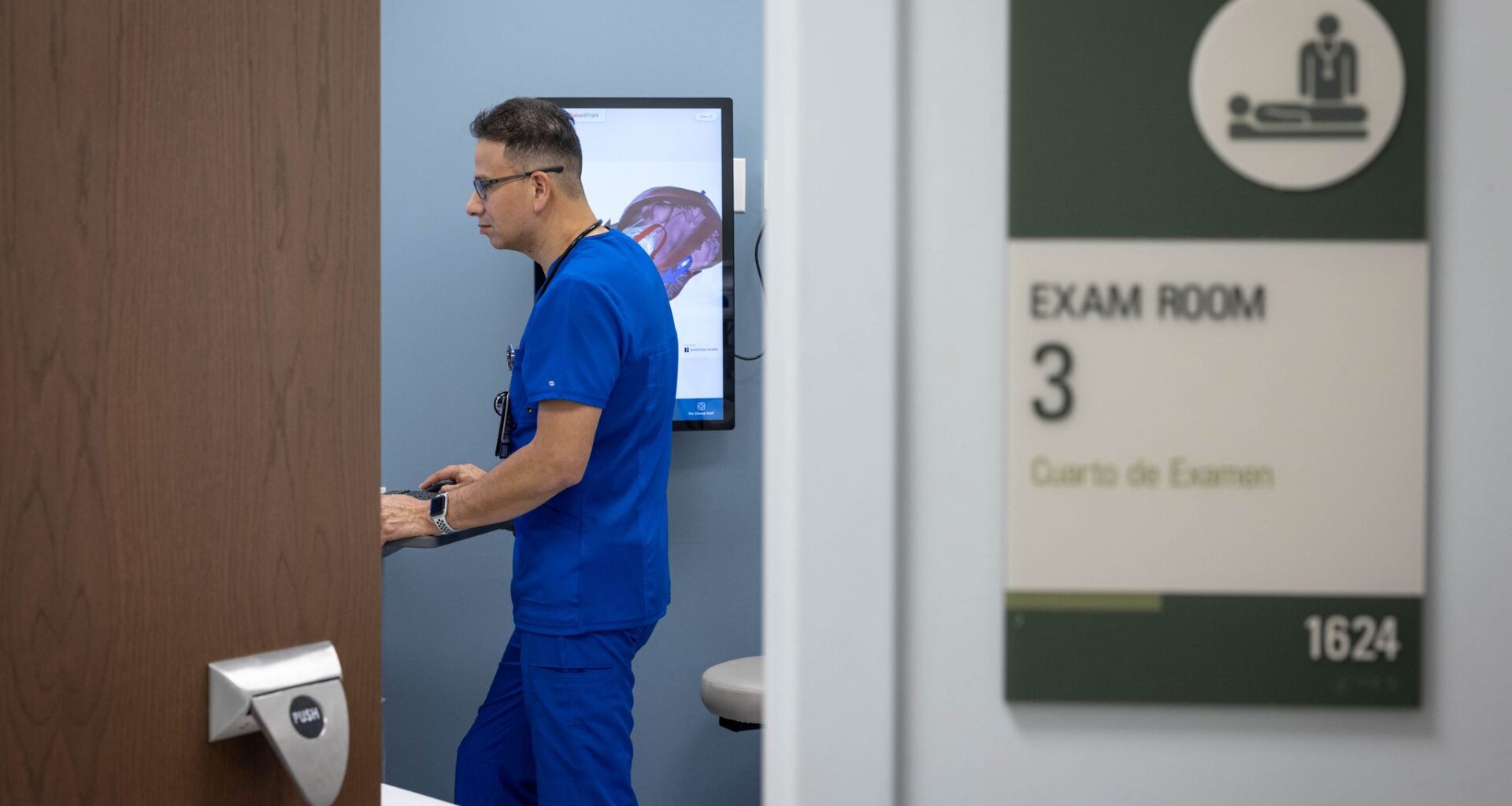
Omar Torres, a licensed vocational nurse, prepares a room for a patient at Parkland’s C.V. Roman Health Center in Dallas, Tuesday, April 7, 2026.
Angela Piazza/The Dallas Morning News
For years, communities in southern Dallas have grappled with dire health needs, including higher rates of chronic disease, fewer resources and earlier deaths.
South of Interstate 30, life expectancy is about 17 years shorter for some residents when compared with those to the north, according to a new Dallas County analysis. South of the highway, there are fewer doctors. Grocery stores are farther from reach and residents are less likely to have transportation or insurance that could help them live healthier lives.
“We want everyone in our community to be healthy and to do as well as they can,” said Dr. Philip Huang, the Dallas County public health director. “That helps all of us, whether it’s economic. Economic success benefits all of us and helps the community to be thriving.”
Huang said Dallas, like other cities across the state and nation, shows a pattern of disparities and socioeconomic factors tied to the community’s health. He said healthier communities can relieve the burden on health care systems. When people can’t afford health care, it raises costs across the board. There’s not just one issue playing into community health, he said, but several.
Officials, health leaders and nonprofits have been working to fill these gaps. Every three years, the county health department and its public hospital, Parkland Health, produce an analysis that could serve as a guide for decision-makers who want community health trending in the right direction. The latest report, or the 2025 Community Health Needs Assessment, was released this year.
At more than 230 pages, it shows which areas across the county see the most need or improvement and what residents have to say about it.

Areas repeatedly making the list for lower life expectancies tend to also face issues with housing, access to health care, transportation and other basic infrastructure. This reflects the “underlying socio-economic disparity that is so important to health,” Huang said.
Article continues below this ad
Parkland’s C.V. Roman Health Center in Dallas, Tuesday, April 7, 2026.
Angela Piazza/The Dallas Morning News
Life expectancy
Between South Dallas and the Highland Park area, there is a more than 17-year gap in life expectancies. This is smaller than the 22 years seen in the previous assessment, but only because the highest life expectancy estimate is lower.
Huang said COVID, at one point the third leading cause of death, decreased expectancies for “even the highest groups.”
Among the five ZIP codes with the lowest life expectancy, four are south of Interstate 30. The other is 75246 in Old East Dallas.
Pleasant Grove and Red Bird areas were in the bottom five for the 2022 report. They are no longer on the list.
Article continues below this ad
South Dallas remained at the bottom for the latest report, with the lowest average lifespan. Residents are expected to live just under 68 years in ZIP codes 75210 and 75215.
The top life expectancy estimate is around the Park Cities and northern Oak Lawn, in 75205, where residents live an average of 85 years. That’s about five years shorter than in the 2022 assessment, which showed residents in Uptown and Old East Dallas living to about 90.
Experts point to lack of resources
While access to health care is one piece of the puzzle, doctors say a number of lifestyle factors play a part in southern Dallas’ wellbeing. Some residents could be traveling miles to access groceries or a doctor.
“When we talk about improving health, it’s not just getting more hospitals and getting more MRIs or something,” Huang said. “It’s also that social structure and social support that needs to be provided.”
Article continues below this ad
Communities are strained by a lack of access to nutritious food, stable housing and transportation. Residents who are most vulnerable to health-related issues face compounding challenges. The report says these needs limit a resident’s ability to get health services or pursue a healthier lifestyle.
Make Dallas News a preferred source so your search results prioritize writing by actual people, not AI.
Add Preferred Source
Southern Dallas isn’t the only area affected; neighborhoods and cities to the west and northwest are vulnerable. And to the northeast, pockets of vulnerable communities pepper neighborhoods.
Article continues below this ad
Gaps persist in southeast Dallas County
In the report, one map shows grocery retailers are sparse in the southeastern quadrant. Similarly, the very highest vulnerabilities for food insecurity, between 2019 and 2022, were found in the south and mostly the southeast.
“Transportation limitations pose considerable barriers to accessing a variety of needs, ranging from healthcare services to grocery stores to green spaces, all of which improve the ability to lead a healthy life,” according to the assessment.
Related: New Parkland Health center planned in southern Dallas County to address lack of resources
Article continues below this ad
A lack of access is especially true for southeast Dallas County. Southern areas have a lower rate of households with vehicles compared with communities to the north. To the southeast, residents have also lacked access to buses and other transit systems, like DART.
Few hospitals exist south of Interstate 30, with a gap in the southeastern corner. This is mirrored by the distribution of primary care doctors.
Chronic disease in southeast Dallas County
Chronic diseases are among the leading causes of death, with diabetes, cardiovascular issues and cancer dominating mortality statistics.
Disproportionately, diseases impact people in the southeastern part of the county, particularly Black and Hispanic populations.
For kids, asthma is among the top five causes of hospital admission, “highlighting the need for improved environmental health and access to preventive care,” the report says. Parkland saw the most patients for an asthma program from areas of Oak Cliff and southeast Dallas.
Article continues below this ad
Parkland has been working to better understand the prevalence of chronic diseases like diabetes to see “if our interventions are making a difference,” said Jessica Hernandez, the chief health equity officer for Parkland Health.
More screenings increase the prevalence of diseases, she said.
“It’s positive that we’re doing more screening, but in doing more screening, we know we’re going to find more illnesses and diagnoses of chronic conditions,” Hernandez said.
Communities see improvement
For some southern Dallas communities, the chronic disease trend is changing.
Article continues below this ad
Areas with long-standing vulnerabilities are seeing improvements with diabetes indicators — including in South Dallas and southeast Oak Cliff. The gains are appearing in areas where officials and health leaders took steps to make health resources available after previous assessments.
The progress “highlights the potential impact of sustained, place-based strategies in addressing chronic disease disparities,” the 2025 analysis says.
Related: Children’s Health announces plans for specialty center at The Shops at RedBird
Michelle Yazza, medical practice assistant, checks a patient in at Parkland’s C.V. Roman Health Center in Dallas, Tuesday, April 7, 2026.
Angela Piazza/The Dallas Morning News
The decrease in diabetes indicators appears to show the effects of “collective impact,” Hernandez said, helping a community identify issues and have resources aimed at solving them.
“We know that our health care system cannot do it on its own,” Hernandez said. “If we get our officials, if we get community-based organizations, if we get other health facilities … all focused on diabetes, behavioral health, hypertension, that is how we’re going to move the needle.”
Still, Huang said measuring long-term impact and seeing the results of efforts can be difficult. It’s hard to track when someone starts making lifestyle changes — like eating healthy food or increasing activity — or stops them, he said. Some healthy habits fall off.
Article continues below this ad
“They’re harder interventions to sustain,” Huang said. “Some of the outcomes are harder to absolutely attribute to some of those changes.”
Dallas County perspectives
In an effort to better understand what may be driving community health, 36 focus groups were surveyed for the latest county analysis. People described a number of challenges, including a need for healthy food choices, housing, child care and access to gyms or parks.
People also described affordability issues, like choosing between medication and food, or facing long waits for doctor’s appointments. Hernandez said Parkland, like other health systems, asks patients about difficulties like food insecurity or a lack of transportation.
“That helps us kind of paint a picture, in terms of what challenges our patients are facing,” Hernandez said, “so that we can understand what we need t
Article continues below this ad
Related: Can food be medicine? Health is shaped by far more than what happens in a doctor’s office

By signing up, you agree to our Terms Of Use and acknowledge that your information will be used as described in our Privacy Policy.
Huang said over the years, the county health department has been aligning its social services and other resources with health needs. Huang noted it’s also a human services agency, connecting people to resources for housing or utility assistance.
Huang said the department modernized its data system to better track community health and expanded its community outreach efforts.
“These are persistent problems,” Huang said. “It’s not new, but we are trying to make concrete progress improving it.”
Hernandez emphasized thinking about the future.
“We have to support our adults so that they can better support the children that they care for,” Hernandez said. “When you think about long-term, that’s our best opportunity to grow someone healthy, rather than trying to treat someone who’s already suffering from a chronic disease.”
Article continues below this ad
This reporting is part of the Future of North Texas, a community-funded journalism initiative supported by the Commit Partnership, Communities Foundation of Texas, The Dallas Foundation, the Dallas Mavericks, the Dallas Regional Chamber, Deedie Rose, Lisa and Charles Siegel, the McCune-Losinger Family Fund, The Meadows Foundation, the Perot Foundation, the United Way of Metropolitan Dallas and the University of Texas at Dallas. The News retains full editorial control of this coverage.